Blog
How we use AI to build entire businesses end-to-end. Tactics, case studies, prompt patterns, lessons from real launches.

Independent dog walker video marketing in 2026: the 60-second at-the-door named-walker meet-your-dog-walker walkthrough that fills the reactive-rehab-and-XL-Bully-compliance-and-senior-hospice-and-ground-nesting-bird-season diary (and the polished cinematic drone-over-moorland-pack-walk reel that quietly loses first clients)
Almost every independent dog walker who finally takes video seriously in 2026 ends up commissioning the same thing — a ninety-second cinematic reel of a signwritten crew-cab Volkswagen Transporter Kombi with a bespoke six-crate Lintran Translink dog-transit system and matte-black vinyl wrap, a slow drone push along a frost-bright Lake District fell at golden hour, a moody montage of a colour-coordinated line of a Ruffwear Front Range harness, a Perfect Fit modular Y-front harness, a bio-thane traffic-handle long-line, a sealed roll of Dicky Bag poo-waste pouches, a sealed box of Natural Instinct raw-fed treats, a Petzl head-torch, a Garmin Alpha 300i GPS pack-tracker, a shrink-wrapped Mountain Rescue Casualty Carry sling and a Pet First Aid Certificate from ProTrainings UK still in its presentation sleeve, a rack-focus close-up of a Professional Canine Walkers Association member card and a Kennel Club Dog Friendly accreditation and a NarpsUK membership and a Pet Industry Federation sticker and a Dog Welfare Alliance pledge all still in blister-pack, a lingering hero shot of a smiling walker in an unrealistically pressed softshell on a dry bracken-slope ridge nobody has ever seen her actually recover a reactive rescue bull-breed cross out of a reactive-episode lunge on a muddy canal towpath at eight on a Wednesday before a new owner's 9am Teams call, a slow-motion sequence of six off-lead dogs rounding a stone wall in perfect formation under a controlled whistle recall, and a closing tagline card promising "happy, exercised dogs, every single day". It looks like the opening frame of a national dog-walking-franchise autumn campaign spot and it books almost nobody, because the owner on the other side of the Google Maps pin at 9:40pm on a Sunday — a new rescue-adopter whose six-month-old collie-cross out of a Battersea or Dogs Trust or Blue Cross or RSPCA Branch rehoming pathway has a documented dog-trainer-signed behaviour-assessment plan flagging on-lead reactivity, a working-from-home professional whose Labrador has a documented post-TPLO cruciate-ligament repair recovery schedule from a RCVS-registered surgical practice ruling out off-lead running and group pack walks for an eight-week post-operative window, an XL Bully owner whose dog is on a Certificate of Exemption under the Dangerous Dogs Act 1991 (Compensation and Exemptions) (Amendment) Order 2023 with a muzzle-and-lead-at-all-times-in-public legal condition whose previous walker breached the muzzle condition on a canal towpath and triggered a Section 3 police investigation, a daughter whose seventy-nine-year-old father is housebound under an Equality Act 2010 Section 20 reasonable-adjustment schedule, a brand-new puppy owner whose fourteen-week-old cockapoo is inside the Kennel Club Good Citizen puppy-foundation socialisation window, a bereaved family whose fourteen-year-old labrador is on a RCVS palliative-care pathway, a competitive-obedience owner inside a Kennel Club Good Citizen Gold pre-assessment window, a landowner-adjacent countryside owner whose two labradors are walked across moorland under the Countryside and Rights of Way Act 2000 ground-nesting-bird-season on-lead restriction between 1 March and 31 July, a shift-working nurse whose rescue greyhound has a documented sight-hound-prey-drive muzzle-first livestock-worrying risk assessment under the Dogs (Protection of Livestock) Act 1953, a dog-reactive-rehabilitation owner whose Institute of Modern Dog Trainers-referred BAT-and-LAT trainer has specifically named a Pet Professional Guild-aligned force-free walker, and a long-covid owner on an Equality Act Section 20 reasonable-adjustment pathway, three dog-walker names in three tabs and a fourth tab open on a local Facebook group post about "the £15-cash lad with the Transit who turned up at eleven, bundled my on-lead-only post-TPLO Labrador into a crate with four unknown dogs including an unmuzzled bull-breed, drove them to a muddy wood I'd specifically asked him not to use, let the whole pack off-lead inside a ground-nesting-bird-season Open Access area, left my dog's recovery stitches contaminated and his crate soaking in another dog's urine, returned him with a six-inch tear in his harness and a note saying 'he's fine, just a bit tired', and then disappeared on the WhatsApp number before I could see his public-liability certificate" and a fifth tab open on the Professional Canine Walkers Association member directory and the NarpsUK register and the Pet Industry Federation list and the Kennel Club Dog Friendly map and the Dog Welfare Alliance pledge list and the Pet Professional Guild British Isles trainer directory and the Institute of Modern Dog Trainers approved walker panel and the Canine Massage Guild therapist map and the ProTrainings UK Pet First Aid Certified Walker register — isn't asking to be impressed. They're asking one small, quiet, slightly humiliating question: if I ring this number tomorrow morning and book a first collection for a Wednesday at nine, will the same named Professional-Canine-Walkers-Association-registered NarpsUK-member Kennel-Club-Dog-Friendly-accredited Pet-First-Aid-certified Pet-Professional-Guild-aligned force-free dog walker whose face I've been looking at on the profile actually be the one who steps through my front door at the time she quoted on the call, will she refuse under any pressure to put my on-lead-only post-TPLO Labrador in a crate with four unknown dogs, will she refuse under any pressure to walk my XL Bully off-muzzle anywhere beyond my doorstep where the Dangerous Dogs Act 1991 Section 3 exemption condition applies, will she refuse under any pressure to let my sight-hound off-lead near livestock where the Dogs (Protection of Livestock) Act 1953 criminal offence applies, will she refuse under any pressure to let any dog off-lead inside a ground-nesting-bird-season Access Land window between 1 March and 31 July where the Countryside and Rights of Way Act 2000 Schedule 2 statutory restriction applies, will she refuse under any pressure to walk my unvaccinated puppy in a pack of fourteen dogs before the Kennel Club Good Citizen puppy-foundation socialisation window closes, will she honestly say "the slow-rehab post-TPLO protocol your vet has set is a six-week staged on-lead programme — I will not take him with the group, the price is £22 per solo visit not £12 per pack visit, and the pack walk would void his insurance claim and risk a re-rupture", will the price she quotes on the phone hold to the invoice at the kitchen door, will her Professional Canine Walkers Association registration be current, will her NarpsUK membership be in-date, will her Pet First Aid Certificate from ProTrainings UK or Pet First Aid Awareness UK be current, will her Kennel Club Dog Friendly accreditation be in-date, will her DBS Enhanced check be current for her Equality Act 2010 Section 20 housebound-owner home-visit panel, will her public-liability schedule be to £5m or £10m, will her care-custody-and-control cover actually extend to a dog in her van and a dog in her care on third-party land, will her non-ownership cover apply if a dog in her care injures a member of the public, and if my job is a reactive-rehab Pet-Professional-Guild staged below-threshold programme, an XL-Bully-exemption muzzle-and-lead compliance walk, a Kennel-Club Good-Citizen puppy foundation sniffari, a post-TPLO cruciate-recovery schedule, an RCVS-palliative senior-dog short walk, an Equality-Act Section 20 housebound-owner home collection, a Canine-Massage-Guild post-surgery rehab walk, a ground-nesting-bird-season moorland on-lead walk, a sight-hound-prey-drive muzzle-first walk, or an IMDT-approved force-free socialisation walk, will she genuinely have done it before or will I be paying for her learning curve on the one dog I cannot re-run. The one number the Google Business Profile video actually moves (booked first visits per 100 profile views, currently sitting at 0.3-1.2 on most under-tuned dog-walker profiles, movable to 4-7 with a well-tuned 60-second walkthrough), the three clip shapes that lift it — the at-the-door named-walker walkthrough for solo visits / small-group walks / first-enquiry households, the what-happens-next scenario explainer for reactive-rehab / post-op recovery / XL Bully exemption / hospice-palliative / housebound, and the specialism welcome for IMDT / PPGBI / Canine Massage Guild / Kennel Club Dog Friendly / XL Bully exemption compliance / Equality Act housebound / RCVS palliative — plus the cinematic drone-over-moorland reel trap, where each clip belongs, the five failure modes that keep the slot from working, where AI collapsed the £1,500-per-shoot economics that used to keep video off small dog-walker profiles, and the one metric that steers it (booked-first-visits-per-100-views, rolling 30-day, not Instagram plays).

Independent mobile hairdresser video marketing in 2026: the 60-second at-the-door named-stylist meet-your-hairdresser walkthrough that fills the pre-wedding-trial-and-cold-cap-recovery-and-dementia-friendly-care-home-schedule diary (and the polished cinematic salon-tour reel that quietly loses first clients)
Almost every independent mobile hairdresser who finally takes video seriously in 2026 ends up commissioning the same thing — a ninety-second cinematic reel of a pristine signwritten Mini Clubman estate with a monogrammed vinyl wrap and a boot-mounted tool trolley with brass drawer-pulls, a slow drone push along a Georgian high-street terrace lit by golden hour, a moody montage of a colour-coordinated line of shrink-wrapped Wella Koleston Perfect and Schwarzkopf Igora Royal and Redken Shades EQ and Davines Mask-with-Vibrachrom and L'Oréal Majirel tubes next to a sealed box of Olaplex No.1 and No.2 bond-building concentrate and a Great Lengths pre-bonded hair-extension set and a Beauty Works tape-in weft kit and a wrapped Dyson Supersonic and a GHD Platinum+ styler and a Mason Pearson brush and a Fellowship for British Hairdressing badge still in its presentation sleeve, a rack-focus close-up of a City & Guilds VRQ Level 3 Hairdressing certificate and a Habia Afro-textured-hair specialist endorsement and a Hair & Barber Council State Registered Hairdresser card and a Macmillan Cancer Support "Hair Confidence" award and an Institute of Trichologists Associate Member certificate all still in blister-pack, a lingering hero shot of a smiling stylist in an unrealistically pressed monogrammed smock on a bone-dry showroom concrete slab nobody has ever seen her actually resolve a bodged box-dye orange-brass regrowth in a 1980s pebble-dash semi at nine in the morning on a bride's wedding-trial Saturday before a 2pm registrar window, and a closing tagline card promising "salon-quality hair at your door, every time". It looks like the opening frame of a national mobile-beauty-franchise autumn campaign spot and it books almost nobody, because the client on the other side of the Google Maps pin at 9:12pm on a Sunday — a bride whose Saturday-afternoon ceremony at a licensed-wedding-venue registrar slot has a documented ten-week countdown and whose previous mobile stylist bleached a strip of balayage lift-highlights too high on the mid-lengths at the trial and left a visible banding line that will not tone out before the pre-ceremony confetti shot, a new mother five months into post-partum telogen effluvium whose Great Lengths micro-bead extensions were fitted eighteen weeks ago by a non-GL-approved operator and are now shedding against a documented NHS-dermatology referral for traction alopecia, a cold-cap chemotherapy recovery patient whose Macmillan Cancer Support "Hair Confidence" referral has specifically named a Macmillan-trained stylist for the first post-treatment short cut, a daughter whose eighty-three-year-old mother living with mid-stage vascular dementia at a CQC-registered residential care home has a documented monthly set-and-blow-dry on the care-plan rota whose Mental Capacity Act 2005 Section 2 capacity-assessed consent schedule has specifically named a Dementia-Friends-trained Hair-&-Barber-Council-registered stylist with an in-date DBS Enhanced check, a woman with 4C-textured natural hair whose previous "any-stylist £45 wash-and-set" chemically straightened the parietal section with an ammonium-thioglycolate formulation across a Habia-identified type-4C density without a strand-test and left a documented breakage-and-weak-point pattern along the demarcation line, a wedding-mother-of-the-bride whose documented sensitivity to PPD was flagged on an AAT patch test eight years ago, a mother whose nine-year-old autistic son is on the ASD-sensory-friendly haircut pathway at the local children's hospital, a housebound client under an Equality Act 2010 Section 20 reasonable-adjustment home-visit duty, a trans client whose documented GenderGP endorsement pathway has specifically named an LGBTQ+-affirming salon-free kitchen-table environment for the first affirming cut, and a documented Alopecia UK-referred alopecia-areata client whose dermatology-coordinated topical-minoxidil regrowth schedule has specifically named a trichologist-adjacent stylist, three mobile-hairdresser names in three tabs and a fourth tab open on a local Facebook group post about "the £35-cash mobile girl who turned up at six with a boots-of-her-car tool bag, bleached my sister's parietal section white, told her the orange banding would 'tone out', charged another £40 at the kerb for 'the hair being thicker than the phone booking suggested', tipped a litre of developer-and-bleach wash-off down the kitchen sink into the mains drain where it ran out into the garden surface-water gully, and then disappeared on the WhatsApp number before I could see her Hair & Barber Council State Registered Hairdresser certificate" and a fifth tab open on the Hair & Barber Council State Registered Hairdresser online register and the National Hair & Beauty Federation member directory and the Fellowship for British Hairdressing membership list and the Habia Approved Centre list and the Macmillan Cancer Support Hair Confidence specialist directory and the Alzheimer's Society Dementia-Friends-trained practitioner map and the Alopecia UK stylist panel and the Institute of Trichologists Associate Member register and the Great Lengths Approved Extensionist map — isn't asking to be impressed. They're asking one small, quiet, slightly humiliating question: if I ring this number tomorrow morning and book a first visit for a Wednesday at nine, will the same named City-&-Guilds-Level-3-qualified Hair-&-Barber-Council-registered Habia-Afro-textured-hair-endorsed Macmillan-Hair-Confidence-trained Dementia-Friends-trained Great-Lengths-Approved-Extensionist mobile stylist whose face I've been looking at on the profile actually be the one who steps through my front door at the time she quoted on the call, will she refuse under any pressure to apply a colour without a documented PPD-and-PTD Allergy Alert Test forty-eight hours in advance where the EU-retained Cosmetic Products Regulation 1223/2009 Annex III has specifically ruled it in, will she refuse under any pressure to apply an ammonium-thioglycolate chemical relaxer across my daughter's 4C-textured parietal section without a documented strand-test and a Habia-identified porosity-and-elasticity pre-assessment, will she refuse under any pressure to apply a formaldehyde-adjacent keratin-smoothing system across my pregnant daughter-in-law's mid-lengths where the retained Cosmetic Products Regulation 1223/2009 Annex II has specifically ruled it out, will she refuse under any pressure to tip her chlorine-and-peroxide colour wash-off and ammonium-thioglycolate relaxer rinse down my kitchen sink into the surface-water drain where the Water Resources Act 1991 Section 85 pollution-of-controlled-waters offence applies, will she honestly say "your mid-lengths already have four strand-tested breakage points along a previous bodged bleach line — the honest answer is a six-week Olaplex-and-K18 rebuild schedule before any further lift, £320 across four visits not £65, and I will not quote the £65 full head of highlights because the single-pass lift will snap the breakage-points off at the demi-line and the £1,200 bridal cost-per-visit extension top-up on the Saturday will never bond", will the price she quotes on the phone hold to the invoice at the kitchen table, will her Hair & Barber Council State Registered Hairdresser registration be current for the bride's SRH-only wedding-insurance panel, will her Fellowship for British Hairdressing membership be in-date for the heritage-styling specialist panel, will her Habia Afro-textured-hair endorsement be current for the 4C-density specialist panel, will her Macmillan Cancer Support "Hair Confidence" training be in-date for the cold-cap post-chemo recovery panel, will her Alzheimer's Society Dementia-Friends training and her DBS Enhanced check be current for the CQC-registered care-home rota panel, will her Institute of Trichologists Associate Member registration be in-date for the Alopecia UK referral panel, will her Great Lengths Approved Extensionist position be current for the manufacturer-warranty extension panel, will her Local Authority Adult Social Care home-visit panel registration be current for the Care Act 2014 Section 2 falls-prevention schedule, will her Environment Agency Section 34 Upper-Tier waste-carrier registration cover the trade-effluent wash-off from oxidative colour and ammonium-thioglycolate relaxer, will her public-liability schedule be to £5m or £10m, will her treatment-risk and professional-indemnity actually cover a chemical-burn PPD-reaction event or a Great Lengths micro-bead-induced traction-alopecia claim, and if my job is a bridal wedding-trial-plus-ceremony schedule, a Great Lengths pre-bonded extension install coordinated through a manufacturer-approved stylist, a Macmillan Cancer Support cold-cap post-chemo first short cut, a CQC-registered residential care-home dementia-friendly monthly rota, a Habia-identified 4C-textured natural-hair cut-and-style, an Equality Act 2010 Section 20 reasonable-adjustment housebound home visit, an Alopecia UK trichologist-adjacent cosmetic-camouflage pass, an ASD-sensory-friendly battery-only kitchen-stool child's cut, a Fellowship-member heritage-wedding period-styling pass, or a GenderGP-affirming trans client's first affirming cut, will she genuinely have done it before or will I be paying for her learning curve on the one head of hair I cannot re-run. The one number the Google Business Profile video actually moves (booked first visits per 100 profile views, currently sitting at 0.3-1.2 on most under-tuned mobile-hairdresser profiles, movable to 4-7 with a well-tuned 60-second walkthrough), the three clip shapes that lift it — the at-the-door named-stylist walkthrough for cut / blow-dry / root-touch-up / first-enquiry households, the what-happens-next scenario explainer for bridal trial / Great Lengths install / Macmillan cold-cap recovery / dementia-friendly care-home rota / Afro-textured specialism / Alopecia UK trichologist pass / GenderGP affirming cut / Equality Act housebound visit, and the specialism welcome for Hair-&-Barber-Council SRH / Fellowship-member heritage styling / Habia Afro-textured / Macmillan Hair Confidence / Dementia Friends care-home / Great Lengths Approved Extensionist / Alopecia UK trichologist panel — plus the cinematic salon-tour-and-tool-pack reel trap, where each clip belongs, the five failure modes that keep the slot from working, where AI collapsed the £1,500-per-shoot economics that used to keep video off small mobile-hairdresser profiles, and the one metric that steers it (booked-first-visits-per-100-views, rolling 30-day, not Instagram plays).
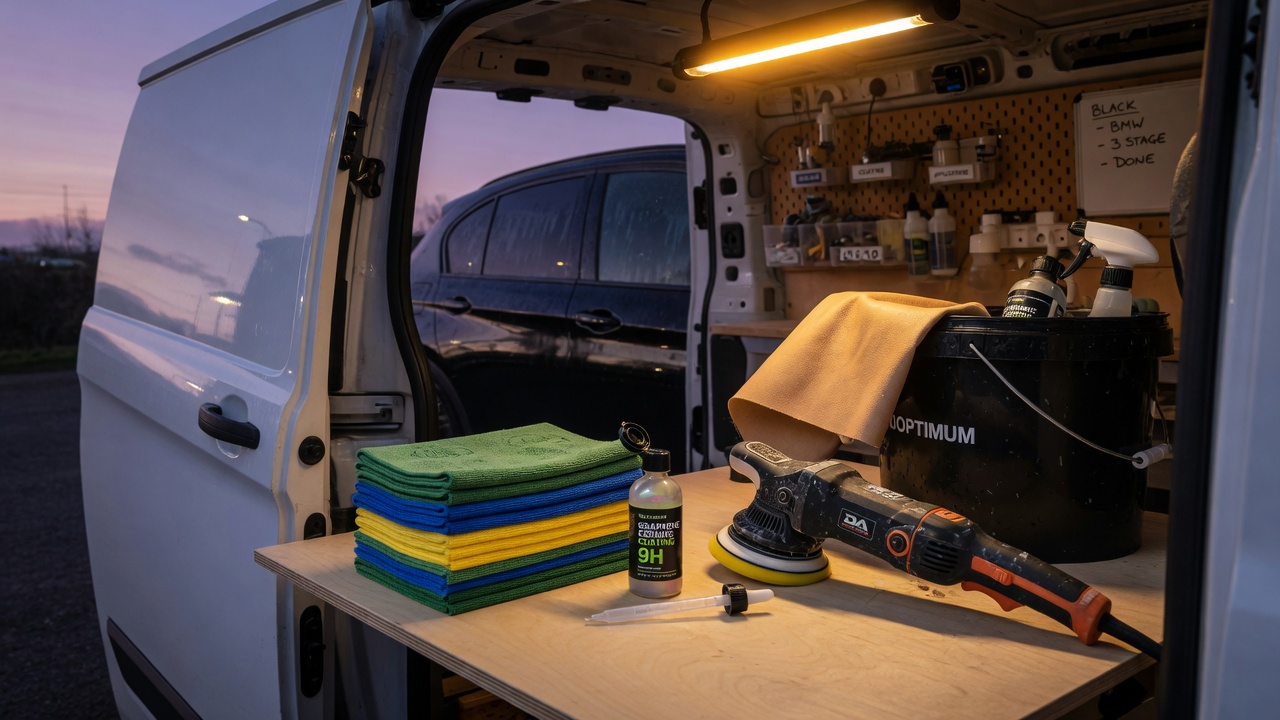
Independent mobile car valeting business video marketing in 2026: the 60-second at-the-van named-detailer meet-your-valeter walkthrough that fills the end-of-lease-BVRLA-and-ceramic-coating-and-insurance-cat-N-schedule diary (and the polished cinematic drone-over-a-signwritten-transit reel that quietly loses first jobs)
Almost every independent mobile car valeter who finally takes video seriously in 2026 ends up commissioning the same thing — a ninety-second cinematic reel of a spotless signwritten Mercedes-Benz Vito Tourer with a fresh matte-black vinyl wrap and a roof-rack-mounted 150-litre fresh-water-and-100-litre-grey-water twin-tank bowser rig and a Honda GX200 petrol-driven hot-water pressure washer and a Numatic George three-in-one wet-and-dry extractor and a Tornador Black compressed-air interior detailing gun parked outside a honey-brick Edwardian driveway at golden hour, a slow drone push along a tree-lined suburban terrace lit by low autumn sun, a moody montage of a colour-coordinated line of a shrink-wrapped bottle of Gtechniq Crystal Serum Ultra 9H ceramic coating concentrate, a boxed set of Gyeon Q² Mohs+ accredited-detailer-only ceramic concentrate, a sealed 5-litre drum of CarPro Reset wash-concentrate, a stack of plush grey microfibre buffing towels still in sealed-pack, a Meguiar's dual-action polisher, a shrink-wrapped International Detailing Association Certified Detailer card and a folded Guild of Master Craftsmen Approved Detailer polo laid at forty-five degrees on a bare oak sign-off bench next to a sealed British Vehicle Rental and Leasing Association Fair Wear and Tear Guide and a British Industrial Cleaning Association member certificate, a rack-focus close-up of a Gtechniq Accredited Detailer certificate and a Gyeon Certified Detailer card and a SONAX Approved Applicator credential and a CarPro Cquartz Finest Reserve installer registration all still in blister-pack, a lingering hero shot of a smiling mobile detailer in an unrealistically pressed embroidered softshell standing next to a Lazer Diamond ceramic-coating curing-lamp rig on a bone-dry showroom concrete slab nobody has ever seen him actually recover an eight-year dog-hair-and-child-seat-crumb-and-coffee-ring interior out of a 2017 Nissan Qashqai at seven in the morning on a buy-to-let landlord's gravel driveway before a 10am WeBuyAnyCar inspection, a slow-motion sequence of a Tornador wand lifting a seam of embedded dog hair from a cloth-trim bolster, a jump-cut of a gloved hand drawing a straight-line micro-fibre pass across a freshly-ceramic-coated front wing, and a closing tagline card promising "a showroom-ready car at your door, every time". It looks like the opening frame of a national detailing-franchise autumn campaign spot and it books almost nobody, because the car owner on the other side of the Google Maps pin at 8:45pm on a Sunday — a company-car driver whose three-year BVRLA-contracted lease on a 2023 BMW 3 Series ends on the Thursday at ten whose British Vehicle Rental and Leasing Association Fair Wear and Tear Guide-aligned de-fleet inspection on the Friday is now contingent on a documented International-Detailing-Association-certified full interior-and-exterior pre-handover de-hire valet with photographic pre-and-post record before the £1,840 end-of-contract excess-mileage-and-condition charge schedule from Lex Autolease or Alphabet or Arval will close out at zero, a company-car fleet manager whose Monday-morning twelve-vehicle de-fleet-and-re-fleet rotation on a mixed Volkswagen-Audi-Skoda-SEAT estate pool is contingent on a documented BVRLA Fair Wear and Tear sign-off per vehicle before the Enterprise Flex-E-Rent re-hire pool will accept the pre-inspection photographic record, a dealership used-car buyer whose Tuesday-morning British Car Auctions e-sale lot inspection has produced a schedule of works naming "interior deep clean, exterior single-stage machine polish, SMART repair touch-in on two leading-edge nearside stone-chips, alloy refurbishment on two kerbed nearside corners, odour-neutralisation pass against documented smoker-vehicle disclosure" before the pre-sale CAP HPI valuation band will not drop a grade, a widow whose late husband of forty-one years always "ran it through the £6 jet-wash at the Shell on the roundabout" and whose adult children have spent an hour staring at a 2003 Mercedes-Benz C-Class with eighteen years of unaddressed grime on a dulled single-stage factory solid-paint finish trying to work out whether the barrel-aged tar-spotting and oxidised clear-coat haze can be recovered to a probate-sale pre-marketing photograph standard before the AutoTrader re-upload next Tuesday, a young family whose 2024 Volvo XC90 has silently had its first-year ceramic-coating factory warranty voided by an un-named "any-car-valeter £45 full valet" that used an acidic alloy-cleaner across the ceramic-coated glass side-windows and stripped the top-topper Si-O layer on the leading A-pillar, a self-build owner whose new McLaren 720S has a factory PPF (Suntek Ultra C) application across the front splitter whose McLaren Approved Service Centre has specifically ruled out any abrasive hand polish or hand-held rotary pass across the paint protection film and whose previous £85 "exterior enhancement" from a non-Suntek-approved operator left a visible edge-lift along the leading nearside splitter line, a classic-car owner whose 1972 Jaguar E-Type Series III V12 has a cellulose factory single-stage paint finish whose Hagerty Classic Car Club concours entry on the Saturday has specifically ruled out any synthetic-wax or silicone-sealant application and whose previous local valeter sprayed a modern SiO₂ spray-sealant across the bonnet that will not weather off before the entry, a licensed hackney-carriage driver whose Transport-for-London or local-council licensing hygiene inspection on the Wednesday is contingent on a documented BICSc-member professional interior shampoo-and-steam-sterilise with photographic documentation of pre-service deposit readings and a Category 1 Legionella-and-bloodborne-pathogen anti-microbial fogging pass before the taxi plate will renew under the Local Government (Miscellaneous Provisions) Act 1976 Section 60, a private-hire operator whose Uber-and-Bolt-platform compliance audit has flagged a four-star rider-review schedule naming "smell" and "stickiness" on three vehicles, a rental landlord whose HMO upstairs-flat tenant has handed back a BVRLA-contracted long-term-hire Vauxhall Movano L3H2 panel van with four years of ad-hoc insulation-and-plasterboard-and-plasterer's-dust abuse, a divorcing husband whose family-court Form D81 financial-remedy schedule has specified a documented photographic condition-and-mileage pre-handover valet across a Range Rover Evoque, an insurance loss adjuster whose post-flood Category 2 escape-of-water interior-restoration schedule on a 2022 Ford Ranger Wildtrak whose cab was submerged to the dash is contingent on a documented British-Damage-Management-Association-aligned anti-microbial decontamination schedule, a Rolls-Royce Phantom owner whose Rolls-Royce Enthusiasts Club concours-prep schedule has specifically named a Rolls-Royce Approved Detailer registered through the SMMT marque-authorised directory for a cashmere-headliner and Mulliner-leather pre-concours pass, three mobile-car-valeter names in three tabs and a fourth tab open on a local Facebook group post about "the £40-cash mobile valet man who turned up at four in a scraped ex-courier Transit with a plastic kitchen bucket and a supermarket shampoo bottle, acid-washed my ceramic-coated alloys, scuffed the clear-coat across my bonnet with a swirl-mark pad that had been dropped on the drive, left a tide-mark along the lower rocker-panel, tipped his dirty soapy run-off into my neighbour's lawn and then quietly billed another £25 at the kerb for 'the interior being worse than the phone booking suggested' before I even saw his public-liability certificate" and a fifth tab open on the International Detailing Association member directory and the Gtechniq Accredited Detailer map and the Gyeon Certified Detailer directory and the SONAX Approved Applicator database and the British Vehicle Rental and Leasing Association Fair Wear and Tear sign-off schedule and the SMMT marque-authorised detailer registry and the Guild of Master Craftsmen Approved Detailer directory — isn't asking to be impressed. They're asking one small, quiet, slightly humiliating question: if I ring this number tomorrow morning and book a first visit for a Wednesday at nine, will the same named International-Detailing-Association-certified Gtechniq-and-Gyeon-and-SONAX-approved BVRLA-Fair-Wear-and-Tear-aligned mobile detailer whose face I've been looking at on the profile actually be the one who steps out of the van when he pulls onto the drive, will he refuse under any pressure to use an acidic alloy-cleaner across my ceramic-coated glass side-windows and strip the Si-O layer, will he refuse under any pressure to run a hand-held rotary pass across my factory-applied Suntek Ultra C paint protection film on the front splitter where McLaren Approved Service Centre has specifically ruled it out, will he refuse under any pressure to apply a modern SiO₂ spray-sealant across my 1972 Jaguar E-Type's cellulose single-stage paint ahead of a Hagerty concours entry where any synthetic sealant has been specifically ruled out, will he refuse under any pressure to tip his dirty soapy run-off into my neighbour's lawn or into the surface-water drain where the Water Resources Act 1991 Section 85 pollution-of-controlled-waters offence applies, will he honestly say "the clear-coat on the bonnet already has three visible holograms from a previous bodged rotary pass, the honest answer is a two-stage machine-polish correction with a dual-action polisher at a documented 1200rpm with a Scholl Concepts Spider Pad and a documented coating prep before any ceramic layer, £420 not £95, and I will not quote the £95 full valet because the single-stage one-coat polish will leave the holograms and the ceramic will lock them in for four years" rather than take the money on the cheaper diagnosis, will he arrive inside the response window he quoted on the call, will the price he quoted on the phone hold to the invoice at the tailgate, will his Gtechniq Accredited Detailer registration be current for the ceramic-coating warranty panel, will his Gyeon Certified Detailer position be in-date, will his SONAX Approved Applicator credential be current for the ceramic-and-PPF manufacturer-warranty panel, will his International Detailing Association certification be current for the BVRLA Fair Wear and Tear sign-off panel, will his British Industrial Cleaning Association member registration be in-date for the licensing-authority hackney-carriage hygiene schedule, will his Environment Agency Section 34 Upper-Tier waste-carrier registration cover the removal of the trade-effluent-and-wash-arising grey-water from the bowser, will his crew be his own PAYE'd apprentice and himself or a rotating cast of subcontracted "weekend second-bowser lads" from a Shiply-and-Facebook subcontract pool, will his public-liability schedule be to £5m or £10m, will his treatment-risk / professional-indemnity actually cover a stripped ceramic coating on a 2024 Volvo XC90 or an edge-lifted Suntek PPF on a McLaren 720S front splitter, and if my job is a BVRLA Fair Wear and Tear end-of-contract de-hire valet, a Gtechniq-Crystal-Serum-Ultra accredited-detailer ceramic application with a nine-year warranty-aligned prep, a Suntek Ultra C or XPEL Ultimate Plus paint protection film install coordinated through a manufacturer-approved installer, a Hagerty-insured classic concours pre-event preparation, a Rolls-Royce or Bentley or Ferrari or McLaren marque-approved detailer schedule, a hackney-carriage or private-hire operator-licensing hygiene inspection pre-service, an Uber-and-Bolt-platform compliance interior-sanitisation pass, a Primary Authority Enterprise Flex-E-Rent BVRLA panel-van return-inspection valet, a British-Damage-Management-Association-aligned post-flood Category 2 escape-of-water interior restoration, an insurance Category N or Category S recovery pre-handover valet, a Transport-for-London private-hire-vehicle MOT-adjacent hygiene schedule, a probate-sale AutoTrader pre-marketing refresh, or an Enterprise-and-Avis-and-Hertz-and-SIXT dealer-handover fleet-contract rotation, will he genuinely have done it before or will I be paying for his learning curve on the one car I cannot re-run. The one number the Google Business Profile video actually moves (booked first jobs per 100 profile views, currently sitting at 0.3-1.2 on most under-tuned mobile-valeter profiles, movable to 4-7 with a well-tuned 60-second walkthrough), the three clip shapes that lift it — the at-the-van named-detailer walkthrough for full-valet / maintenance-wash / interior shampoo / first-enquiry households, the what-happens-next scenario explainer for BVRLA de-fleet / Gtechniq ceramic coating / Suntek PPF install / hackney-carriage licensing hygiene / Uber-and-Bolt compliance / insurance Cat-2 interior restoration / Hagerty-insured classic concours prep / probate pre-marketing recovery, and the specialism welcome for Gtechniq Accredited Detailer / Suntek Approved Installer / BVRLA Fair Wear and Tear panel / hackney-carriage licensing hygiene specialist / insurance Cat-2 restoration specialist / SMMT marque-authorised specialist / Hagerty-insured classic concours specialist — plus the cinematic drone-over-signwritten-transit reel trap, where each clip belongs, the five failure modes that keep the slot from working, where AI collapsed the £1,500-per-shoot economics that used to keep video off small mobile-valeter profiles, and the one metric that steers it (booked-first-jobs-per-100-views, rolling 30-day, not Instagram plays).

Independent man and van removals video marketing in 2026: the 60-second at-the-tailgate named-mover walkthrough that fills the probate-house-clearance-and-pre-marketing-and-insurance-salvage-schedule diary (and the polished cinematic drone-over-a-Luton-reel that quietly loses first jobs)
Almost every independent man-and-van and small removals operator who finally takes video seriously in 2026 ends up commissioning the same thing — a ninety-second cinematic reel of a spotless signwritten Ford Transit Luton 3.5-tonne box van with a Dhollandia DH-LM 500kg hydraulic column tail-lift and a Mercedes Atego 7.5-tonne box lorry parked wheel-to-wheel on a dawn-lit depot apron, a slow drone push along a tree-lined suburban terrace lit by low autumn sun, a moody montage of stacked wardrobe cartons and crush-proof dish-barrel cartons and picture-and-mirror cartons and sealed roll-on-roll-off mattress covers and quilted brown furniture-blankets, a rack-focus close-up of a British Association of Removers accredited-member certificate and an RHA Removals Group membership card and a Restricted O-licence disc still in its wallet, a shrink-wrapped NGRS polo laid at forty-five degrees on a bare oak sign-off bench next to a stack of 60kg-rated Hoddy sack-barrows and a four-wheel GRP piano shoe, a lingering hero shot of a smiling mover in an unrealistically pressed embroidered softshell on a bone-dry showroom concrete slab nobody has ever seen him actually clear a thirty-seven-year accumulation out of a probate 1930s semi at seven in the morning before a solicitor-triggered Rightmove re-upload, a slow-motion sequence of a ratchet-strap being cinched across a mahogany sideboard, a jump-cut of a gloved hand lowering a Steinway Model M grand piano down a tail-lift on a hand-operated piano-shoe trolley, and a closing tagline card promising "your move, handled with care, every time". It looks like the opening frame of a national removals-franchise autumn campaign spot and it books almost nobody, because the customer on the other side of the Google Maps pin at 9:20pm on a Sunday — a daughter three weeks into probate on her late mother's three-bed 1930s semi whose solicitor has emailed to say the executor's pre-marketing Rightmove re-upload is contingent on a documented photographic house-clearance by the Friday, whose late mother's hoarded accumulation of thirty-seven years of weekly QVC deliveries, Reader's Digest condensed-book collections, Royal Doulton figurines and a wall of unopened Christmas gift boxes dating back to 2019 has to be sorted into a Mental Capacity Act 2005-respected keep-and-donate-and-dispose schedule inside the three-week vacant-possession window before the completion date triggers an SDLT clock on the beneficiary chain, a seller inside a pre-marketing downsize whose chartered surveyor's RICS Red Book pre-marketing valuation has flagged "visible occupancy density, obstructed primary circulation routes" against a down-valuation proposal of £18,500 against the asking price and whose photographer refuses to re-shoot the primary reception until a documented downsize-and-stage pass clears the kitchen island, the hall console and the primary reception from the floor plan, a buy-to-let landlord whose Monday-morning HMO change-over on a two-bed first-floor conversion has produced an end-of-tenancy abandoned-belongings schedule that under Torts (Interference with Goods) Act 1977 Section 12 and 13 cannot be disposed of without a documented Notice of Intention to Dispose and a minimum fourteen-day storage interval before the Tuesday morning tenancy-start, a letting agent whose inventory check-out clerk at a four-bed Victorian terrace has produced an abandoned-belongings and left-behind-furniture schedule inside the Tenancy Deposit Scheme fourteen-day window with the incoming tenant's holding deposit already paid, an Occupational Therapist whose grant-funded Care Act 2014 Section 2 falls-prevention referral for a stroke-rehab discharge needs the primary reception cleared of three unsecured rugs, two low coffee-tables and a nest of occasional-tables inside the forty-eight-hour hospital-discharge window before Addenbrooke's will release the client to home, a hoarding-support social-worker whose Mental Capacity Act 2005 Section 2 capacity-assessed age-in-place client has consented to a graded hoarding-disorder specialist clearance protocol under the National Fire Chiefs Council clutter-image-rating 5-to-6 risk categorisation that requires a documented pre-and-post photographic record and a UKATA Category A pre-check against the Public Health (Control of Disease) Act 1984 Section 83 statutory-nuisance threshold, an insurance loss adjuster whose post-flood contents-salvage schedule on a Victorian end-terrace needs the primary reception contents removed to a documented EN 14873 Furniture Storage Standard-compliant sealed container inside the forty-eight-hour policy-trigger window with a bulk-cold-sterilisation pass before any Category 3 water-damage escape-of-water contents payout, a divorcing husband whose family-court consent-order Form D81 financial-remedy schedule has specified a documented photographic furniture-split pass across a four-bed detached inside the fourteen-day decree-nisi-to-decree-absolute window, a university-student parent whose late-June undergraduate inter-city move from a shared Victorian conversion in a university quarter to a graduate-house in another city needs a sealed-and-insured one-way inter-city schedule inside the two-week vacate-and-arrive window with a documented chain-of-custody audit, a self-build owner whose newly-completed 240-sqm oak-frame residence has a continental fine-art move of a 2.4-by-1.8m hand-knotted Isfahan silk-and-wool oriental rug, a signed Lucian Freud etching and a Fine Art Trade Guild-coordinated 1940s Ben Nicholson relief whose Fine Art Trade Guild-approved specialist crating specification requires a bespoke clear-wall-crate construction and a documented BAR Advanced Payment Guarantee Scheme-aligned transit, three man-and-van names in three tabs and a fourth tab open on a local Facebook group post about "the £150-cash man-and-van and his mate from the pub who turned up at six in a scraped-off ex-council Luton with no tail-lift, scratched my late mother's Victorian pine chest down the length of the front hallway dragging it over the Minton tile, dropped the sealed moving-box of family photographs down the three concrete steps outside the back porch, and then quietly billed another £95 at the kerb for 'the stairs being tighter than the phone booking suggested' before I even saw his goods-in-transit certificate" and a fifth tab open on the British Association of Removers member directory and the National Guild of Removers and Storers register and the RHA Removals Group and the Removals Industry Ombudsman Scheme and the Fine Art Trade Guild Approved Carrier directory and the Pianoforte Tuners Association specialist mover register — isn't asking to be impressed. They're asking one small, quiet, slightly humiliating question: if I ring this number tomorrow morning and book a first visit for a Wednesday at nine, will the same named BAR-accredited RHA-member Removals-Industry-Ombudsman-Scheme-registered mover whose face I've been looking at on the profile actually be the one who steps out of the Luton when he pulls onto the drive, will he refuse under any pressure to attempt a load-move with no sack-barrow, no furniture-skates, no corner-protectors, no tail-lift and no removal blankets on a 1930s solid-oak sideboard that will quietly split along the grain inside the first lift, will he refuse under any pressure to drag an Isfahan silk rug across a bare-boards hallway where the pile-direction requires a documented Fine Art Trade Guild-approved roll-pack-and-crate protocol, will he refuse under any pressure to attempt a Steinway grand-piano lift without a documented Pianoforte Tuners Association-coordinated specialist-mover protocol with a GRP piano shoe, a four-wheel piano-trolley and a dedicated eight-person lift team, will he honestly say "this probate house clearance needs a staged two-visit protocol with a solicitor-signed-off keep-and-donate-and-dispose schedule, a Fine Art Trade Guild-coordinated specialist carrier for the three unlabelled oil-paintings in the hallway, a UKATA Category A asbestos-awareness pre-check for the loft hatch access, and a documented chain-of-custody photographic record on every item above £500 insured value, £1,480 not £320, and I will not quote the £320 house-clearance sweep because the solicitor's completion-chain SDLT clock will slip when the Theft Act 1968 Section 22 clearance surfaces at the auction gavel" rather than take the money on the cheaper diagnosis, will he refuse under any pressure to attempt a hoarding-disorder specialist clearance without a documented Mental Capacity Act 2005 Section 2 capacity-assessed consent schedule, a hoarding-support social-worker sign-off, a UKATA Category A asbestos-awareness pre-check, a National Fire Chiefs Council clutter-image-rating pre-score, a Public Health (Control of Disease) Act 1984 Section 83 statutory-nuisance threshold assessment and a Hazardous Waste Regulations 2005 waste-code pre-sort protocol, will he arrive inside the response window he quoted on the call, will the price he quoted on the phone hold to the invoice at the tailgate, will his BAR accredited-member registration be current, will his RHA Removals Group membership be in-date, will his Fine Art Trade Guild Approved Carrier registration be current for the specialist crating panel, will his Pianoforte Tuners Association specialist-mover registration be current for the Steinway panel, will his Removals Industry Ombudsman Scheme registration be in-date for the arbitration-cover panel, will his Environment Agency Section 34 Upper-Tier waste-carrier registration cover the Hazardous Waste Regulations 2005 arisings from the hoarding-disorder clearance, will his O-licence be a Restricted or Standard National or Standard International-grade schedule, will his Driver CPC be current across every named driver, will his crew be his own PAYE'd apprentices and himself or a rotating cast of subcontracted "weekend second-van lads" from a Shiply-and-AnyVan platform-aggregator route-ping, will his public-liability schedule be to £5m or £10m, will his goods-in-transit schedule be to £50,000 or £100,000 or £250,000 and will his cover actually extend to a Steinway Model M grand piano or a Fine Art Trade Guild-coordinated Lucian Freud etching, and if my job is a probate house clearance with specialist crating, a pre-marketing estate-agent downsize-and-stage pass, a letting-agent end-of-tenancy Torts (Interference with Goods) Act 1977 schedule, a hoarding-disorder specialist clearance under Mental Capacity Act 2005 Section 2, an OT Disabled Facilities Grant falls-prevention primary-circulation-route clearance, an insurance contents-salvage EN 14873 Furniture Storage Standard sealed-container schedule, a Fine Art Trade Guild-approved specialist crating transit, a Pianoforte Tuners Association-coordinated piano move, a divorcing-family consent-order furniture-split pass, a university inter-city student-vacate schedule, or a Fire Safety (England) Regulations 2022 Reg 10 leasehold-block communal-area obstruction remedial, will he genuinely have done it before or will I be paying for his learning curve on the one house I cannot re-run. The one number the Google Business Profile video actually moves (booked first jobs per 100 profile views, currently sitting at 0.3-1.2 on most under-tuned man-and-van profiles, movable to 4-7 with a well-tuned 60-second walkthrough), the three clip shapes that lift it — the at-the-tailgate named-mover walkthrough for general-residential / end-of-tenancy / flat-pack-single-sofa / first-enquiry households, the what-happens-next scenario explainer for probate house clearance / pre-marketing downsize-and-stage / letting-agent end-of-tenancy Torts / hoarding-disorder Mental Capacity Act / OT falls-prevention / insurance Category 3 contents-salvage / Fine Art Trade Guild specialist crating / Pianoforte Tuners Association piano move / divorcing-family Form D81 / university inter-city / Fire Safety Reg 10 communal-area, and the specialism welcome for probate specialist / pre-marketing downsize specialist / letting-agent Torts specialist / hoarding-disorder Mental Capacity Act specialist / OT falls-prevention specialist / insurance Category 3 contents-salvage specialist / Fine Art Trade Guild Approved Carrier specialist / Pianoforte Tuners Association specialist piano mover / divorcing-family specialist / university inter-city specialist / Fire Safety Reg 10 specialist — plus the cinematic drone-over-the-Luton reel trap, where each clip belongs, the five failure modes that keep the slot from working, where AI collapsed the £1,500-per-shoot economics that used to keep video off small man-and-van profiles, and the one metric that steers it (booked-first-jobs-per-100-views, rolling 30-day, not Instagram plays).
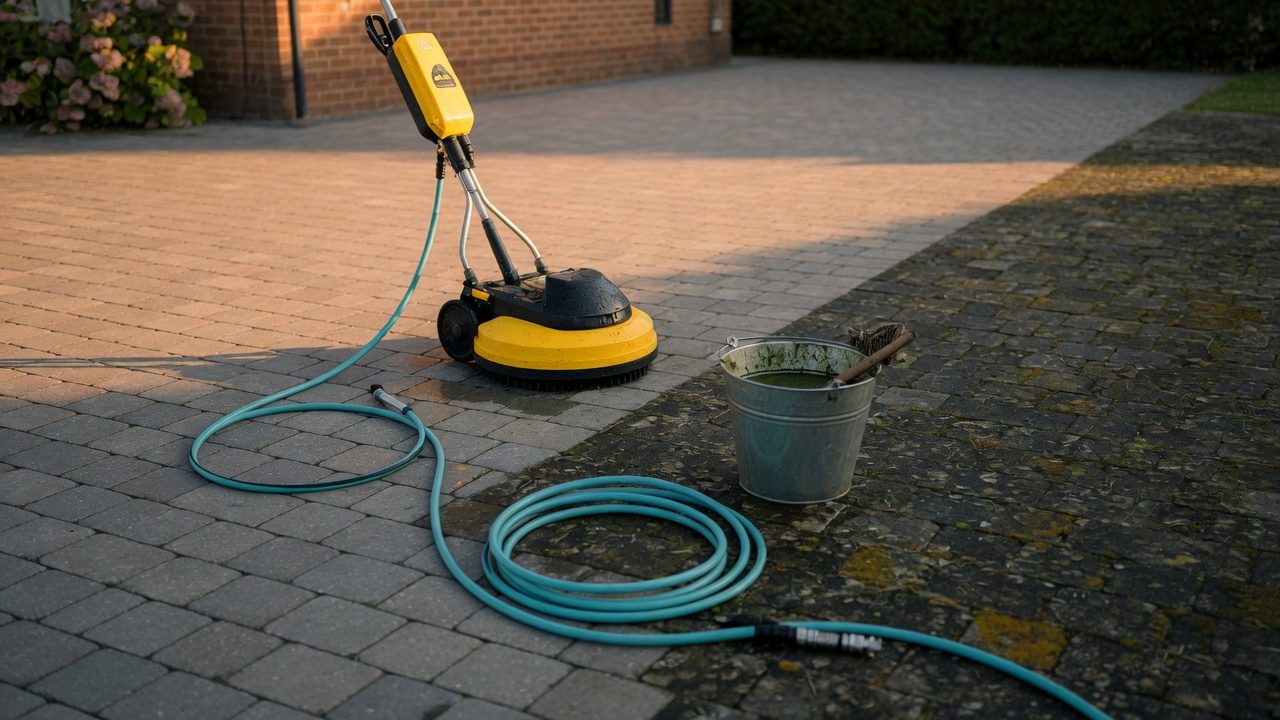
Independent pressure washing business video marketing in 2026: the 60-second at-the-van named-technician meet-your-pressure-washer walkthrough that fills the pre-marketing-driveway-and-Grade-II-Portland-stone-and-commercial-forecourt-schedule diary (and the polished cinematic drone-over-a-signwritten-transit reel that quietly loses first jobs)
Almost every independent pressure washing technician who finally takes video seriously in 2026 ends up commissioning the same thing — a ninety-second cinematic reel of a spotless signwritten Ford Transit Custom with a fresh vinyl wrap and a roof-rack-mounted Honda GX390 petrol-driven cold-water pressure washer and a Spinaclean SX15 twenty-inch rotary flat-surface cleaner and a bundle of Mesto surge-pump softwash applicators parked outside a honey-brick Edwardian semi at golden hour, a slow drone push along a tree-lined suburban terrace lit by low autumn sun, a moody montage of a colour-coordinated line of a boxed Nilfisk MH 4M-200/960 hot-water pressure washer, a shrink-wrapped Stonehealth DOFF super-heated-steam listed-building cleaning system, a boxed TORC rotary vortex kaolin-and-granulate low-pressure heritage cleaner, a sealed 25-litre drum of sodium-hypochlorite softwash concentrate and a folded Property Care Association member polo laid at forty-five degrees on a bare oak sign-off bench, a rack-focus close-up of a City & Guilds Level 2 Diploma in Pressure Washing certificate and a COSHH Awareness Category 1 Corrosives card still in blister-pack, a lingering hero shot of a smiling pressure-washing technician in an unrealistically pressed embroidered softshell standing next to a Dragon Pro twin-axle trailer-rig on a bone-dry showroom concrete slab nobody has ever seen him actually recover a three-season algae-and-lichen-choked honey-coloured Indian-sandstone patio behind a 1930s semi at seven in the morning before a Monday-morning Rightmove pre-marketing photograph refresh, a slow-motion sequence of a surface cleaner lifting a seam of black bio-film off a block-paving driveway, and a closing tagline card promising "clean driveways, clean kerb appeal, every spring". It looks like the opening frame of a national property-maintenance-brand spring campaign spot and it books almost nobody, because the homeowner on the other side of the Google Maps pin at 8:50pm on a Sunday — a couple whose 1930s semi has a honey-coloured Indian-sandstone patio and a Marshalls Driveline 50 block-paving driveway with three winters of algae-and-lichen film and a visible green-black streak-stain across the leading edge whose pre-marketing estate-agent coordinator has just emailed to say the Rightmove re-upload cannot run against the current driveway photograph set and whose Tuesday-morning solicitor-triggered RICS Red Book pre-survey will flag "defective external hardscape, long-term algae-and-lichen film, slip-risk under BS 7976-2 wet pendulum testing" as a Category 2 condition rating with a buyer's £8,500 retention proposed inside the mortgage offer, a buy-to-let landlord whose Monday-morning routine HMO licensing inspection has produced a schedule of works from the environmental health officer naming documented professional patio-and-pathway-and-communal-step algae-and-lichen clearance after a near-miss fall at the back-door communal step before the HMO licence will renew under the Housing Act 2004 Part 2 Section 55, a Grade-II-listed-cottage owner whose Historic England-advised honey-coloured Portland-limestone front elevation has a three-season black-biofilm-and-sulphation-crust spreading across the string course and a hairline-cracked plinth coping whose Society for the Protection of Ancient Buildings-coordinated conservation-area officer has specifically ruled out any high-pressure water or sodium-hypochlorite application and whose previous £180 "soft-wash special" from a non-DOFF-trained operator left a visible chlorine-bleach-ghost shadow across the Portland-stone soffit course that will not weather off for three seasons, a widow whose late husband of thirty-eight years always "scrubbed the back-step with the stiff brush and the washing-up liquid from under the sink" and whose adult children have spent an hour staring at a visibly algae-and-moss-choked riven Yorkstone rear-elevation patio trying to work out whether the three winters of unaddressed bio-film can be recovered to a pre-marketing estate-agent photograph standard before the probate completion-conditioned Rightmove re-upload next Tuesday, a young family whose 1890s Victorian terrace has a 60-square-metre Addagrip Terraco resin-bound-gravel driveway laid in 2023 whose factory-warranty specifically voids under any application of pressure above 1,500psi or a surface-cleaner rotary head run under its own weight and whose previous £120 "driveway special" from a non-Addagrip-approved operator stripped the top-dressing binder across the leading-edge spine with a Dirtblaster rotating turbo nozzle and has carried a visible pitted texture-change ever since, a self-build owner whose new 240-sqm oak-framed residence has a 180-square-metre Marshalls Argent 160mm block-paving driveway whose first-year factory warranty will void if the un-named "any-driveway £85 special" uses a surface cleaner at a nozzle distance below 100mm and blasts the kiln-dried polymeric sand out of the joints and triggers the sub-base washout and the laying-course failure the manufacturer warranty specifically names, a listed-property owner whose Grade-II-star Elizabethan farmhouse has a flagged honey-coloured Portland-limestone front plinth whose Historic England-advised conservation officer's spring inspection has flagged a biofilm-and-sulphation-crust band across the leading elevation, a block-management responsible person whose annual leasehold-block communal-car-park BS 7976-2 slip-risk assessment on a mixed-use retail-and-residential block has flagged seven algae-contaminated bay markings and three oil-staining spots, a hotelier whose independent four-star townhouse boutique has had a one-star TripAdvisor review posted at 2am naming "a near-slip on the back-stairs where the moss had taken hold" whose insurance broker has emailed to say a documented BS 7976-2 wet pendulum post-service test with photographic pre-and-post record is required within forty-eight hours before the booking.com Preferred Partner status is suspended, a food-premises owner whose Primary Authority BRCGS Food Safety Issue 9 audit on the Wednesday is contingent on a documented clearance of the kitchen-waste-bin yard with photographic documentation of the pre-service biofilm-and-fat-grime readings before the Grade-A Food Hygiene Rating will be upheld, a town-council works-coordinator whose Thursday-morning chewing-gum-removal programme across the pedestrianised high-street Portland-stone paving is contingent on a documented operator qualification against the Historic England listed-townscape protocol, three pressure-washing-business names in three tabs and a fourth tab open on a local Facebook group post about "the £85 round-the-houses pressure-washer man who turned up at four after a six-hour window and blasted the polymeric sand out of my Marshalls Driveline joints, lifted the Addagrip resin binder across the leading-edge spine, left a visible chlorine-bleach-ghost shadow across my Portland-stone plinth and a dead-grass stripe where the slurry run-off had routed across the lawn" and a fifth tab open on the Property Care Association member directory and the Stonehealth DOFF-and-TORC-approved operator database and the Marshalls Register of Accredited Installers and the Addagrip Terraco Approved Installer directory — isn't asking to be impressed. They're asking one small, quiet, slightly humiliating question: if I ring this number tomorrow morning and book a first visit for a Wednesday at nine, will the same named Property-Care-Association-member DOFF-and-TORC-trained City-and-Guilds-Level-2 pressure-washing technician whose face I've been looking at on the profile actually be the one who steps out of the van when he pulls onto the drive, will he refuse under any pressure to run a surface cleaner at a nozzle distance below 100mm across my Marshalls Driveline block-paving and blast the kiln-dried polymeric sand out of the joints and void the factory warranty, will he refuse under any pressure to apply a sodium-hypochlorite softwash concentrate to my Grade-II-listed Portland-limestone plinth where Historic England has specifically ruled out any high-pressure water or chlorine chemistry and insist on a Stonehealth DOFF super-heated-steam low-pressure heritage protocol instead, will he refuse under any pressure to run a Dirtblaster rotating turbo nozzle across my Addagrip Terraco resin-bound-gravel driveway where the factory warranty specifically voids above 1,500psi, will he honestly say "the Marshalls Driveline joints have already lost half their kiln-dried polymeric sand from a previous bodged surface-cleaner pass — the honest answer is a controlled 40-degree fan-tip clean at a 300mm standoff with a documented post-clean kiln-dried polymeric re-sanding and Marshalls-ClearSeal re-sealing to the Register of Accredited Installers maintenance protocol, £520 not £120, and I will not quote the £120 driveway sweep because the surface cleaner pass will strip the remaining joint sand and trigger the sub-base washout the manufacturer warranty specifically names" rather than take the money on the cheaper diagnosis, will he refuse under any pressure to route the chlorine-and-slurry run-off into my neighbour's lawn or into the surface-water drain where the Water Resources Act 1991 Section 85 pollution-of-controlled-waters offence applies, will he arrive inside the response window he quoted on the call, will the price he quotes on the phone hold to the invoice on the drive, will his Marshalls Register of Accredited Installers membership be current, will his Addagrip Terraco Approved Installer certification be in-date, will his Stonehealth DOFF-and-TORC operator certification be current for the Grade-II-listed Historic-England-coordinated conservation panel, will his Biocidal Products Regulations BPR 528/2012 competent-user position on sodium-hypochlorite and benzalkonium-chloride softwash chemistry be documented against the Health and Safety Executive COSHH Reg 7 inspection schedule, will his Environment Agency Section-34 Upper-Tier waste-carrier registration cover the removal of the chlorine-and-slurry trade-effluent arisings, will his crew be his own PAYE'd apprentice and himself or a rotating cast of subcontracted "weekend second-trailer lads" from a Gumtree-and-Facebook subcontract pool, will his public-liability schedule be to £5m or £10m and will his treatment-risk / professional-indemnity actually cover a stripped resin binder on an Addagrip Terraco driveway, and if my job is a pre-marketing estate-agent driveway refresh inside a solicitor-triggered Rightmove re-upload window, a routine HMO licensing officer BS 7976-2 slip-risk pathway schedule, a Grade-II-listed Historic-England-compliant Portland-limestone or honey-coloured-sandstone DOFF soft-wash, a Marshalls Register of Accredited Installers Driveline block-paving annual maintenance pass, an Addagrip Terraco resin-bound-gravel approved-installer refresh, a commercial car-park or forecourt BS 7976-2 wet-pendulum post-service slip-risk test, a BRCGS Food Safety Issue 9 waste-bin-yard pre-audit clearance, an insurance-schedule post-slip-trip incident make-safe inside the forty-eight-hour policy-trigger window, a Fire Safety (England) Regulations 2022 Reg 10 leasehold-block communal-forecourt schedule, or a probate-sale pre-marketing hard-landscape clearance, will he genuinely have done it before or will I be paying for his learning curve on the one driveway I cannot re-run. The one number the Google Business Profile video actually moves (booked first jobs per 100 profile views, currently sitting at 0.3-1.1 on most under-tuned pressure-washer profiles, movable to 4-7 with a well-tuned 60-second walkthrough), the three clip shapes that lift it — the at-the-van named-technician walkthrough for driveway / patio / decking / first-enquiry generalists, the what-happens-next scenario explainer for pre-marketing RICS Red Book / HMO BS 7976-2 slip-risk / Marshalls Driveline maintenance / Addagrip Terraco approved-installer refresh / Grade-II-listed Portland-stone DOFF soft-wash / commercial forecourt BS 7976-2 test / insurance post-slip-trip / probate pre-marketing recovery, and the specialism welcome for Marshalls Register of Accredited Installers block-paving specialist / Addagrip Terraco Approved Installer resin-bound-gravel specialist / Stonehealth DOFF-and-TORC listed-stone specialist / commercial forecourt BS 7976-2 slip-risk specialist / HMO licensing portfolio specialist / insurance post-slip-trip specialist / pre-marketing RICS Red Book specialist — plus the cinematic drone-over-signwritten-transit reel trap, where each clip belongs, the five failure modes that keep the slot from working, where AI collapsed the £1,500-per-shoot economics that used to keep video off small pressure-washer profiles, and the one metric that steers it (booked-first-jobs-per-100-views, rolling 30-day, not Instagram plays).

Independent gutter cleaning service video marketing in 2026: the 60-second at-the-van named-technician meet-your-gutter-cleaner walkthrough that fills the pre-marketing-RICS-and-HMO-licensing-and-insurance-storm-schedule diary (and the polished cinematic drone-over-a-signwritten-transit reel that quietly loses first jobs)
Almost every independent gutter cleaning technician who finally takes video seriously in 2026 ends up commissioning the same thing — a ninety-second cinematic reel of a spotless signwritten Ford Transit Custom with a fresh vinyl wrap and a roof-rack-mounted SkyVac Industrial 85 Pro and a bundle of carbon-fibre 40-foot gutter-vac poles parked outside a honey-brick Edwardian semi at golden hour, a slow drone push along a tree-lined suburban terrace lit by low autumn sun, a moody montage of a colour-coordinated line of a boxed Omega Supersonic gutter vac, an iTEC pole-mounted inspection camera, a shrink-wrapped IPAF 3a/3b Mobile Elevating Work Platform operator card and a folded Confederation of Roofing Contractors member polo laid at forty-five degrees on a bare oak sign-off bench, a rack-focus close-up of a CITB Health and Safety Test certificate and a PASMA Towers for Users card still in its blister-pack, a lingering hero shot of a smiling gutter cleaner in an unrealistically pressed embroidered softshell standing next to a Niftylift HR12 cherry picker on a bone-dry showroom concrete slab nobody has ever seen him actually pull three seasons of silt-and-moss-and-sycamore-key compost out of a blocked Victorian cast-iron ogee gutter on a four-storey end-terrace at seven in the morning before a Monday-morning Rightmove pre-marketing photograph refresh, a slow-motion sequence of a gutter-vac nozzle lifting a core of black moss-and-leaf-litter, and a closing tagline card promising "clear gutters, dry walls, every autumn". It looks like the opening frame of a national property-maintenance-brand autumn campaign spot and it books almost nobody, because the homeowner on the other side of the Google Maps pin at 8:50pm on a Sunday — a couple whose 1930s semi has visible damp staining spreading down the gable-end render from a blocked rainwater-head whose RICS Red Book pre-marketing survey arrived on the Friday afternoon flagging "defective external rainwater drainage, probable long-term saturation" as a Category 2 condition rating with a buyer's £11,500 retention proposed inside the mortgage offer, a buy-to-let landlord whose Monday-morning routine HMO licensing inspection has produced a schedule of works from the environmental health officer naming documented professional gutter-and-downpipe clearance to clear a two-year moss-and-leaf-litter build-up and a visible damp-and-mould ingress pattern across the first-floor bathroom ceiling before the HMO licence will renew under the Housing Act 2004 Part 2 Section 55, a Grade-II-listed-cottage owner whose Historic England-advised ornate cast-iron ogee gutter run along the north elevation has three cracked joints and a dropped bracket after a late-September storm whose Society for the Protection of Ancient Buildings-coordinated specialist's sealed-leadwork repair price has arrived at £1,480 and whose previous £65 round-pole gutter-vac operator split the cast-iron socket joint with a 45psi back-flush that was never on the quote, a widow whose late husband of thirty-eight years always "went up the ladder himself with the trowel from the shed" and whose adult children have spent an hour staring at a visibly sagging rear-elevation plastic ogee gutter trying to work out whether the three winters of unlifted sycamore keys can be recovered to a pre-marketing estate-agent photograph standard before the probate completion-conditioned Rightmove re-upload next Tuesday, a young family whose 1890s Victorian terrace has an ornate hopper-and-rainwater-head system across the party-wall whose cast-iron collar has shifted a quarter-turn under three seasons of thermal expansion whose previous £35-a-gutter man wedged it back with a mastic bead that lifted first frost and now carries a visible iron-oxide streak-stain down the London-stock-brick, a self-build owner whose new 240-sqm oak-framed residence has a continental half-round zinc-coated steel gutter system whose first-year factory warranty will void if the un-named "any-ladder-man £85 special" uses an aluminium-oxide abrasive pad on the zinc-and-tin anti-corrosion surface, a listed-property owner whose Grade-II-star Elizabethan farmhouse has a thatched eave whose Master Thatchers Association-registered thatcher's annual spring inspection has flagged two displaced water-ingress ridges, a rental landlord whose HMO upstairs-flat kitchen-extension flat-roof outlet backed up on the Thursday night and whose first-floor ceiling plaster is now bowed around the recessed LED pendant whose insurance loss adjuster has emailed to say a documented pre-and-post photographic clear-out of the entire rainwater-goods run with a borescope-camera post-clearance survey is required inside the forty-eight-hour policy-trigger window before the £8,400 escape-of-rainwater remediation payout will be released, a block-management responsible person whose Fire Safety (England) Regulations 2022 Reg 10 quarterly inspection schedule on a leasehold block has flagged seven first-floor timber soffit-vents blocked with starling-nest litter whose Wildlife and Countryside Act 1981 Section 1 bird-nesting window has only just closed, a food-premises owner whose Primary Authority BRCGS Food Safety Issue 9 audit on the Wednesday is contingent on a documented clearance of the kitchen-extension flat-roof outlet before the pigeon-guano-and-rainwater standing-pool across the inspection catwalk will be signed off, three gutter-cleaning-service names in three tabs and a fourth tab open on a local Facebook group post about "the £45 round-the-houses pole man who turned up at four after a six-hour window and left my hopper split, my downpipe collar lifted, my rendered gable streaked with run-off and a brown rust-and-moss trail I can't scrub off" and a fifth tab open on the Confederation of Roofing Contractors member directory and the NFRC Roofcert register and the IPAF cherry-picker operator database and the Property Care Association damp-and-timber-decay register — isn't asking to be impressed. They're asking one small, quiet, slightly humiliating question: if I ring this number tomorrow morning and book a first visit for a Wednesday at nine, will the same named IPAF-3a-and-3b-certified PASMA-tower-trained Working-at-Height-competent gutter-cleaning technician whose face I've been looking at on the profile actually be the one who steps out of the van when he pulls onto the drive, will he refuse under any pressure to run a 45psi back-flush through a hairline-cracked cast-iron ogee gutter socket on a Grade-II-listed elevation without a documented Society for the Protection of Ancient Buildings pre-service inspection, will he honestly say "the north-elevation hopper is cracked across the collar from a previous bodged mastic patch — the honest answer is a specialist leadwork sealed-joint repair before any pole-vac clearance, £240 not £85, and I will not quote the £85 round-pole sweep because the back-flush will blow the socket joint and route the rainwater down the party-wall render into the sub-floor void" rather than take the money on the cheaper diagnosis, will he refuse an active bird-nesting-season exclusion on a swift or house-martin or starling colony and refer the eave to a Natural England-licenced ornithologist rather than disturb a Schedule 1 species, will he arrive inside the response window he quoted on the call, will the price he quotes on the phone hold to the invoice on the drive, will his IPAF 3a and 3b MEWP operator certification be current for the cherry-picker panel work, will his PASMA Towers for Users card be in-date for the leasehold-block Fire Safety Regulations 2022 Reg 10 inspection panel, will his Confederation of Roofing Contractors membership be current for the pre-marketing RICS Red Book referral list, will his Working at Height Regulations 2005 Regulation 6 avoidance-and-prevention risk-assessment actually be documented against the Health and Safety Executive INDG 401 inspection schedule, will his crew be his own PAYE'd apprentice and himself or a rotating cast of subcontracted "weekend second-ladder lads" from an insurance-ping-pool, will his public-liability schedule be to £5m or £10m and will his treatment-risk / professional-indemnity actually cover a stripped zinc anti-corrosion surface from an incorrect abrasive-pad pre-clean on a continental half-round steel gutter, and if my job is a pre-marketing estate-agent RICS Red Book pre-survey clearance, a routine HMO licensing officer schedule, a Grade-II-listed Historic-England-compliant cast-iron ogee hopper-and-rainwater-head service, a BRCGS Food Safety Issue 9 flat-roof outlet schedule, an insurance-schedule post-storm make-safe inside the forty-eight-hour policy-trigger window, a Fire Safety Regulations 2022 Reg 10 leasehold-block soffit-vent schedule, a thatched-eave Master Thatchers Association-coordinated spring inspection, a continental half-round zinc-steel import-channel annual service, or a probate-sale pre-marketing property-condition clearance, will he genuinely have done it before or will I be paying for his learning curve on the one roof I cannot re-run. The one number the Google Business Profile video actually moves (booked first jobs per 100 profile views, currently sitting at 0.3-1.2 on most under-tuned gutter-cleaner profiles, movable to 4-7 with a well-tuned 60-second walkthrough), the three clip shapes that lift it — the at-the-van named-technician walkthrough for semi / detached / terrace / first-enquiry generalists, the what-happens-next scenario explainer for pre-marketing RICS Red Book / HMO licensing-officer portfolio / Grade-II-listed cast-iron ogee / Fire Safety Regulations 2022 Reg 10 leasehold-block / insurance post-storm / thatched-eave spring inspection / probate pre-marketing recovery, and the specialism welcome for Confederation-of-Roofing-Contractors-member RICS Red Book specialist / HMO-licensing portfolio specialist / Grade-II-listed Historic England cast-iron ogee specialist / Fire Safety Regulations 2022 Reg 10 leasehold-block specialist / thatched-eave Master-Thatchers-coordinated specialist / insurance post-storm specialist / continental half-round zinc-steel specialist — plus the cinematic drone-over-signwritten-transit reel trap, where each clip belongs, the five failure modes that keep the slot from working, where AI collapsed the £1,500-per-shoot economics that used to keep video off small gutter-cleaner profiles, and the one metric that steers it (booked-first-jobs-per-100-views, rolling 30-day, not Instagram plays).
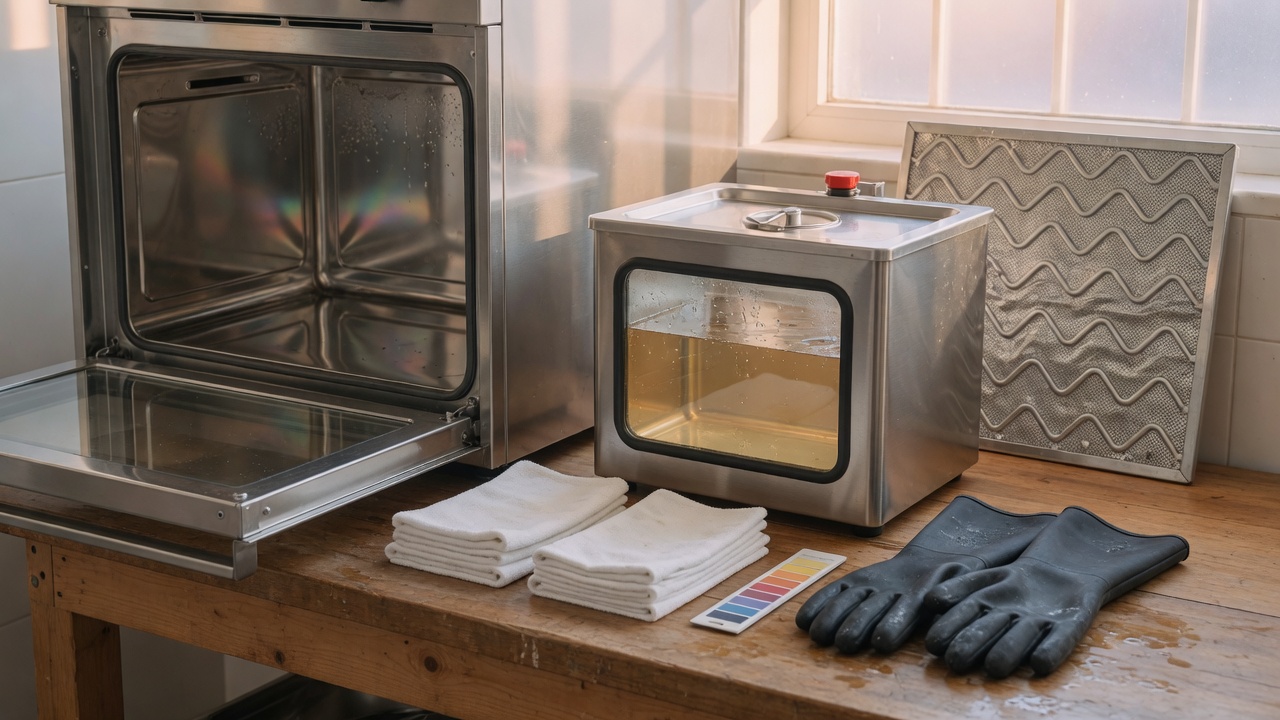
Independent oven cleaning service video marketing in 2026: the 60-second at-the-doorway named-technician meet-your-oven-cleaner walkthrough that fills the end-of-tenancy-and-AGA-Rayburn-and-insurance-fire-schedule diary (and the polished cinematic drone-over-a-signwritten-transit reel that quietly loses first jobs)
Almost every independent oven cleaning technician who finally takes video seriously in 2026 ends up commissioning the same thing — a ninety-second cinematic reel of a spotless signwritten Ford Transit Custom with a fresh vinyl wrap and a roof-mounted 240-litre heated Soteria sealed-chamber dip-tank parked outside a honey-brick Edwardian semi at golden hour, a slow drone push along a tree-lined suburban terrace lit by low autumn sun, a moody montage of a colour-coordinated line of a sealed 25-litre drum of potassium-hydroxide-based oven-cleaner concentrate, a boxed set of chemical-resistant Ansell AlphaTec gauntlets, a shrink-wrapped Association of Oven Cleaning Professionals membership certificate and a folded SafeContractor-and-CHAS member polo laid at forty-five degrees on a bare oak sign-off bench, a rack-focus close-up of a City & Guilds Level 2 Diploma in Cleaning Principles card and a COSHH Awareness Category 1 certificate still in blister-pack from the AOCP trade stand, a lingering hero shot of a smiling technician in an unrealistically pressed embroidered softshell standing next to a Thermaglow heated-dip rig on a bone-dry workshop apron nobody has ever seen him actually strip a six-year carbonised AGA four-oven at seven in the morning before a Tuesday-morning letting-agent inventory check-in, a slow-motion sequence of a wire-brush rotary cleaning a cooker-hood baffle filter backed by a fingerpicked acoustic-guitar cover of Debussy, a jump-cut of a gloved hand lifting a glass-fronted oven door clear of its hinges, and a closing tagline card promising "a sparkling kitchen, every season" over a soft-focus shot of a hand pressing a green Ring doorbell on a freshly-painted front door. It looks like the opening frame of a national facilities-management-brand autumn campaign spot and it books almost nobody, because the homeowner on the other side of the Google Maps pin at 8:40pm on a Sunday — a couple whose rented three-bedroom Victorian terrace has a tenancy end on the Wednesday at ten whose letting agent's inventory check-in on the Thursday is now contingent on a documented AOCP-member professional oven-and-hob-and-extractor-hood clean with before-and-after photographs inside the TDS-approved end-of-tenancy guidance before the £3,200 deposit will be released, a buy-to-let landlord whose previous tenants left a four-year carbonised grease-and-fat build-up across a Zanussi fan-oven whose My Deposits adjudicator has just emailed a schedule of works requiring documented pre-and-post photographs before the deduction will be upheld, a downsizer in a Grade-II-listed Georgian townhouse whose AGA-approved specialist's sealed-enamel service price for a four-oven AGA Dual Control has arrived at £285 and whose previous local round-aggregator cleaner lifted the vitreous-enamel glaze on the hotplate lid with an alkaline caustic dip that left a visible dulling across the top plate, a widow whose late husband of forty-one years always "scrubbed the oven himself with the Mr Muscle from the supermarket" and whose adult children have spent an hour staring at a 1980s Rayburn Royal cast-iron range trying to work out whether the baked-on grease-and-carbon film can actually be recovered to a letting-agent inventory sign-off standard before the probate pre-marketing photograph refresh next Tuesday, a self-build owner whose new 240-sqm La Cornue CornuFé 110 induction-range has silently had its first-year factory warranty voided by an un-named "any-oven-cleaner £85 special" that stripped the brass-finish knob-collars with a muriatic-acid pre-spray and lifted the fugitive-dye enamel-and-chrome bezel, a listed-property owner whose Grade-II-star Elizabethan farmhouse has a 1973 Esse four-oven heat-storage range whose vitreous-cast-iron oven-floors have oxidised in a condensation-and-salt-chimney corrosion pattern whose previous cleaner wet-cleaned directly across the cast-iron sealed hot-plate and lifted the oil-impregnated original factory-season layer, a rental landlord whose HMO extractor-hood grease-fire incident on the Thursday night upstairs-kitchen is contingent on a documented BESA TR19 Grease specification-compliant professional ductwork and grease-filter deep clean with before-and-after thermographic imaging before the insurance loss adjuster will release the £22,000 fire-damage-and-smoke-residue-remediation payout, a holiday-let owner whose October guest left a four-star review specifically naming the "grease-smell from the extractor hood when I turned it on" that the previous four-weekly turnaround oven clean had quietly skipped on a short-notice re-let, a food-premises owner whose Primary Authority BRCGS Food Safety Issue 9 audit on the Wednesday is contingent on a documented AOCP-member or BICSc-member professional ductwork-and-canopy clean to the BESA TR19 Grease specification with photographic documentation of pre-clean deposit thickness readings before the Grade-A Food Hygiene Rating will be upheld, three oven-cleaning-service names in three tabs and a fourth tab open on a local Facebook group post about "the £35-an-oven man who turned up at eleven after a six-hour window and left my AGA hot-plate dulled, my oven-door seal cracked, my fan-oven glass pane half-smeared and a brown ring across the vitreous enamel I'd never seen before" and a fifth tab open on the Association of Oven Cleaning Professionals member directory and the AGA Approved Service Engineer register and the BESA TR19 Grease-compliant cleaner directory and the British Institute of Cleaning Science and the SafeContractor-CHAS-Constructionline directories — isn't asking to be impressed. They're asking one small, quiet, slightly humiliating question: if I ring this number tomorrow morning and book a first visit for a Wednesday at nine, will the same named AOCP-member AGA-approved City-and-Guilds-trained BESA-TR19-competent oven-cleaning technician whose face I've been looking at on the profile actually be the one who steps out of the van when he pulls onto the drive, will he refuse under any pressure to use a caustic potassium-hydroxide dip-tank liquor on a vitreous-enamel AGA hot-plate lid or a La Cornue CornuFé induction-range brass-finish bezel without a documented AGA Approved Service Engineer pre-service compatibility check, will he honestly say "the AGA has not been serviced since 2019, the vitreous enamel on the hot-plate lid is already fading on the leading edge from a previous caustic-dip cleaner — the honest answer is a non-caustic hand-detergent sealed-service with specialist AGA-approved detergents and a factory-season reapplication, £285 not £85, and I will not quote the £85 four-oven caustic-dip service because it will lift the vitreous enamel on the hot-plate lid and void the AGA factory warranty" rather than take the money on the cheaper diagnosis and leave the enamel-damage behind the lid untouched, will he refuse a BESA TR19 Grease commercial extractor-ductwork clean without a documented pre-and-post thermographic-imaging and deposit-thickness-reading schedule, will he arrive inside the response window he quoted on the call, will the price he quotes on the phone hold to the invoice on the drive, will his AOCP membership be current for the letting-agent panel, will his AGA Approved Service Engineer registration be in-date for the heritage-range work, will his BESA TR19 Grease competence certification be current for the commercial-kitchen ductwork panel, will his Environment Agency Section-34 Upper-Tier waste-carrier registration cover the removal of the caustic bath-liquor trade-effluent arisings, will his COSHH Category 1 Corrosives training be documented against the Health and Safety Executive inspection schedule, will his crew be his own PAYE'd apprentice and himself or a rotating cast of subcontracted "weekend second-van lads", will his public-liability schedule be to £5m or £10m and will his treatment-risk / professional-indemnity actually cover a stripped brass-finish bezel from an incorrect muriatic-acid pre-spray, and if my job is a letting-agent end-of-tenancy TDS-schedule clean, a Grade-II-listed Historic-England-compliant AGA or Rayburn or Esse heritage-range service, a BESA TR19 Grease commercial-kitchen ductwork clean before a BRCGS Food Safety Issue 9 audit, an insurance-schedule post-grease-fire make-safe, a holiday-let pre-letting Christmas turnaround, a probate-sale pre-marketing property-condition clean, a Neff or Siemens pyrolytic-cycle appliance recovery, a La Cornue or Lacanche imported-range specialist service, or a Rangemaster or Belling Classic British-made-range annual service, will he genuinely have done it before or will I be paying for his learning curve on the one kitchen I cannot re-run. The one number the Google Business Profile video actually moves (booked first jobs per 100 profile views, currently sitting at 0.3-1.1 on most under-tuned oven-cleaner profiles, movable to 4-7 with a well-tuned 60-second walkthrough), the three clip shapes that lift it — the at-the-doorway named-technician walkthrough for single-oven / two-oven-and-hob / full-kitchen / first-enquiry generalists, the what-happens-next scenario explainer for letting-agent end-of-tenancy TDS schedule / AGA-Rayburn-Esse heritage service / BESA TR19 Grease commercial ductwork / insurance post-grease-fire / holiday-let turnaround / probate pre-marketing recovery, and the specialism welcome for AOCP-member AGA-approved specialist / BESA TR19 Grease commercial specialist / letting-agent end-of-tenancy TDS specialist / insurance post-grease-fire specialist / La Cornue / Lacanche imported-range specialist / Grade-II-listed Historic England heritage specialist — plus the cinematic drone-over-signwritten-transit reel trap, where each clip belongs, the five failure modes that keep the slot from working, where AI collapsed the £1,500-per-shoot economics that used to keep video off small oven-cleaner profiles, and the one metric that steers it (booked-first-jobs-per-100-views, rolling 30-day, not Instagram plays).

Independent handyman video marketing in 2026: the 60-second at-the-doorway named-handyman meet-your-handyman walkthrough that fills the flat-pack-TV-mount-pre-marketing-snagging-and-OT-handrail diary (and the polished cinematic drone-over-a-signwritten-transit reel that quietly loses first jobs)
Almost every independent handyman who finally takes video seriously in 2026 ends up commissioning the same thing — a ninety-second cinematic reel of a spotless signwritten Ford Transit Custom with a fresh vinyl wrap and a roof-rack-mounted Werner three-section 3.5m combination ladder parked outside a honey-brick Edwardian semi at golden hour, a slow drone push along a tree-lined suburban terrace, a moody montage of a colour-coordinated line of a DeWalt 18V XR impact driver, a Bosch GLM 50 laser distance measurer, a boxed Faithfull Fire Door Reg 10 ironmongery pack and a folded Trustmark Government-Endorsed-Scheme polo laid at forty-five degrees on a bare oak sign-off bench, a lingering hero shot of a smiling handyman in an unrealistically pressed embroidered softshell standing next to a Hilti PR 30-HVS laser level on a bone-dry showroom concrete slab nobody has ever seen him actually fit a flat-pack IKEA PAX wardrobe into on a landlord change-over in a third-floor flat with a laminate floor and a wobbly plasterboard stud wall, and a closing tagline card promising "all your home fixes, done right first time". It looks like the opening frame of a national home-services autumn campaign spot and it books almost nobody, because the homeowner on the other side of the Google Maps pin at 9:40pm on a Sunday — a widow in her late seventies with a hallway cupboard full of flat-pack boxes still unopened eight months after a bereavement whose adult daughter has told her not to let strangers into the house but who has a loose stair-handrail and a dripping tap and a kitchen cupboard door hanging by one hinge she is quietly embarrassed to ring the council about, a landlord whose Monday change-over on a two-bed HMO flat has produced an inventory snagging schedule of twenty-three small items ahead of a Tuesday morning tenancy-start with a holding deposit already paid, an estate agent whose Wednesday morning pre-marketing photograph refresh on a probate end-terrace needs the sticking back door, the two blown spotlights outside Part P scope and the loose hallway dado-rail dealt with before the Rightmove re-upload, an Occupational Therapist whose grant-funded Disabled Facilities Grant handrail-and-grab-rail package for a stroke-rehab discharge needs installation to BS 8300-2:2018 Equality Act Part M dimensions inside the forty-eight-hour hospital-discharge window, a letting agent whose end-of-tenancy inventory clerk has produced a schedule of fourteen small items against the deposit with photographic documentation requirements inside the Tenancy Deposit Scheme fourteen-day window, an insurance loss adjuster whose storm-damage make-safe schedule across a terraced row needs the slipped fence panels and the swinging gate re-hung inside the forty-eight-hour policy-trigger window, an executor of a probate estate whose late father's 1930s semi needs a punchlist of twenty-nine small snags ahead of a solicitor-triggered pre-marketing photograph refresh, a Fire Safety (England) Regulations 2022 Reg 10 responsible person whose quarterly flat-entrance fire-door inspection schedule on a leasehold block has flagged seventeen doors with intumescent-strip gaps outside the 3mm tolerance across the top edge, a care-coordinator whose age-in-place client's falls-risk assessment has flagged a loose stair-handrail and three unsecured rugs for immediate attention under the Local Authority Care Act 2014 Section 2 prevention duty — isn't asking to be impressed. They're asking one small, quiet, slightly humiliating question: if I ring this number tomorrow morning and book a first visit for a Wednesday at nine, will the same named Trustmark-registered CSCS-carded UKATA-asbestos-aware handyman whose face I've been looking at on the profile actually be the one who steps out of the van when he pulls onto the drive, will he refuse under any pressure to touch the dripping shower-mixer that quietly turns out to be a sealed combi flow pipe he isn't Gas Safe to open, will he refuse under any pressure to swap the two blown downlighters in the kitchen that quietly fall inside Part P Zone 1 bathroom-adjacent scope he isn't NICEIC or NAPIT registered to sign off, will he honestly say "the drilled hole for the TV mount on that stud wall will miss the dot-and-dab void by nine millimetres and the 65" OLED will tear out across the plasterboard inside a week on a toggle-only fix — the honest answer is a timber-batten-and-cavity-fix mount at £120 not £65 and I will not quote the £65 toggle sweep because the picture-hook video on YouTube didn't show the dot-and-dab failure mode", will he refuse under any pressure a spray-foam insulation top-up in a loft a prospective-buyer's mortgage lender has already flagged as a RICS Red-Book down-valuation risk, will he arrive inside the response window he quoted on the call, will the price he quotes on the phone hold to the invoice on the doorway or will "the stud wall was harder than the phone booking suggested" push £120 to £320 the moment he opens the van door, will his Trustmark Government-Endorsed-Scheme registration be current for the Disabled Facilities Grant panel or a lapsed membership that expired in 2023, will his UKATA Asbestos Awareness Category A certificate be in-date before he drills into a pre-2000 ceiling boss, will his CSCS Skilled Worker card be currently valid for the block-management-company fire-door Reg 10 panel, will his Working at Height Regulations 2005 Reg 7 PPE for a first-floor fascia-and-soffit repair actually be a tied-off harness-and-tower setup or a leaning-ladder-with-the-apprentice-footing-it answer that will trigger a RIDDOR notification the first time he slips, will his public-liability schedule be to £5m or £10m and will his cover actually extend to a Hilti PR 30-HVS laser-level over-penetration through a party-wall into a neighbour's picture-rail that catches a Grade-II-star Georgian plaster cornice, and if my job is an OT Disabled Facilities Grant handrail-and-grab-rail installation to BS 8300-2:2018 Equality Act Part M dimensions or a letting-agent end-of-tenancy inventory schedule or a pre-marketing estate-agent snagging schedule or a Fire Safety (England) Regulations 2022 Reg 10 fire-door remedial schedule or a Disabled Facilities Grant falls-prevention package or an insurance storm-damage make-safe schedule, will he genuinely have done it before or will I be paying for his learning curve on the one house I cannot re-run. The one number the Google Business Profile video actually moves (booked first jobs per 100 profile views), the three clip shapes that lift it — the at-the-doorway named-handyman walkthrough for flat-pack / TV-mount / picture-and-shelving / generalist domestic / first-enquiry households, the what-happens-next scenario explainer for letting-agent end-of-tenancy / estate-agent pre-marketing / OT Disabled Facilities Grant handrail / Fire Safety Regulations 2022 Reg 10 fire-door / insurance storm-damage make-safe / flat-pack IKEA PAX / 65" OLED on dot-and-dab, and the specialism welcome for OT Disabled Facilities Grant specialist / Fire Safety Regulations 2022 Reg 10 fire-door specialist / letting-agent end-of-tenancy specialist / estate-agent pre-marketing snagging specialist / insurance storm-damage make-safe specialist / flat-pack IKEA PAX specialist / 65" OLED on dot-and-dab specialist — plus the cinematic drone-over-signwritten-transit reel trap, where each clip belongs, the five failure modes that keep the slot from working, where AI collapsed the £1,500-per-shoot economics that used to keep video off small handyman profiles, and the one metric that steers it (booked-first-jobs-per-100-views, rolling 30-day, not Instagram plays).

Independent pest controller video marketing in 2026: the 60-second at-the-van named-technician meet-your-pest-controller walkthrough that fills the wasp-nest-bedbug-rat-and-food-premises-audit diary (and the polished cinematic drone-over-a-signwritten-transit reel that quietly loses first jobs)
Almost every independent pest controller who finally takes video seriously in 2026 ends up commissioning the same thing — a ninety-second cinematic reel of a spotless signwritten Ford Transit Custom with a fresh vinyl wrap and a roof-rack-mounted Birchmeier Spray-Matic 20 pressure sprayer parked outside a honey-brick Edwardian semi at golden hour, a slow drone push along a tree-lined suburban terrace lit by low autumn sun, a moody montage of a colour-coordinated line of a Bayer Ficam W insecticide tub, a boxed Protecta LP tamper-resistant bait station, a shrink-wrapped CRRU UK Think Wildlife rodenticide-stewardship certificate and a folded British Pest Control Association member polo laid at forty-five degrees on a bare oak sign-off bench, a rack-focus close-up of a Royal Society for Public Health Level 2 Award in Pest Management certificate and a current Think Wildlife CRRU UK rodenticide-stewardship card still in its blister-pack from the PPC Live trade stand, a lingering hero shot of a smiling pest controller in an unrealistically pressed embroidered softshell standing next to a Pulse-Fog K-10-SP ULV cold-fogger on a bone-dry warehouse apron nobody has ever seen him actually treat for a stored-product-insect flour-beetle outbreak in a Birmingham baker's loading bay at four in the morning before an SALSA audit, a slow-motion sequence of a bait-station being screwed down to a plinth-brick backed by a fingerpicked acoustic-guitar cover of Debussy, a jump-cut of a gloved hand lifting a Vikane-fumigated bedbug mattress-encasement out of a sealed hotel-room transport sack, and a closing tagline card promising "a pest-free home, every season" over a soft-focus shot of a hand pressing a green Ring doorbell on a freshly-painted front door. It looks like the opening frame of a national facilities-management-brand autumn campaign spot and it books almost nobody, because the homeowner on the other side of the Google Maps pin at 9:40pm on a Sunday — a mum whose three-year-old was stung on the sole of the foot that afternoon by a Vespula vulgaris worker that had nested in a soffit-box behind the gable-end fascia whose GP has emailed to say the next sting could trigger anaphylaxis and whose school-run on the Monday morning is now blocked by a visible wasp-sentry hover across the drive, a buy-to-let landlord whose Thursday-morning routine HMO licensing inspection has produced a schedule of works from the environmental health officer naming documented BPCA-member or NPTA-member professional pest-controller treatment-and-monitoring records for an unresolved brown-rat ingress across the kitchen under-counter before the licence will renew, a hotelier whose independent four-star townhouse boutique has just had a one-star TripAdvisor review posted at 2am naming "bedbug bites across my daughter's forearm in Room 4" whose insurance broker has emailed to say a documented BPCA-member bedbug heat-treatment with a Thermal Lightning TL-180 and a canine-detection post-treatment inspection is required within forty-eight hours before the booking.com Preferred Partner status is suspended and the next twelve weeks of corporate bookings fall off the calendar, a food-premises owner whose Primary Authority BRCGS Food Safety Issue 9 audit on the Wednesday is contingent on a documented pest-controller contract naming visit frequency, bait-station mapping, EFK monitoring and a rodenticide-stewardship Think Wildlife CRRU UK competent-user certificate before the Grade-A Food Hygiene Rating will be upheld, a Grade-II-listed-farmhouse owner whose Pipistrellus pipistrellus bat-roost in the loft has returned to the hibernation window requiring a Natural England bat-licence-coordinated exclusion-and-mitigation protocol rather than any treatment-based intervention under the Wildlife and Countryside Act 1981 Section 9 absolute offence that applies to all seventeen UK bat species whether or not a roost is in occupation, a widow whose late husband of forty-one years always "set the mouse-traps himself with the cheese from the fridge" and whose adult children have spent an hour staring at a droppings-trail across the pantry floor trying to work out whether a conventional snap-trap can actually recover a six-month house-mouse infestation before the probate house-clearance pre-marketing photograph refresh next Tuesday, a young family whose 1930s semi has a chimney-breast cluster-fly infestation across the first-floor landing whose late-autumn warm-day emergence of Pollenia rudis has carried a visible congregation of a thousand flies across the gable-end leading-light window, a self-build owner whose new 240-sqm oak-frame residence has carpet-moth Tineola bisselliella damage to a 2.4 by 1.8 hand-knotted Isfahan silk-and-wool oriental rug across the main reception, an executor of a probate estate whose late father's 2008 end-terrace Victorian has a feral-pigeon ingress across the party-wall gable-end roost whose cost of guano removal and PPE-grade Class-II histoplasmosis-and-psittacosis-and-cryptococcosis COSHH-and-RIDDOR-compliant bio-cleaning is now a schedule in its own right before the house can be marketed, a shift-working nurse whose Grade-II-listed Georgian-terrace loft has not been treated in two seasons because a nesting pair of common swifts (Apus apus) cannot be disturbed under the Wildlife and Countryside Act 1981 Section 1 in the May-to-August bird-nesting window and now needs a late-September one-way exclusion, three pest-controller names in three tabs and a fourth tab open on a local Facebook group post about "the £45 wasp-nest-removal man who sprayed foam into the eaves at four in the afternoon with the workers still foraging and left my toddler stung on the back of the neck" and a fifth tab open on the British Pest Control Association member directory and the National Pest Technicians Association register and the CRRU UK Think Wildlife competent-user directory — isn't asking to be impressed. They're asking one small, quiet, slightly humiliating question: if I ring this number tomorrow morning and book a first visit for a Wednesday at nine, will the same named BPCA-member RSPH-Level-2 CRRU-UK-certified pest controller whose face I've been looking at on the profile actually be the one who steps out of the van when he pulls onto the drive, will he refuse under any pressure to spray a wasp-nest soffit box in the middle of the afternoon with the workers still foraging and insist on a dusk or dawn Ficam-W-into-the-entry-hole treatment with a sealed PPE helmet-and-veil approach, will he honestly say "the brown rat ingress under the HMO kitchen counter has been active since June, there are at least three generations breeding across the party-wall void — the honest answer is a six-visit CRRU-UK-stewardship-compliant treatment programme with proofing of the service-pipe ingress point, EFK monitoring and a documented EHO-schedule report, £680 not £65, and I will not quote the £45-a-visit snap-trap sweep because it will leave the breeding population behind the plasterboard and the next EHO visit will escalate to a licence improvement notice" rather than take the money on the cheaper diagnosis, will he refuse a Pipistrelle-bat-roost treatment and refer the loft to a Natural England registered bat-licence consultant rather than treat under Section 9 of the Wildlife and Countryside Act 1981, will he arrive inside the response window he quoted on the call, will the price he quotes on the phone hold to the invoice on the drive, will his CRRU UK Think Wildlife competent-user certificate be in-date for the second-generation anticoagulant rodenticide stewardship-regime registration, will his BPCA ServiceMark Audited Member registration be current for the hotel chain's Preferred-Supplier panel, will his Environment Agency Section-34 Upper-Tier waste-carrier registration cover the removal of the contaminated bait-station arisings, will his Thermal Lightning TL-180 bedbug heat-treatment rig actually be documented against the manufacturer's warranty schedule, will his crew be his own PAYE'd apprentice and himself or a rotating cast of subcontracted "night van lads", will his public-liability schedule be to £5m or £10m and will his treatment-risk / professional-indemnity actually cover a chlorpyrifos-residue spray-drift onto a neighbour's domestic bees apiary, and if my job is a stinging-insect wasp-nest with an allergy-household child, an HMO-licensing-officer rat-ingress treatment programme, a BPCA-member bedbug heat-treatment with a canine-detection post-inspection, a BRCGS Food Safety Issue 9 pest-controller contract-start, a Natural England bat-licence hibernation-window exclusion, a Grade-II-listed Historic-England-compliant swift-and-swallow one-way exclusion, a feral-pigeon-guano Class-II COSHH probate-house-clearance bio-cleaning, a chimney-breast cluster-fly late-autumn knockdown, a carpet-moth hand-knotted-oriental-rug Woolsafe-coordinated treatment, a stored-product-insect flour-beetle warehouse ULV-fogging, or a Protection-of-Badgers-Act-1992-compliant garden-sett monitoring consultation, will he genuinely have done it before or will I be paying for his learning curve on the one house I cannot re-run. The one number the Google Business Profile video actually moves (booked first jobs per 100 profile views, currently sitting at 0.3-1.2 on most under-tuned pest-controller profiles, movable to 4-7 with a well-tuned 60-second walkthrough), the three clip shapes that lift it — the at-the-van named-technician walkthrough for wasp-nest / rodent / generalist domestic / first-enquiry households, the what-happens-next scenario explainer for HMO rat programme / hotel bedbug thermal-remediation / BRCGS food-premises audit / Natural England bat-licence exclusion / Historic England swift-and-swallow / feral-pigeon Class-II COSHH / carpet-moth hand-knotted-oriental-rug / cluster-fly / stored-product-insect warehouse / stinging-insect wasp-nest / Protection-of-Badgers-Act, and the specialism welcome for BPCA ServiceMark Audited Member / CRRU UK Think Wildlife competent user / BPCA-member bedbug thermal-remediation / BRCGS Food Safety Issue 9 / Natural England bat-licence / Historic England swift-and-swallow / feral-pigeon Class-II COSHH / carpet-moth hand-knotted-oriental-rug / cluster-fly / stored-product-insect warehouse / Protection-of-Badgers-Act — plus the cinematic drone-over-signwritten-transit reel trap that answers the wrong question, where each clip belongs (GBP slot, website homepage, HMO licensing officer and buy-to-let landlord panel, hotel Preferred-Supplier coordinator and hospitality-chain panel, BRCGS Primary Authority and SALSA audit coordinator panel, Natural England bat-licence consultant referral surface, conservation-officer and local-authority heritage panel, insurance loss-adjuster and household-underwriter panel, Woolsafe-approved cleaner and oriental-rug conservator referral surface, service-and-scenario pages, Reels, TikTok, paid ads, enquiry-form autoresponder, Nextdoor and local Facebook-group referral surface), the per-year plus per-season batch rhythm that fits an independent pest controller without turning it into a content marketing agency, the five failure modes that keep the slot from working, where AI collapsed the £1,500-per-shoot economics that used to keep video off small pest-control profiles (including the first-pass ASA CAP / CTSI / FTC / ACCC / BPCA / RSPH / CRRU UK / Natural England / Trustmark / SafeContractor-CHAS-Constructionline / Environment Agency Upper-Tier / Prevention of Damage by Pests Act 1949 / Food Safety Act 1990 / Wildlife and Countryside Act 1981 / Conservation of Habitats and Species Regulations 2017 / Protection of Badgers Act 1992 / Animal Welfare Act 2006 / Spring Traps Approval Order 2018 / BPR 528/2012 / HSE INDG 173 / Consumer Rights Act 2015 / Consumer Contracts Regulations 2013 compliance scrub), and the one metric that steers it (booked-first-jobs-per-100-views, rolling 30-day, not Instagram plays).

Independent carpet cleaner video marketing in 2026: the 60-second at-the-doorway named-cleaner meet-your-carpet-cleaner walkthrough that fills the end-of-tenancy-and-Woolsafe-oriental-rug diary (and the polished cinematic drone-over-a-signwritten-transit reel that quietly loses first jobs)
Almost every independent carpet cleaner who finally takes video seriously in 2026 ends up commissioning the same thing — a ninety-second cinematic reel of a spotless signwritten Ford Transit Custom with a fresh vinyl wrap and a roof-mounted Prochem Blazer GT truckmount vent parked outside a honey-brick Edwardian semi at golden hour, a slow drone push along a tree-lined suburban terrace lit by low autumn sun, a moody montage of a colour-coordinated line of a Prochem Fibre and Fabric Rinse jug, a boxed Chemspec Formula 90 pre-spray, a shrink-wrapped Woolsafe Approved Service Provider certificate and a folded National Carpet Cleaners Association member polo laid at forty-five degrees on a bare oak sign-off bench, a rack-focus close-up of an IICRC Certified Carpet Cleaning Technician card and a current Water Damage Restoration Technician logbook still in its blister-pack from the Prochem trade stand, a lingering hero shot of a smiling carpet cleaner in an unrealistically pressed embroidered softshell standing next to a Craftex Flash wand on a bone-dry wool-twist Axminster nobody has ever seen him actually extract tannin out of in a south-east-London Victorian terrace at seven in the morning before a letting-agent check-in deadline, a slow-motion sequence of a wand pass across a cut-pile saxony backed by a fingerpicked acoustic-guitar cover of Debussy, a jump-cut of a gloved hand lifting a soaked bonnet pad out of a Rotovac head, and a closing tagline card promising "fresh floors, every season" over a soft-focus shot of a hand pressing a green Ring doorbell on a freshly-painted front door. It looks like the opening frame of a national facilities-management-brand autumn campaign spot and it books almost nobody, because the homeowner on the other side of the Google Maps pin at 8:40pm on a Sunday — a couple whose rented three-bedroom Victorian terrace has a tenancy end on the Wednesday at ten whose letting agent's inventory check-in on the Thursday is now contingent on a documented NCCA-member professional carpet-and-upholstery clean inside the TDS-approved end-of-tenancy guidance before the £3,200 deposit will be released, a buy-to-let landlord whose previous tenants left a tomato-sauce-and-red-wine-and-pet-urine stain-set across the cut-pile saxony in the main reception and the staircase runner whose My Deposits adjudicator has just emailed a schedule of works requiring documented pre-and-post photographs on a before-and-after fibre-identification basis before the deduction will be upheld, a downsizer in a Grade-II-listed Georgian townhouse in a conservation area whose Woolsafe-approved specialist's immersion-wash price for a 2.4 by 1.8 Isfahan silk-and-wool oriental rug has arrived at £680 and whose previous local round-aggregator cleaner lifted the natural-dye-and-wool pile with an alkaline pre-spray and a hot-water extraction wand that left a visible fringe-blur across the hand-knotted border, a widow whose late husband of forty-one years always "shampooed the sitting-room himself with the Vax from Argos" and whose adult children have spent an hour staring at a 5m-wide woven-back Wilton trying to work out whether the browning tide-line across the hearth-side is fibre-blow or jute-back migration and whether a professional reclean can actually recover it before the house is on the market in a fortnight, a young family whose 1930s semi has a cream wool-twist saxony across the first-floor landing and the children's bedroom whose cat has been quietly spraying the skirting since the September move whose odour-and-urine-contamination now carries a visible salt-crystal rim at the chair-leg and a steady patina across the underlay that a conventional surface shampoo cannot touch, a self-build owner whose new 180-sqm engineered-oak-and-cut-pile mixed-floor residence has a tide-mark across the hallway rug and a persistent dust-mite-and-house-dust-allergen load that an HEPA-grade allergen-specialist clean with a Prochem Steempro Powerflo truckmount and a BS EN 1822 H13 micro-filter extraction protocol can clear, a listed-property owner whose Grade-II-star Elizabethan farmhouse has a 4m by 3m hand-knotted Isfahan whose silk-fringe-and-wool-pile has oxidised in the UV along the sashlight whose previous cleaner wet-cleaned directly across the warps and lifted the fugitive dye, a rental landlord whose HMO tenant insurance claim for a Thursday-night upstairs-bathroom overflow-and-plasterboard-ceiling collapse incident is contingent on a documented IICRC Water Damage Restoration Technician S500 Category-2 water loss certificate and a BS EN ISO 9001 moisture-reading schedule before the loss adjuster will release the payout for the saturated bedroom carpet and underlay, a commercial estate manager whose previous contract carpet cleaner was terminated after a hotel-corridor bonnet-and-pad run on a 70/30 wool-nylon broadloom triggered a bleach-rim across six rooms whose Georgian oak-boarded under-floor was blotched through the hessian backing, a holiday-let owner whose October guest left a four-star review specifically naming the "pet-smell in the lounge" that the previous four-weekly turnaround had quietly skipped on a short-notice re-let, a shift-working nurse whose Grade-II-listed Georgian-terrace hallway has not been cleaned in three winters because a mature wisteria that cannot be moved under the Wildlife and Countryside Act in the April-to-August bird-nesting window and a side-return access of 71cm now needs a water-fed-pole pump-and-portable-and-extraction-hose carry across the hallway at seven in the morning, three carpet-cleaner names in three tabs and a fourth tab open on a local Facebook group post about "the £15-a-room cleaner who took the £240 deposit for the whole-house end-of-tenancy and disappeared with the master-bedroom cut-pile half-wet and a browning tide-line across the landing" and a fifth tab open on the National Carpet Cleaners Association member directory and the TACCA Approved Carpet Cleaners Alliance register and the IICRC-registered-firm directory and the Woolsafe Approved Service Provider register and the Prochem Preferred Operator directory — isn't asking to be impressed. They're asking one small, quiet, slightly humiliating question: if I ring this number tomorrow morning and book a first visit for a Wednesday at nine, will the same named NCCA-member IICRC-CCT Woolsafe-approved carpet cleaner whose face I've been looking at on the profile actually be the one who steps out of the van when he pulls onto the drive, will he refuse under any pressure to attempt a hot-water-extraction wand pass on a hand-knotted silk-and-wool Isfahan or a jute-back natural-fibre sisal without a fibre-identification burn-test and a pre-spray patch-test, will he honestly say "the cut-pile saxony in the main reception has not been professionally cleaned since 2019, the pet-urine salt-crystal rim along the skirting shows a six-month-plus deep-contamination load — the honest answer is a hot-water-extraction pre-spray-and-rinse plus a sub-surface urine-extraction tool pass and an enzyme-and-oxidiser dwell protocol, £320 not £65, and I will not quote the £15-a-room single-wand sweep because it will leave the ammonia residue that the letting-agent's inventory nose-and-UV-torch inspection will fail" rather than take the money on the cheaper diagnosis, will he refuse a Grade-II-listed hand-knotted Isfahan immersion-wash without a documented Woolsafe-approved pit-wash protocol, will he arrive inside the response window he quoted on the call, will the price he quotes on the phone hold to the invoice on the drive, will his IICRC Certified Firm registration be current for the water-damage restoration, will his Woolsafe Approved Service Provider certificate be in-date for the hand-knotted-oriental-rug immersion-wash insurance-schedule certificate, will his Environment Agency Section-34 Upper-Tier waste-carrier registration cover the removal of the contaminated-waste-water trade-effluent arisings, will his HEPA-grade H13 micro-filter extraction protocol actually be documented against the manufacturer's warranty schedule, will his crew be his own PAYE'd apprentice and himself or a rotating cast of subcontracted "pre-dawn round lads", will his public-liability schedule be to £5m or £10m and will his treatment-risk / professional-indemnity actually cover a bleached-and-shrunk 70/30 wool-nylon axminster from an incorrect alkaline pre-spray, and if my job is an end-of-tenancy letting-agent certificate clean, an insurance-schedule S500 Category-2 water-damage drying-and-restoration, a Grade-II-listed Historic-England-compliant hand-knotted oriental rug immersion-wash, a probate-sale pre-marketing cut-pile recovery, a pet-urine deep-contamination enzyme protocol, a HEPA-grade H13 allergen clean, a Grade-II-star hand-knotted silk-and-wool oriental rug, an HMO tenant-safety annual carpet-and-upholstery certificate, a commercial hotel-corridor broadloom cradle-access clean, a wedding or event marquee-carpet pre-letting turnaround, or a holiday-let pre-letting Christmas-booking turnaround, will he genuinely have done it before or will I be paying for his learning curve on the one carpet I cannot re-run. The one number the Google Business Profile video actually moves (booked first jobs per 100 profile views, currently sitting at 0.3-1.2 on most under-tuned carpet-cleaner profiles, movable to 4-7 with a well-tuned 60-second walkthrough), the three clip shapes that lift it — the at-the-doorway named-cleaner walkthrough for whole-house end-of-tenancy / three-piece-suite upholstery / cut-pile-saxony-and-wool-twist-Wilton / first-enquiry generalists, the what-happens-next scenario explainer for letting-agent end-of-tenancy / insurance-schedule S500 Category-2 water-damage / Woolsafe hand-knotted-oriental-rug immersion-wash / Grade-II-listed Historic-England sisal flat-weave / pet-urine deep-contamination enzyme / HEPA-grade H13 allergen / HMO annual tenant-safety / commercial hotel-corridor broadloom / probate-sale pre-marketing cut-pile recovery / holiday-let Christmas-booking turnaround / wedding-and-event marquee-carpet, and the specialism welcome for NCCA-member IICRC-CCT TACCA-registered Woolsafe-approved specialist / letting-agent end-of-tenancy TDS-DPS-mydeposits specialist / IICRC WRT S500 Category-2 water-damage specialist / Woolsafe-approved hand-knotted-oriental-rug immersion-wash specialist / Grade-II-listed Historic-England sisal flat-weave specialist / pet-urine deep-contamination enzyme specialist / HEPA-grade H13 allergen specialist / HMO annual tenant-safety specialist / commercial hotel-corridor broadloom SafeContractor-CHAS-Constructionline specialist / probate-sale pre-marketing cut-pile recovery specialist / wedding-and-event marquee-carpet specialist — plus the cinematic drone-over-signwritten-transit reel trap that answers the wrong question, where each clip belongs (GBP slot, website homepage, letting-agent property-management-coordinator and buy-to-let-landlord panel, insurance loss-adjuster and household-underwriter panel, chartered-surveyor and estate-agent pre-marketing coordinator panel, oriental-rug conservator and antique-dealer referral surface, conservation-officer and local-authority heritage panel, HMO licensing officer panel, commercial hotel-and-restaurant estates-manager panel, service-and-scenario pages, Reels, TikTok, paid ads, enquiry-form autoresponder, Nextdoor and local Facebook-group referral surface), the per-year plus per-season batch rhythm that fits an independent carpet cleaner without turning it into a content marketing agency, the five failure modes that keep the slot from working, where AI collapsed the £1,500-per-shoot economics that used to keep video off small carpet-cleaner profiles (including the first-pass ASA CAP / CTSI / FTC / ACCC / NCCA / IICRC / Woolsafe / Prochem / TACCA / Trustmark / SafeContractor-CHAS-Constructionline / Environment Agency Upper-Tier / Water Industry Act 1991 Section 118 / Historic England / Planning (Listed Buildings and Conservation Areas) Act 1990 / BS 7877 / BS 8580 / BS EN 1822 H13 / IICRC S500 / IICRC S520 / Consumer Rights Act 2015 / Consumer Contracts Regulations 2013 / TDS-DPS-mydeposits compliance scrub), and the one metric that steers it (booked-first-jobs-per-100-views, rolling 30-day, not Instagram plays).

Independent chimney sweep video marketing in 2026: the 60-second at-the-hearth named-sweep meet-your-chimney-sweep walkthrough that fills the thatched-cottage-and-insurance-certificate diary (and the polished cinematic drone-over-a-Cotswold-chimney-stack reel that quietly loses first jobs)
Almost every independent chimney sweep who finally takes video seriously in 2026 ends up commissioning the same thing — a ninety-second cinematic reel of a spotless signwritten Ford Transit Custom with a fresh vinyl wrap and a roof-mounted rotary-power-sweep rod reel parked outside a honey-coloured Cotswold-stone thatched cottage at golden hour, a slow drone push along a mossed clay-tile roof lit by low autumn sun, a moody montage of a colour-coordinated line of a Rodtech blue nylon rotary brush head, a boxed Chim-Scan Dixion CCTV camera reel, a shrink-wrapped Draftbooster chimney-fan pressure-test kit and a folded National Association of Chimney Sweeps member polo laid at forty-five degrees on a bare oak sign-off bench, a rack-focus close-up of a HETAS Approved Sweep card and an APICS Guild-of-Master-Sweeps logbook still in its blister-pack from the Stove Industry Alliance trade stand, a lingering hero shot of a smiling sweep in an unrealistically pressed embroidered softshell standing next to a brass-fitted inglenook open-fire nobody has ever seen him actually power-sweep in a nineteenth-century lath-and-plaster cottage at six in the morning before an insurance-schedule deadline, a slow-motion sequence of a rotary rod ascending a parged flue backed by a fingerpicked acoustic-guitar cover of Debussy, a jump-cut of a gloved hand lifting a soot-filled brush head out of a cast-iron fireback, and a closing tagline card promising "a warm hearth, every winter" over a soft-focus shot of a hand pressing a green Ring doorbell on a freshly-painted thatched-cottage front door. It looks like the opening frame of a national solid-fuel-stove-brand autumn campaign spot and it books almost nobody, because the homeowner on the other side of the Google Maps pin at 8:40pm on a Sunday — a couple whose Grade-II-listed thatched Devon longhouse has an inglenook open-fire whose brick-lined flue has not been swept since 2019 whose insurer's loss adjuster has emailed a schedule of works requiring documented NACS or HETAS or APICS annual-sweep certificates plus a CCTV flue-condition report on an endoscope-camera basis before the thatched-roof renewal premium will proceed, a downsizer in a Grade-II-starred thatched longhouse in a conservation area whose last chimney-fire incident in October 2024 was logged by Devon and Somerset Fire and Rescue whose combined-buildings-and-contents policy now carries a thatched-property endorsement requiring documented annual sweep-and-CCTV certificate inside a specified fourteen-day window before each heating season, a widow whose late husband of forty-one years always "cleared the flue himself with the chimney balloon and a car-boot-sale rod set" and whose adult children have spent an hour staring at a lead-flashing-and-pot stack trying to work out whether the carbon-monoxide alarm that triggered on the Sunday night falls inside or outside the Smoke and Carbon Monoxide Alarm (England) Regulations 2015 Amendment 2022 landlord-and-tenant hierarchy, a young family whose 1930s semi has a decommissioned Baxi back-boiler whose soot-and-tar accumulation across three unswept winters now carries a visible glaze across the terracotta pot and a steady patina of creosote staining that a conventional rod-and-brush sweep cannot reach, a self-build owner whose new 8kW Clearview Pioneer wood-burning stove has silently failed its first annual HETAS commissioning CCTV review on an unapproved twin-wall flue-and-register-plate interface whose HETAS-registered installer has quietly told them that a sweep with a Chim-Scan camera, a flue-draw-test smoke pellet set and a documented pre-commissioning CCTV protocol compliant with HETAS Technical Note 044 would clear the sign-off, a listed-property owner whose Grade-II-star Elizabethan farmhouse has four parged brick flues set into chalk-and-flint stacks whose previous sweep rotary-brushed directly across the flue parging with a hard-nylon head and lifted a fillet joint, a rental landlord whose HMO solid-fuel-stove tenant insurance claim for a chimney-fire-and-ceiling-smoke-damage incident last Thursday is contingent on a documented NACS-member sweep certificate and a BS EN 15287-1 CCTV flue-condition report before the loss adjuster will release the payout, a commercial estate manager whose previous external-sweep contractor was terminated after a cradle-access rotary-sweep on a Grade-II-listed pub inglenook triggered a soot-fall through the register plate onto a Georgian-oak-boarded saloon-bar floor, a holiday-let owner whose October guest left a four-star review specifically naming the "smoky inglenook" that the previous July sweep had quietly skipped on a short-notice re-let, a shift-working nurse whose Grade-II-listed Georgian-terrace open-fire has not been swept in two seasons because a jackdaw's nest built in April cannot be removed under the Wildlife and Countryside Act 1981 Section 1 bird-nesting-season window and that now needs a late-September removal with a lantern-and-mirror pot inspection, three sweep names in three tabs and a fourth tab open on a local Facebook group post about "the sweep who took the £180 deposit for the thatched-cottage pre-season CCTV-and-sweep and disappeared with soot all over the brass-fitted inglenook fireback and the Chim-Scan reel still packed in his van" and a fifth tab open on the National Association of Chimney Sweeps member directory and the HETAS Approved Sweep register and the Association of Professional Independent Chimney Sweeps and the Guild of Master Sweeps directories — isn't asking to be impressed. They're asking one small, quiet, slightly humiliating question: if I ring this number tomorrow morning and book a first visit for a Wednesday at nine, will the same named NACS-member HETAS-Approved-Sweep APICS-registered chimney sweep whose face I've been looking at on the profile actually be the one who steps out of the van when he pulls onto the drive (not a subcontracted "weekend second rod lad" his cousin has drafted in for the fortnight whose NACS membership nobody has verified and whose public-liability schedule has lapsed since the summer), will he refuse under any pressure to attempt a rotary power-sweep on a parged nineteenth-century thatched-cottage flue without first running a Chim-Scan CCTV pre-condition inspection or will he take the day rate and send a nylon brush head up a flue whose fillet-joints will not withstand the pass, will he honestly say "the brick-lined inglenook flue on the back elevation has not been swept since 2019, there is a visible creosote glaze across the upper third of the parging and a jackdaw's nest material that an endoscope reveals is still rooted into the chimney breast — the honest answer is a staged CCTV pre-condition inspection, a hand-rod-and-brush loosening pass, a rotary-power-sweep final pass, a post-sweep CCTV flue-condition report and a BS EN 15287-1 inspection certificate, £240 not £65, and I will not quote the £65 single-pass sweep because it will leave the creosote glaze that caused the October chimney fire still rooted in the stack" rather than take the money on the cheaper diagnosis and leave the fire-risk behind the register plate untouched, will he refuse a thatched-property pre-season sweep without a documented NACS-and-HETAS CCTV-and-sweep protocol signed off against the insurer's thatched-roof endorsement, will he arrive inside the response window he quoted on the call — annual sweep on the agreed autumn appointment, same-week post-chimney-fire assessment inside 5 working days for a Fire and Rescue Service incident number, forty-eight hours for a post-carbon-monoxide-alarm safety sweep before the Smoke and Carbon Monoxide Alarm (England) Regulations 2015 landlord-and-tenant response window closes, three working days for a new-stove HETAS pre-commissioning sweep during the Q3 pre-heating-season peak, five working days for a Grade-II-listed heritage inglenook sweep on a conservation-area elevation — or will "we're just finishing another job across town" become a rolling three-week slip in the diary with the thatched-cottage insurance renewal lapsing and the HETAS commissioning sign-off missed, will the price he quotes on the phone hold to the invoice on the drive or will "the flue had more creosote than the phone booking suggested" push £240 to £420 the moment he sets down the dust-sheet, will his HETAS Approved Sweep registration be current for the new-stove commissioning CCTV sign-off or a lapsed card that expired in 2023, will his APICS or Guild-of-Master-Sweeps logbook be in-date for the thatched-property insurance-schedule certificate or a photocopied certificate from a weekend-course provider whose Awarding Body is not UKAS-accredited, will his Environment Agency Section-34 Upper-Tier waste-carrier registration cover the removal of the creosote-and-soot arisings or a "I'll just tip it in a corner of your garden" answer that will make the fly-tipping traced back to my postcode my problem, will his Chim-Scan CCTV camera be a genuine Dixion or Pearce reel with a documented recording and a timestamped PDF report or a pound-shop endoscope that will produce a thumbprint image inside eighteen seconds of running the lens through a soot-coated flue, will his HETAS-and-Technical-Note-044-compliant pre-commissioning protocol actually be approved by the stove manufacturer's warranty schedule or a hand-rod-and-torch approach that will miss the register-plate air-leak that will void the ten-year stove-body generation warranty, will his crew be his own PAYE'd apprentice and himself or a rotating cast of subcontracted "pre-dawn round lads" whose DBS-basic status nobody has verified before they walk down the hallway past the children's cot at seven in the morning, will his public-liability schedule be to £5m or £10m and will his professional-indemnity actually cover a cracked Georgian cast-iron fireback from a dropped rotary head or a Chim-Scan camera reel that caught a lead-flashing-and-pot ridge-joint at an inset reveal, and if my job is an annual-sweep thatched-cottage pre-season certificate, an insurance-schedule post-chimney-fire assessment, a Grade-II-listed Historic-England-compliant inglenook sweep, a HETAS new-stove pre-commissioning CCTV protocol, a Smoke-Control-Area DEFRA-exempt-appliance verification, a Grade-II-star parged-brick heritage flue sweep, an HMO solid-fuel-stove tenant-safety annual certificate, a commercial pub-inglenook-and-pizza-oven cradle-access sweep, a holiday-let pre-letting turnaround, or a jackdaw's-nest Wildlife-and-Countryside-Act-compliant late-September removal, will he genuinely have done it before or will I be paying for his learning curve on the one hearth I cannot re-run. The one number the Google Business Profile video actually moves (booked first jobs per 100 profile views, currently sitting at 0.3-1.2 on most under-tuned chimney-sweep profiles, movable to 4-7 with a well-tuned 60-second walkthrough), the three clip shapes that lift it — the at-the-hearth named-sweep walkthrough for annual-sweep / Rayburn-or-Esse-heritage-range / first-enquiry generalists, the what-happens-next scenario explainer for thatched-cottage pre-season CCTV / insurance-schedule post-chimney-fire / HETAS new-stove commissioning CCTV / Grade-II-listed heritage inglenook / Smoke-Control-Area DEFRA-exempt / HMO solid-fuel-stove annual tenant-safety / commercial pub-inglenook-and-pizza-oven cradle-access / holiday-let pre-letting / jackdaw's-nest Wildlife-and-Countryside-Act, and the specialism welcome for NACS-member HETAS-Approved-Sweep APICS-registered Guild-of-Master-Sweeps / thatched-property pre-season / Chim-Scan CCTV / insurance-schedule post-chimney-fire / HETAS Technical Note 044 / Grade-II-listed heritage / Smoke-Control-Area DEFRA-exempt / HMO annual tenant-safety / commercial pub-inglenook cradle-access / holiday-let pre-letting / jackdaw's-nest Wildlife-and-Countryside-Act — plus the cinematic drone-over-chimney-stack reel trap that answers the wrong question, where each clip belongs (GBP slot, website homepage, thatched-roof insurance loss-adjuster and household-underwriter panel, HETAS-registered installer referral surface, chartered-surveyor and estate-agent pre-marketing coordinator panel, conservation-officer and local-authority heritage panel, HMO licensing officer and local-authority panel, flue-reliner and roofing-contractor referral surface, service-and-scenario pages, Reels, TikTok, paid ads, enquiry-form autoresponder, Nextdoor and local Facebook-group referral surface), the per-year plus per-season batch rhythm that fits an independent chimney sweep without turning it into a content marketing agency, the five failure modes that keep the slot from working, where AI collapsed the £1,500-per-shoot economics that used to keep video off small chimney-sweep profiles (including the first-pass ASA CAP / CTSI / FTC / ACCC / NACS / HETAS / APICS / Guild of Master Sweeps / Trustmark / Rodtech UKAS / Environment Agency Upper-Tier / Historic England / Planning (Listed Buildings and Conservation Areas) Act 1990 / Clean Air Act 1993 / Smoke and Carbon Monoxide Alarm (England) Regulations 2015 Amendment 2022 / Wildlife and Countryside Act 1981 / Consumer Rights Act 2015 / Consumer Contracts Regulations 2013 compliance scrub), and the one metric that steers it (booked-first-jobs-per-100-views, rolling 30-day, not Instagram plays).

Independent window cleaner video marketing in 2026: the 60-second at-the-ladder named-cleaner meet-your-window-cleaner walkthrough that fills the gutter-fascia-conservatory-and-solar-PV diary (and the polished cinematic drone-over-a-Georgian-sash-elevation reel that quietly loses first jobs)
Almost every independent window cleaner who finally takes video seriously in 2026 ends up commissioning the same thing — a ninety-second cinematic reel of a spotless signwritten Ford Transit Custom with a fresh vinyl wrap and a roof-mounted 650-litre pure-water tank parked outside a Grade-II-listed Georgian townhouse at golden hour, a slow drone push along a Yorkstone-flagged terrace lit by low autumn sun, a moody montage of a colour-coordinated line of a Gardiner SLX-22 carbon water-fed pole, a boxed Unger ErgoTec squeegee, a shrink-wrapped Spotless Water 25-litre reverse-osmosis-and-deionised cartridge and a folded Federation of Window Cleaners member polo laid at forty-five degrees on a bare oak sign-off bench, a rack-focus close-up of an IPAF 3a-and-3b Powered Access Licence card and an IRATA Level 1 rope-access logbook still in its blister-pack from the ARA trade stand, a lingering hero shot of a smiling window cleaner in an unrealistically pressed embroidered softshell standing next to a Grafter 650-litre twin-outlet static tank nobody has ever seen him actually wind down to a two-storey rear elevation at seven in the morning in the rain, a slow-motion sequence of a brush head arcing across a nineteenth-century six-over-six sash backed by a fingerpicked acoustic-guitar cover of Debussy, a jump-cut of a gloved hand squeegeeing a shopfront pane in a single pull, and a closing tagline card promising "sparkling windows, exceptional service" over a soft-focus shot of a hand pressing a green Ring doorbell on a freshly-washed Georgian front door. It looks like the opening frame of a national facilities-management-brand autumn campaign spot and it books almost nobody, because the homeowner on the other side of the Google Maps pin at 8:40pm on a Sunday — a couple whose Victorian bay-fronted terrace has twenty-two single-glazed six-over-six sashes and a hopper-head ogee gutter run that has not been cleared in eleven years whose downstairs bay-window ceiling is now showing a tide-mark from the last October storm whose insurer's loss adjuster has emailed a schedule of works requiring documented gutter-vac clearance photographs on an endoscope-camera basis before the claim will proceed, a downsizer in a Grade-II-listed Georgian terrace in a conservation area whose council has refused a replacement-sash application on the front elevation and whose heritage surveyor has specified that any external cleaning must avoid detergent-and-pressure-washing in favour of a pure-water reach-and-wash system compliant with Historic England guidance on nineteenth-century crown-glass preservation, a widow whose late husband of forty-one years always "did the back windows himself off the stepladder" and whose adult children have spent an hour staring at a 2.6m-reach Henchman tripod ladder in the garage trying to work out whether the first-floor rear sash cleaning they are now responsible for falls inside or outside the Work at Height Regulations 2005 Regulation 6 hierarchy-of-control thresholds, a young family whose 1930s semi has a double-glazed uPVC conservatory roof covered in mossy algae growth over three winters whose polycarbonate panels now carry a visible green film and whose Rhododendron-and-oak drip-line over the ridge adds a steady patina of tannin staining that a conventional ladder-and-sponge wash cannot reach, a self-build owner whose new 7.5kW rooftop solar PV array has silently lost 11% of its first-year generation to pollen-and-pigeon-droppings-and-airborne-diesel-particulate soiling across the twenty-four panel surface area whose MCS-registered installer has quietly told them that a specialist solar-panel cleaner with a dedicated pure-water system and an inverter-safe cleaning protocol would recover most of the loss, a listed-property owner whose Grade-II-star farmhouse has twelve mullioned leaded-light windows set into Cotswold-stone surrounds whose lead-cames are now oxidised and whose previous cleaner brush-cleaned directly across the diamond leads with a mild acid and lifted a joint, a rental landlord whose HMO conservatory-roof gutter run was blocked by sycamore seedlings over the summer and whose tenant insurance claim for a water-ingress-and-ceiling-collapse incident last Thursday is contingent on a documented gutter-clearance photograph set from an endoscope-camera inspection before the loss adjuster will release the payout, a commercial estate manager whose previous external-cleaning contractor was terminated after a cradle-access high-level clean on an office block went wrong when an uninsured subcontracted operative dropped a squeegee through a car-park skylight onto a tenant's parked E-Class, an Airbnb-let owner whose October guest left a four-star review specifically naming the "cloudy bay-window" that the previous four-weekly round had quietly skipped for three visits, a shift-working nurse whose semi-detached first-floor rear bedroom window has not been reachable from the garden because of a mature wisteria that cannot be moved under the Wildlife and Countryside Act in the April-to-August bird-nesting window and that needs a cherry-picker or a water-fed-pole-and-reach-and-wash system to approach, three window-cleaner names in three tabs and a fourth tab open on a local Facebook group post about "the window cleaner who took the £240 deposit for the yearly conservatory-and-gutter clean and disappeared with the front elevation half-done and the back ladder still against the dormer" and a fifth tab open on the Federation of Window Cleaners member directory and the British Window Cleaning Academy register and the SafeContractor and CHAS and Constructionline directories — isn't asking to be impressed. They're asking one small, quiet, slightly humiliating question: if I ring this number tomorrow morning and book a first visit for a Wednesday at nine, will the same named FWC-member BWCA-trained Working-at-Height-Regulations-2005-competent window cleaner whose face I've been looking at on the profile actually be the one who steps out of the van when he pulls onto the drive (not a subcontracted "weekend lad" his cousin has drafted in for the fortnight whose IPAF Powered Access Licence nobody has verified and whose SSE Combined Liability Insurance schedule has lapsed since the summer), will he refuse under any pressure to work above 4m on an unrestrained ladder in winds forecast above 23mph on the Met Office hourly or will he take the day rate and lean the ladder against a cast-iron rainwater hopper that is already pulling off the wall-plate at the arris-brick corbel, will he honestly say "the ogee gutter run on the back elevation has not been cleared since 2015, there are three sycamore seedlings rooted in the hopper and the leaf-mould is holding a litre of standing water above the party-wall soffit — the honest answer is a gutter-vac-and-endoscope-camera clearance with a photographic report, £180 not £60, and I will not quote the £60 ladder-off-the-garage clearance because it will miss the hopper-head blockage that is actually causing the tide-mark on your bay-window ceiling" rather than take the money on the cheaper diagnosis and leave the leak-source behind the fascia untouched, will he refuse a Grade-II-listed front-elevation detergent-wash in favour of the pure-water reach-and-wash system Historic England guidance specifies, will he arrive inside the response window he quoted on the call — fortnightly on the agreed round for domestic rounds, same-week for a post-storm gutter-vac on an insurance schedule, forty-eight hours for a conservatory-roof-moss-and-algae clean before a photographic Airbnb-listing refresh, three working days for a solar-PV generation-recovery clean during the Q2 pollen-and-pigeon-dropping wave, five working days for a leaded-mullioned-window-and-stone-sill restoration clean on a Grade-II-star heritage elevation — or will "we're just finishing another job across town" become a rolling three-week slip in the diary with the Airbnb listing re-published to the same cloudy photographs, will the price he quotes on the phone hold to the invoice on the drive or will "the gutter had more leaf-mould than the phone booking suggested" push £180 to £320 the moment he steps off the ladder, will his IPAF 3a MEWP Powered Access Licence be current for the cherry-picker work on the second-floor dormer or a lapsed card that expired in 2023, will his IRATA Level 1 rope-access logbook be in-date for the high-rise commercial contract abseil-anchor-point installation or a photocopied certificate from a weekend-course provider whose Awarding Body is not UKAS-accredited, will his Environment Agency Section-34 Upper-Tier waste-carrier registration cover the removal of the gutter-sludge-and-leaf-mould arisings or a "I'll just dump it in a corner of your garden" answer that will make the fly-tipping traced back to my postcode my problem, will his pure-water system be a genuine reverse-osmosis-and-deionised twin-stage with a 25-micron pre-filter and a 100-litre buffer tank or a tap-water-and-tablet-salt softener that will leave spot-marks on the glass inside forty-eight hours of a sunny drying, will his MCS-and-inverter-safe solar-panel cleaning protocol actually be compliant with the installer's warranty schedule or a wire-brush-and-detergent approach that will etch the ethylene-vinyl-acetate panel surface and void the twenty-five-year generation warranty, will his crew be his own PAYE'd apprentice and himself or a rotating cast of subcontracted "early-morning round lads" whose DBS-basic status nobody has verified before they walk down the side-return past the children's trampoline at seven in the morning, will his public-liability schedule be to £5m or £10m and will his professional-indemnity actually cover a cracked conservatory-polycarbonate panel from a dropped squeegee or a water-fed-pole brush-head that caught a sash-weight pulley at an inset reveal, and if my job is a fortnightly-round domestic-and-conservatory clean, an insurance-schedule post-storm gutter-vac-and-endoscope clearance, a Grade-II-listed Historic-England-compliant pure-water reach-and-wash front elevation, a Rhododendron-dripline conservatory-roof moss-and-algae softwash, an MCS-registered solar-PV generation-recovery clean, a Grade-II-star leaded-mullioned-window-and-stone-sill restoration, an HMO water-ingress gutter-blockage clearance with a documented photographic report, a commercial office-block cradle-access or rope-access high-level contract, an Airbnb pre-photoshoot bay-window-and-front-door turnaround, or a wisteria-covered rear-elevation Wildlife-and-Countryside-Act-compliant pole clean, will he genuinely have done it before or will I be paying for his learning curve on the one house I cannot re-run. The one number the Google Business Profile video actually moves (booked first jobs per 100 profile views, currently sitting at 0.3-1.2 on most under-tuned window-cleaner profiles, movable to 4-7 with a well-tuned 60-second walkthrough), the three clip shapes that lift it — the at-the-ladder named-cleaner walkthrough for fortnightly-round / four-weekly-round / bay-window-and-front-door turnaround / first-enquiry generalists, the what-happens-next scenario explainer for insurance-schedule post-storm gutter-vac-and-endoscope clearance / Grade-II-listed Historic-England-compliant pure-water front elevation / Rhododendron-dripline conservatory-roof softwash / MCS solar-PV generation-recovery clean / Grade-II-star leaded-mullioned-window restoration / HMO water-ingress loss-adjuster schedule / commercial cradle-access or rope-access high-level contract / Airbnb pre-photoshoot turnaround / probate-sale pre-marketing property-condition clean / wedding-at-home garden-party elevation / wisteria-covered Wildlife-and-Countryside-Act-compliant pole clean, and the specialism welcome for FWC-member BWCA-Level-2 pure-water specialist / IPAF-3a-and-3b MEWP operator / IRATA Level 1 or 2 rope-access specialist / SafeContractor-CHAS-Constructionline commercial-contract specialist / MCS-registered solar-PV cleaning specialist / Historic-England Grade-II-listed conservation-area specialist / HMO water-ingress endoscope-camera gutter-vac specialist / Rhododendron-dripline conservatory-roof softwash specialist / probate-sale pre-marketing property-condition specialist / wisteria-and-Wildlife-and-Countryside-Act-compliant pole-cleaning specialist / Airbnb pre-photoshoot turnaround specialist — plus the cinematic drone-over-sash-elevation reel trap that answers the wrong question, where each clip belongs (GBP slot, website homepage, insurance loss-adjuster and household-underwriter panel, chartered-surveyor and estate-agent pre-marketing coordinator panel, MCS-registered solar-PV installer referral, conservation-officer and local-authority heritage panel, HMO licensing officer and local-authority panel, roofing-contractor and fascia-and-soffit specialist referral surface, service-and-scenario pages, Reels, TikTok, paid ads, enquiry-form autoresponder, Nextdoor and local Facebook-group referral surface), the per-year plus per-season batch rhythm that fits an independent window cleaner without turning it into a content marketing agency, the five failure modes that keep the slot from working, where AI collapsed the £1,500-per-shoot economics that used to keep video off small window-cleaner profiles (including the first-pass ASA CAP / CTSI / FTC / ACCC / FWC / BWCA / IPAF / IRATA / SafeContractor / CHAS / Constructionline / MCS / Water Fed Pole Association / BICSc / Environment Agency Upper-Tier / Historic England / Planning (Listed Buildings and Conservation Areas) Act 1990 / Work at Height Regulations 2005 / Consumer Rights Act 2015 / Consumer Contracts Regulations 2013 compliance scrub), and the one metric that steers it (booked-first-jobs-per-100-views, rolling 30-day, not Instagram plays).

Independent mobile mechanic video marketing in 2026: the 60-second at-the-driveway named-mechanic meet-your-mechanic walkthrough that fills the diagnostic-cambelt-and-DPF-regen diary (and the polished cinematic drone-over-a-signwritten-transit reel that quietly loses first jobs)
Almost every independent mobile mechanic who finally takes video seriously in 2026 ends up commissioning the same thing — a ninety-second cinematic reel of a spotless signwritten Ford Transit Custom with a fresh vinyl wrap parked outside a red-brick Edwardian semi at golden hour, a slow drone push across a tree-lined suburban street lit by low autumn sun, a moody montage of a colour-coordinated line of a Snap-on Modis Ultra diagnostic tablet, a boxed Bosch iridium plug set, a shrink-wrapped Gates PowerGrip cambelt kit and a folded Institute of the Motor Industry TechSafe polo laid at forty-five degrees on a bare oak workbench, a rack-focus close-up of an IMI EV Level 3 certificate still in its blister-pack from the Automechanika trade stand, a lingering hero shot of a smiling mechanic in an unrealistically pressed embroidered softshell standing next to a walk-in service van shelving unit stocked wall-to-wall with brake discs and MANN filters nobody has ever seen him actually fit to a customer's driveway, a slow-motion sequence of a torque wrench click backed by a fingerpicked acoustic-guitar cover of Ludovico Einaudi, a jump-cut of a gloved hand rotating an oil-drain plug on a Skoda Octavia, and a closing tagline card promising "your car, sorted, at your door" over a soft-focus shot of a hand pressing the boot-close button on a family SUV. It looks like the opening frame of a national breakdown-cover autumn campaign spot and it books almost nobody, because the driver on the other side of the Google Maps pin at 7:40am on a Monday — a mum whose Golf refuses to crank on the school-run driveway with two children in the back and a nursery drop-off in eighteen minutes whose warranty ran out in April whose local Halfords Autocentre has quoted a £180 diagnostic fee before it even opens the bonnet, a self-employed courier whose Vauxhall Vivaro has thrown a DPF regeneration warning light on the M25 hard shoulder on the way to the Amazon depot at 4am whose route contract is worth £480 that day whose mobile-mechanic quote arrived at £180 with a same-morning forced-regen on the driveway, a leaseholder whose 2019 BMW 320d has failed the annual MOT on a rear brake-hose weep and a nearside anti-roll-bar link and needs an insurance-approved-garage certificate before the lease-end inspection on the Thursday morning, a nervous downsizer whose 2011 Audi A4 quattro is due a Volkswagen Group cambelt-plus-tensioner-plus-waterpump service at 96,000 miles whose main-dealer quote is £1,240 and a five-day wait for a courtesy car whose mobile-mechanic quote arrived at £480 with a same-day driveway install and a written service-book stamp, a family whose 2017 Nissan Leaf has just refused to start on the driveway on a Saturday morning whose main-dealer diagnosis is "the twelve-volt auxiliary battery, £340 fitted, seven-day wait for an IMI-EV-registered technician" whose mobile-mechanic quote arrived at £140 with a same-afternoon replacement and a written HV-interlock-checked certificate, a landlord-of-parents whose retired father's 2013 Ford Focus 1.6 TDCi has thrown an EGR-and-glow-plug fault code on a cold October morning that has left it non-runner on the driveway whose father cannot drive it to a garage whose mobile-mechanic diagnostic quote arrived at £80 with a same-day inspection and a written fault-code report, a shift-working nurse whose 2015 Mazda 3 has thrown an air-conditioning fault the week before a family holiday whose main-dealer quote is £280 for a leak-detect-and-regas whose mobile-mechanic F-Gas-certificated quote arrived at £140 with a same-day driveway service, a young family whose 2018 Kia Sportage was hit in a supermarket car park whose insurer's third-party claim schedule requires a mechanical-and-suspension inspection by an IMI-registered technician before the payout releases whose mobile mechanic can attend the driveway with an OEM diagnostic tool and a written engineer's report, an executor of an estate whose late father's 2008 Jaguar XF has sat on a driveway for eleven months whose battery is dead whose fuel is stale whose brakes are seized whose family solicitor needs a pre-sale inspection and a written recommission report before the auction house will accept the entry, a lease-fleet manager for a small ten-van outfit whose down-time on a single Transit Custom in for a main-dealer service is costing £360 a day in missed drops whose mobile-mechanic on-driveway service contract has quoted £4,800 a year across the fleet with a written PMI-inspection schedule and a fixed-price VOSA-compliant safety check, a first-time-buyer of a used 2016 Volvo XC60 D5 whose AutoTrader inspection window closes on the Wednesday whose independent pre-purchase-inspection quote from a mobile mechanic arrived at £180 with a same-day driveway inspection and a written condition report against the AA/HPI two-hundred-point checklist, three mobile-mechanic names in three tabs and a fourth tab open on a local Facebook group post about "the mobile mechanic who took the £340 deposit for the cambelt service and disappeared with the timing cover half-off in the driveway" and a fifth tab open on the IMI TechSafe directory and the Good Garage Scheme member finder and the Motor Ombudsman approved-code register — isn't asking to be impressed. They're asking one small, quiet, slightly humiliating question: if I ring this number in the next ten minutes and book a driveway visit for a Wednesday at nine, will the same named IMI-TechSafe-registered City-and-Guilds-ATA-accredited mobile mechanic whose face I've been looking at on the profile actually be the one who steps out of the van when he pulls onto the drive (not a subcontracted freelance fitter from a national mobile-mechanic aggregator whose call-centre has just sold my job to whichever technician clicks the ping first), will he honestly say "the fault code is EGR-cooler-and-DPF-differential-pressure not the alternator you were told at the last visit; the honest answer is a forced regen on the driveway followed by a differential-pressure sensor replacement, not a £980 DPF removal, and the quote is £220 not £980" rather than take the money on the cheaper diagnosis and leave the light on, will he refuse under any pressure to attempt a high-voltage battery-pack inspection on my Leaf if he does not hold a current IMI EV Level 3 or Level 4 qualification and refer me instead to a named EV-registered technician, will he arrive inside the response window he quoted on the call — same-morning for a non-start on the school-run driveway, same-day for a DPF-regen on a courier's van, forty-eight hours for a VAG cambelt-plus-waterpump service, five working days for a pre-purchase inspection — or will "we're just finishing another job across town" become a rolling three-day slip in the driveway with the school run missed all week, will the price he quotes on the phone hold to the invoice on the drive or will "the waterpump was seized harder than the phone booking suggested" push £480 to £780 the moment he steps out of the van, will his F-Gas certification be current for the aircon regas on my Mazda or a lapsed certificate that expired in 2023, will his waste-oil carrier licence be a current Environment Agency Section-34 Upper-Tier registration or a "I'll just take it home in the drum" answer that will make the fly-tipping traced back to my postcode my problem, will he refuse a cambelt job on a Volkswagen Group EA189 without the correct VAG T10008 camshaft-alignment jig on the van or take the day rate and hope, will his OEM diagnostic-tool coverage actually include my Jaguar XF SDV6 or will "I can plug in with a generic OBD2" become a partial fault-code read that misses the manufacturer-specific pending codes, will he supply a written service-book stamp compliant with the manufacturer's warranty-and-service schedule so my Block Exemption Regulation 461/2010 rights are preserved and the lease-end residual is not challenged, will his crew be his own PAYE'd apprentice and himself or a rotating cast of subcontracted "call-out night lads" whose IMI status nobody has verified, will his public-liability schedule be to £5m or £10m and will his professional-indemnity actually cover a mis-fit cambelt tensioner that later strips a valve on the customer's own engine, and if my job is a driveway EGR-and-DPF diagnostic-and-regen, an IMI-EV-registered 12V-and-HV-interlock Leaf battery-replacement, a Volkswagen Group cambelt-plus-tensioner-plus-waterpump 96,000-mile service, an insurance-approved MOT-remedial rear-brake-and-suspension repair with a written engineer's report, a fleet PMI-inspection contract with a written VOSA-compliant safety-check schedule, an F-Gas-certificated aircon leak-detect-and-regas, a pre-purchase inspection with a written AA/HPI-format condition report, an executor's-recommission-and-pre-sale-inspection on a probate estate vehicle, or a small-fleet ten-van annual maintenance contract, will he genuinely have done it before or will I be paying for his learning curve on the one car I cannot re-run. The one number the Google Business Profile video actually moves (booked first driveway visits per 100 profile views, currently sitting at 0.3-1.2 on most under-tuned mobile-mechanic profiles, movable to 4-7 with a well-tuned 60-second walkthrough), the three clip shapes that lift it — the at-the-driveway named-mechanic walkthrough for driveway-diagnostic / oil-and-filter / brake-swap / first-enquiry generalists, the what-happens-next scenario explainer for post-MOT-insurance-approved remedial / VAG cambelt / DPF forced-regen / EV 12V-and-HV / F-Gas aircon regas / fleet PMI / AA/HPI-format pre-purchase inspection / executor's-probate recommission / ULEZ/CAZ DPF-compliance / courier-fleet driveway service / small-fleet ten-van maintenance contract, and the specialism welcome for IMI TechSafe Master Technician / IMI EV Level 3 / F-Gas Company Certificate / Environment Agency Upper-Tier / Good Garage Scheme / VAG-cambelt with T10008 jig / DPF forced-regen / fleet PMI / AA/HPI pre-purchase / probate-vehicle recommission / CAZ compliance / courier-fleet driveway — plus the cinematic drone-over-signwritten-transit reel trap that answers the wrong question, where each clip belongs (GBP slot, website homepage, lease-broker and end-of-contract-inspection panel, insurance loss-adjuster and third-party-mechanical-claim panel, fleet-management-panel referral, CAZ-compliance-office and local-authority panel, probate-solicitor and executor-of-estate referral, service-and-scenario pages, Reels, TikTok, paid ads, enquiry-form autoresponder, Nextdoor and local Facebook-group referral), the per-year plus per-season batch rhythm that fits an independent mobile mechanic without turning it into a content marketing agency, the five failure modes that keep the slot from working, where AI collapsed the £1,500-per-shoot economics that used to keep video off small mobile-mechanic profiles (including the first-pass ASA CAP / CTSI / FTC / ACCC / IMI TechSafe / IMI EV Level 3 / F-Gas / Environment Agency Upper-Tier / Good Garage Scheme / Motor Ombudsman / Block Exemption Regulation 461/2010 / Regulation 61A Road Vehicles Construction and Use 1986 / DVSA Guide-to-Maintaining-Roadworthiness / Consumer Rights Act 2015 / Consumer Contracts Regulations 2013 compliance scrub), and the one metric that steers it (booked-first-driveway-visits-per-100-views, rolling 30-day, not Instagram plays).

Independent locksmith video marketing in 2026: the 60-second at-the-van named-locksmith meet-your-locksmith walkthrough that fills the emergency-lockout-and-insurance-approved-lock diary (and the polished cinematic drone-over-a-signwritten-van reel that quietly loses first jobs)
Almost every independent locksmith who finally takes video seriously in 2026 ends up commissioning the same thing — a ninety-second cinematic reel of a spotless signwritten Ford Transit Custom with a fresh vinyl wrap parked outside a red-brick Edwardian semi at golden hour, a slow drone push across a tree-lined suburban street lit by low autumn sun, a moody montage of a colour-coordinated line of a Silca Futura Pro key-cutting machine, a boxed ABUS Granit padlock, a shrink-wrapped Avocet ABS 3-star anti-snap euro-cylinder and a folded Master Locksmiths Association member polo laid at forty-five degrees on a bare oak workbench, a rack-focus close-up of a BS3621 Kitemark hologram on an ERA Fortress mortice deadlock still in its blister-pack from the National Locksmiths Show trade stand, a lingering hero shot of a smiling locksmith in an unrealistically pressed embroidered softshell standing next to a walk-in service van shelving unit stocked wall-to-wall with cylinders nobody has ever seen him actually cut a bump-key from, a slow-motion sequence of a spinning key blank being clamped into a laser-cutter backed by a fingerpicked acoustic-guitar cover of Ludovico Einaudi, a jump-cut of a gloved hand rotating a fresh anti-snap cylinder into a uPVC gearbox, and a closing tagline card promising "your home, secured, 24 hours a day" over a soft-focus shot of a hand pressing a green Ring doorbell on a freshly-repainted front door. It looks like the opening frame of a national home-security-brand autumn campaign spot and it books almost nobody, because the homeowner on the other side of the Google Maps pin at 11:40pm on a Tuesday — a couple whose back door was kicked in on Sunday night while they were at a wedding whose insurer's loss adjuster has just emailed a schedule of works requiring like-for-like TS007 3-star Sold Secure Diamond-grade anti-snap euro-cylinders across every external door within seven days or the claim will be closed, a widow whose husband of thirty-eight years died on Thursday morning at four whose adult children have discovered a Chubb safe in the loft holding the deeds and the original life-assurance policy whose combination died with him and whose probate solicitor needs the will out of it inside a fortnight, a landlord whose HMO tenant has just been arrested and whose remaining five tenants are refusing to sleep in the property until every external door, every bedroom door and the fire-escape latch is re-keyed to a BS8621 key-egress specification compliant with the local authority's HMO licence conditions, a nervous first-time buyer who completed on a Victorian bay-front two-bedroom on Friday whose solicitor's completion pack included a single mortice key and a note that "the previous owner mentioned there may be additional keys with a former lodger" and whose front door still carries a 1970s five-lever mortice that would not stop a screwdriver, a domestic-abuse survivor whose ex-partner returned to the property on Sunday evening and whose Refuge caseworker has phoned Women's Aid to arrange a same-day silent re-key across every external door before the courts sign the non-molestation order on the Wednesday morning, a shift-working nurse who has locked herself out of her ground-floor flat at 11:15pm on the way home from a twelve-hour shift on a night when her ten-year-old is asleep at her mother's and whose landlord's office is closed until Thursday, a family whose ten-year-old woke at 3am on Monday with a bang from the front door and whose Ring doorbell captured a hooded figure attempting to snap the euro-cylinder on the composite door with a mole-grip and whose insurer's incident-response line has just asked for an MLA-approved locksmith to attend for a "make-good and upgrade" the same morning, an elderly father whose adult son with dementia has begun leaving the front door on the latch overnight and whose social-worker's referral has asked about a smart-lock override system that can be operated remotely from the daughter's phone if the father forgets to lock up before bed, a Range Rover owner whose Sport transponder key snapped inside the ignition barrel at Tesco on Sunday afternoon whose Land Rover dealer has quoted £1,200 and a nine-day wait for a new smart key coded to the immobiliser and whose mobile auto-locksmith quote arrived at £340 with a same-afternoon reprogramming on the driveway, a Grade-II-listed farmhouse owner whose original 1830s cast-iron rim-lock on the front door has been slowly seizing whose local conservation officer has quietly indicated that a modern euro-cylinder retrofit would not comply with the Listed Building Consent for the elevation and whose insurance broker has demanded a documented restoration by a locksmith with heritage-lock experience before renewal in November, a small commercial premises owner whose master-key suite across the back-of-house doors was compromised when a former manager kept a spare set and whose loss adjuster has asked for a full re-suite and a written key-control policy before the theft-claim payout releases, three locksmith names in three tabs and a fourth tab open on a local Facebook group post about "the lockout locksmith who drilled the Yale on my mum's front door at midnight and charged £480 when a slip-and-lift would have opened it in ninety seconds" and a fifth tab open on the Master Locksmiths Association company-search directory and the Trustmark register and the Which? Trusted Traders directory — isn't asking to be impressed. They're asking one small, quiet, slightly humiliating question: if I ring this number tomorrow morning and book a call-out for a Wednesday at ten, will the same named MLA-approved DBS-enhanced locksmith whose face I've been looking at on the profile actually be the one who steps out of the van when he pulls onto the drive (not a subcontracted lead-swap from a national lockout aggregator forty miles away his call-centre has passed the job to at 11:47pm on a Tuesday), will he actually try a non-destructive entry method — slip-and-lift, letterbox tool, bypass, decoding, picking, bump-resistant impressioning — before he reaches for the drill on my Yale night-latch and turns a £120 job into a £480 new-door-lock replacement, will he honestly say "the cylinder on your uPVC is a British-Standard-only 1-star and it will snap in eighteen seconds under a mole-grip attack; your insurer requires a TS007 3-star Sold Secure Diamond-grade anti-snap or your claim will be repudiated after a break-in, and the fitted price for a like-for-like across every external door is £280 not £160" rather than quote the cheaper cylinder and take the money on a spec that will invalidate my policy the day of the burglary, will he arrive inside the response window he quoted on the call — thirty minutes for an emergency lockout, two hours for a same-day post-burglary make-good, twenty-four hours for a full HMO re-key — or will "we're just finishing another job across town" become a three-hour slip in the driveway with the children in the car, will the price he quotes on the phone hold to the invoice on the drive or will "the cylinder was harder to remove than the phone booking suggested" push £160 to £340 the moment he steps out of the van, will his van insurance and public liability cover the neighbour's composite door if the mortice chisel slips, will his DBS certificate be enhanced and current for the domestic-violence re-key or a basic check that expired in 2022, will his membership card be a genuine MLA-approved-company vetting-and-audit membership or a £120-a-year subscription to a directory that will let anyone with a website and a Ford Transit list themselves as an "MLA member", will he refuse to drill a mortice lock on a Grade-II-listed 1830s cast-iron rim-lock front door that a heritage specialist should be restoring, will he refer me to a Master Locksmiths Association safe-engineer for the Chubb in the loft rather than pretend he can open a probate-grade cash safe with a drill, will he refuse a mobile auto-locksmithing job on a Range Rover if he doesn't hold the ADI Auto Data / IAA IT immobiliser subscription for that specific model year, will he ring Women's Aid on the doorstep for the safeguarded silent re-key rather than announce himself to the whole street, will he supply a certificate of insurance-approved locks in writing on the day so the underwriter's claim proceeds, will his crew be his own PAYE'd apprentice and himself or a rotating cast of subcontracted "call-out night lads" whose DBS status nobody has verified, will his public-liability schedule be to £5m or £10m and will his professional-indemnity actually cover a mis-fit multipoint gearbox that fails on the front door of a family's own composite, and if my job is an emergency post-burglary insurance-schedule make-good, a probate-safe Chubb-manipulation opening, an HMO BS8621 key-egress fire-safety re-key, a first-time-buyer completion-day full re-suite, a Women's Aid safeguarded silent re-key, a domestic-lockout non-destructive entry, a Ring-doorbell attempted-snap upgrade, a dementia-carer smart-lock override retrofit, a Range Rover transponder-key reprogramming, a Grade-II-listed heritage rim-lock restoration, or a small-commercial master-key-suite re-suite with a written key-control policy, will he genuinely have done it before or will I be paying for his learning curve on the one door I cannot re-run. The one number the Google Business Profile video actually moves (booked first jobs per 100 profile views, currently sitting at 0.3-1.4 on most under-tuned locksmith profiles, movable to 4-7 with a well-tuned 60-second walkthrough), the three clip shapes that lift it — the at-the-van named-locksmith walkthrough for emergency-lockout / cylinder-replacement / spare-key / first-enquiry generalists, the what-happens-next scenario explainer for post-burglary insurance make-good / TS007 3-star upgrade / HMO BS8621 re-key / probate-safe MLA-manipulation / Refuge-safeguarded silent re-key / first-time-buyer completion-day re-suite / Ring-doorbell attempted-snap / dementia-carer smart-lock / auto-transponder reprogramming / heritage-rim-lock restoration / commercial master-key-suite, and the specialism welcome for MLA-approved company / Sold Secure Diamond-grade specifier / HMO BS8621 / MLA-approved safe engineer / Refuge-safeguarded / first-time-buyer / dementia-carer / mobile auto-locksmith / heritage restoration / commercial master-key / SBD PAS 24 new-build inspection — plus the cinematic drone-over-signwritten-van reel trap that answers the wrong question, where each clip belongs (GBP slot, website homepage, insurance loss-adjuster and household-underwriter panel, estate-agent completion-day handover, Women's Aid Refuge caseworker referral surface, HMO licensing officer and local-authority panel, probate-solicitor and executor-of-estate referral surface, service-and-scenario pages, Reels, TikTok, paid ads, enquiry-form autoresponder, Nextdoor and local Facebook-group referral surface), the per-year plus per-season batch rhythm that fits an independent locksmith without turning it into a content marketing agency, the five failure modes that keep the slot from working, where AI collapsed the £1,500-per-shoot economics that used to keep video off small locksmith profiles (including the first-pass ASA CAP / CTSI / FTC / ACCC / MLA / DBS-Update-Service / Trustmark / Sold Secure / SBD / Which? Trusted Traders / ADI Auto Data / LPCB / Regulatory Reform (Fire Safety) Order 2005 / Consumer Rights Act 2015 / Consumer Contracts Regulations 2013 compliance scrub), and the one metric that steers it (booked-first-jobs-per-100-views, rolling 30-day, not Instagram plays).

Independent painter and decorator video marketing in 2026: the 60-second at-the-scaffold named-decorator meet-your-decorator walkthrough that fills the sash-window-and-listed-property diary (and the polished cinematic Farrow-and-Ball-colour-swatch-fan reel that quietly loses first jobs)
Almost every independent painter and decorator who finally takes video seriously in 2026 ends up commissioning the same thing — a ninety-second cinematic reel of a spotless signwritten Ford Transit Custom parked outside a Cotswold-stone townhouse at golden hour, a slow drone push across a Georgian sash-window elevation lit by low autumn sun, a moody montage of a colour-coordinated line of a Wooster Silver Tip cutting-in brush, a folded Purdy Nylox 2.5-inch, a rolled Fox seam-free polyester pad and an unopened tin of Little Greene Intelligent Matt in Slaked Lime Deep laid at forty-five degrees on a bare oak dust-sheet, a rack-focus close-up of a Farrow & Ball National Trust hand-mixed swatch fan still shrink-wrapped from the Homebuilding & Renovating Show trade stand, a lingering hero shot of a smiling decorator in unrealistically pressed Snickers workwear standing on a Youngman podium nobody has ever seen him actually cut in a Georgian architrave from, a slow-motion sequence of a spray-gun mist arcing across an MDF-substrate kitchen door soundtracked by a fingerpicked acoustic-guitar cover of Debussy, a rack-focus of a fresh Farrow & Ball Estate Emulsion tin lid being lifted with the paint stick still in the tin, and a closing tagline card promising "beautiful finishes for the homes you love" over a soft-focus shot of a herringbone-parquet floor freshly restored under a bay window. It looks like the opening frame of a national heritage-paint brand's autumn colour-launch spot and it books almost nobody, because the homeowner on the other side of the Google Maps pin at 9:40pm on a Sunday — a couple whose Victorian bay-fronted terrace has twelve original 1898 sash windows whose lower rails are now soft to a screwdriver test and whose previous decorator brush-painted directly over unstable putty and blistering lead paint with a modern acrylic that has cracked and lifted inside eighteen months, a downsizer in a Grade-II-listed Georgian townhouse in a conservation area whose local planning authority has just refused a colour-change application on the front elevation because the pigment "does not fall within the historic palette agreed for this stretch of the terrace" and whose next application requires evidence of a mineral silicate coating specification, a widower whose late wife of forty-one years had a specific Sanderson chinoiserie hand-painted wallpaper hung in the drawing room forty years ago whose two seams have opened and whose adult children want the same paper repaired by someone who has actually hung a hand-painted-silk panel not a factory-printed vinyl, a young family who have inherited a 1930s semi with a Crittall-window sun lounge and a mid-century woodblock parquet floor and a dining room whose original lath-and-plaster ceiling has a spidering crack the width of a fivepence coin they cannot tell whether is cosmetic or a settlement issue that needs a structural review before a decorator lifts a brush, a couple who bought a new-build in October whose developer's contractor left the walls with a Grade-C snagging list of forty-two visible defects — mist-coat missed on plasterboard joints, dust-nibs across the entire hallway ceiling, brush-marks on satinwood architraves, roller stipple visible under skimmed patches — and whose ten-year new-build warranty has already refused the remedial specification, a listed-property owner whose Grade-II-star manor house needs a full internal repaint compliant with a Historic England Conservation Area Consent that specifies a lime-based casein interior emulsion on original lime-plaster walls and refuses any modern vinyl paint that would trap moisture and cause the eighteenth-century lime plaster to blow, a rental landlord who has been quoted £15,400 for a full new kitchen but has been told by the tenant's insurance loss adjuster that a professional kitchen respray by a spray-finishing decorator with a 2K polyurethane cross-linked lacquer spec would come in at £3,400 with a five-year finish warranty, a couple whose baby is due in eleven weeks whose nursery needs a low-VOC child-and-nursery-safe emulsion with a specific Type-A ventilation regime and whose GP has asked about a Zinsser Perma-White cause-of-damp diagnosis on a mould patch behind the cot wall before any paint goes over it, a farmhouse owner whose Victorian-era front door has thirteen coats of alternating oil-and-lead-and-acrylic paint whose weight is now causing the hinges to sag and whose stripping needs a HSE INDG 385-compliant lead-paint removal protocol before any repaint begins, a family whose ground-floor flat has just been through a Category-3 water damage claim from the flat above and whose insurer's schedule of works names a full replaster-and-repaint programme that must be signed off by a Property Care Association-registered damp specialist before decorating begins, three decorator names in three tabs and a fourth tab open on a local Facebook group post about "the decorator who took the £4,200 deposit for the four-room heritage repaint and disappeared with the sash-window rebuild half-stripped and putty missing" and a fifth tab open on the Painting and Decorating Association member directory and the Trustmark register — isn't asking to be impressed. They're asking one small, quiet, slightly humiliating question: if I ring this number tomorrow morning and book an on-site quote for a Wednesday at ten, will the same named PDA-membered Dulux Select City-and-Guilds NVQ Level 3 painter-decorator whose face I've been looking at on the profile actually be the one who steps out of the van when he pulls onto the drive (not a subcontracted freelance labourer his brother-in-law has drafted in for the fortnight), will he actually test the substrate with a moisture meter before quoting rather than take the money and paint over rising damp that will show through in six weeks, will he honestly say "the sash windows have not been maintained for seventeen years, the lower rails need splice-and-scarf repairs by a joiner before any paint goes near them, the lead-paint layers need HSE INDG-385-compliant removal not a random sanding, and it's £6,800 not £3,200 because the job is a full restoration not a quick brush over" rather than sell me the tidier answer I asked for on windows that shouldn't be brush-coated, will he carry a Control-of-Lead-at-Work-Regulations 2002 risk assessment for the pre-1960 lead paint or will he sand it dry into my back garden and my child's play area, will he refuse to paint a listed-property front elevation in a modern acrylic that would fail the Conservation Area consent and blow the eighteenth-century lime plaster, will he honestly say "the ceiling crack is a settlement issue that a structural engineer should look at before I plaster over it" rather than skim it and hope, will he arrive on the Tuesday at eight or will "we've been held up on another job" become a rolling three-week slip, will the quote hold to the invoice or will "the substrate turned out worse than the site visit suggested" push £3,400 to £5,800 the day before the crew leaves, will his crew be his own PAYE'd painters with current CSCS and PASMA and HAVS-medical records or a rotating cast of day-labourers whose HSE lead-medical status nobody has checked, will his public-liability schedule be to £5m or £10m and will it actually cover the neighbour's herringbone hardwood floor if a spray-gun overspray drifts under the door, will he refuse an exterior masonry job on a lime-mortar Grade-II wall that has been misspecified as a plastic-paint job or take the day rate and hope, will he refer me to a Property Care Association-registered damp specialist before he paints over a mould patch, and if my job is a Victorian sash-window full-strip lead-paint restoration or a Grade-II-listed Conservation Area consent-controlled front elevation in a specified heritage colour or a Chinoiserie hand-painted wallpaper repair or a 1930s Crittall-window and parquet-floor sequence or a Grade-C new-build snagging schedule or a Grade-II-star manor house lime-plaster and casein-emulsion interior or a professional kitchen respray with a 2K polyurethane cross-linked lacquer or a nursery low-VOC child-safe paint with a Perma-White damp diagnosis or a farmhouse thirteen-coat lead-paint front-door strip or a Category-3 water-damage-insurance replaster-and-repaint programme, will he genuinely have done it before or will I be paying for his learning curve on the one room I cannot re-run. The one number the Google Business Profile video actually moves (booked first on-site quotes per 100 profile views, currently sitting at 0.3-1.2 on most under-tuned decorator profiles, movable to 4-7 with a well-tuned 60-second walkthrough), the three clip shapes that lift it — the at-the-scaffold named-decorator meet-your-decorator walkthrough for hallway repaint / single-room refresh / exterior masonry brush-over / first-enquiry generalists, the what-happens-next scenario explainer for Victorian sash-window full-lead-strip restoration / Grade-II-listed conservation-area colour-consent work / Chinoiserie hand-painted wallpaper hang / 1930s Crittall-and-parquet sequence / Grade-C new-build snagging / Grade-II-star manor lime-plaster and casein-emulsion / professional 2K kitchen respray / nursery low-VOC and cause-of-damp / thirteen-coat lead-paint front-door strip / Category-3 water-damage replaster-and-repaint, and the specialism welcome for PDA full-member / Dulux Select / heritage lime plaster / Historic England Conservation Area Consent / HSE Control-of-Lead-at-Work restoration / professional 2K kitchen respray / Chinoiserie hand-painted wallpaper hang / insurance-claim replaster / Grade-C new-build snagging / low-VOC nursery and Property Care Association referral / mineral silicate exterior — plus the cinematic F&B-colour-swatch reel trap that answers the wrong question, where each clip belongs (GBP slot, website homepage, RICS-surveyor and interior-design and heritage-architect referral surface, insurance loss-adjuster and Property Care Association panel, service-and-scenario pages, Reels, TikTok, paid ads, enquiry-form autoresponder, Nextdoor and local Facebook-group referral surface), the per-year plus per-season batch rhythm that fits an independent decorator without turning it into a content marketing agency, the five failure modes that keep the slot from working, where AI collapsed the £1,500-per-shoot economics that used to keep video off small decorator profiles (including the first-pass ASA CAP / CTSI / FTC / ACCC / PDA / Dulux Select / Trustmark / CHAS / Control-of-Lead-at-Work / CDM / Planning-Listed-Buildings-and-Conservation-Areas-Act / Property Care Association / EPA-RRP compliance scrub), and the one metric that steers it (booked-first-quotes-per-100-views, rolling 30-day, not Instagram plays).
Independent tree surgeon video marketing in 2026: the 60-second at-the-base-of-the-tree named-arborist meet-your-tree-surgeon walkthrough that fills the crown-reduction-and-storm-callout diary (and the polished cinematic drone-over-a-woodland reel that quietly loses first jobs)
Almost every independent tree surgeon who finally takes video seriously in 2026 ends up commissioning the same thing — a ninety-second cinematic reel of a spotless signwritten Isuzu D-Max and a fresh-liveried chipper at golden hour, a slow drone push through a mature beech woodland with the sun coming through the canopy, a moody montage of a colour-coordinated line of Silky Zubat handsaws and Stihl 201T top-handles laid at forty-five degrees on the open tailgate, a rack-focus close-up of an unopened Petzl Sequoia harness and a coiled Marlow rigging line still shrink-wrapped from the New Forest Show trade stand, a lingering hero shot of a smiling arborist in unrealistically pressed Arbortec chainsaw trousers standing next to a MEWP nobody has ever seen him take up to a canopy, a jump-cut of a section-felled Leyland cypress being lowered on a Portawrap through a slot the size of a garden gate, a slow-motion frame of oak chips arcing out of a Timberwolf 230 backed by a piano cover of Ludovico Einaudi, and a closing tagline card promising "expert care for the trees you love" over a soft-focus shot of a Barbour-jacketed climber holding an ArbAC-approved-contractor sticker under one arm. It looks like the opening frame of a national-grid vegetation-management brand spot and it books almost nobody, because the homeowner on the other side of the Google Maps pin at 9:40pm on a Sunday — a couple whose Victorian semi has a self-seeded sixty-foot ash overhanging the neighbour's greenhouse whose upper crown is showing Chalara dieback with a strong prevailing-westerly load on the house side, a downsizer in a Grade-II-listed Georgian terrace with a Tree Preservation Order on the 130-year-old cedar of Lebanon whose crown has begun shedding limbs and whose council conservation officer has just refused an over-the-counter Section 211 notice as insufficient, a widower whose semi has three mature limes on a boundary a solicitor's letter arrived about eleven days ago and who cannot ring "the man in the van with the flyer" because the neighbour's insurer has already put down "unauthorised tree work" as a possible line, a young family whose 1930s semi has a mature horse chestnut over the trampoline whose crown is holding a bleeding canker with a fresh limb-drop last August, a listed-property owner whose Grade II farmhouse has a Section-198-TPO'd oak whose Occupiers'-Liability-Act obligation bumps against a Wildlife-and-Countryside-Act-nesting-bird-and-bat-roost obligation his previous contractor tried to work around, a rural landowner whose two-acre paddock backs onto an SSSI whose Natural England advisor has asked for a felling licence on a bulk of self-seeded sycamores exceeding 5 cubic metres in a quarter, a couple whose new-build cul-de-sac garden has a "specimen tree" that turned out to be a leylandii dying from Kabatina blight, an Airbnb-let owner whose September guest has left a four-star review naming the "unmanaged garden" and whose four twelve-metre Lawson cypresses are casting the lounge into shade by three in the afternoon, a farm-succession son whose late father contracted a wayleave clearance to the DNO on a hedgerow the ecologist has identified as active dormouse habitat under Regulation 43 of the Habitats Regulations, an estate manager whose commercial block's public-liability insurer has demanded a formal PICUS-tomograph decay-assessment on a veteran plane above the visitor entrance, three tree-surgeon names in three tabs and a fourth tab open on a Facebook group post about "the tree surgeon who took the £2,400 deposit for the beech reduction and disappeared with the crown half-done at forty-two feet" and a fifth tab open on the Arboricultural Association ARB Approved Contractor directory and the Trustmark register — isn't asking to be impressed. They're asking one small, quiet, slightly humiliating question: if I ring this number tomorrow morning and book an on-site quote for a Wednesday at ten, will the same named ArbAC-approved-contractor NPTC CS30/31/38/39-tickets-current LOLER-inspected-rigging arborist whose face I've been looking at on the profile actually be the one who steps out of the chip-truck when he pulls onto the drive (not a subcontracted freelance climber his cousin has drafted in for the week), will he actually check whether my ash is inside a conservation area under Section 211 or covered by a Tree Preservation Order under Section 198 before quoting the felling rather than take the money and leave me facing an £8,000 fine and a criminal prosecution, will he refuse a hedgerow cut in May because it's inside the Wildlife and Countryside Act bird-nesting-season window or take the day rate and hope, will he honestly say "the ash is far enough gone with dieback that a phased reduction is not a serious option and a section-fell over the greenhouse is the honest answer, and it's £2,900 not £1,600 because it needs a MEWP and a rigging plan for the neighbour's roof" rather than sell me the reduction I asked for on a tree that shouldn't be climbed, will his LOLER inspection paperwork on the harness and rigging kit actually be current for the last six months, will he arrive on the Wednesday at eight or will "we've been held up on an emergency storm callout" become a rolling three-week slip, will the quote hold to the invoice or will "denser than it looked from the ground" push £2,900 to £4,200 the day before the crew leaves, will he clear all arisings and produce a waste-transfer note under the Environmental Protection Act 1990 or will fly-tipping traced back to my postcode become my Section-34 duty-of-care problem, will his crew be his own PAYE'd climbers whose CS38 and first-aid-at-heights tickets he can show me on the drive or a rotating cast of day-labourers whose insurance status nobody has verified, will his public-liability schedule be to £5m or £10m and will it actually cover the neighbour's roof if a limb drops through it, will he refuse an over-a-neighbour's-greenhouse rigging job that needs a MEWP if he only owns a set of throw-bags and a Portawrap, will he refer me to an ecologist on the bat-roost or dormouse concern before he lifts a saw, and if my job is a Chalara-ash section-fell over a boundary or a TPO'd cedar crown reduction with a conservation-officer consent or a veteran-oak PICUS decay-assessment or a boundary-dispute solicitor's-letter three-lime removal or a Wildlife-and-Countryside-Act nesting-season hedgerow or a Habitats-Regulations dormouse hedgerow or a Natural-England SSSI-adjacent felling-licence bulk of sycamores or a Kabatina-blight leylandii or a wayleave for the DNO or a post-storm emergency callout at 3am on a Saturday, will he genuinely have done it before or will I be paying for his learning curve on the one tree I cannot re-run. The one number the Google Business Profile video actually moves (booked first on-site quotes per 100 profile views, currently sitting at 0.2-1.0 on most under-tuned tree-surgeon profiles, movable to 4-7 with a well-tuned 60-second walkthrough), the three clip shapes that lift it — the at-the-base-of-the-tree named-arborist walkthrough for crown-reduction / hedgerow / small-tree-removal / first-enquiry generalists, the what-happens-next scenario explainer for TPO consent / conservation-area Section-211 / veteran-tree PICUS decay-assessment / ash-dieback phased management / boundary-dispute solicitor's letter / nesting-season and dormouse hedgerow / SSSI-adjacent felling licence / DNO wayleave / listed-property planning-condition / storm-callout emergency, and the specialism welcome for ArbAC-approved-contractor / TPO and conservation-area / veteran-tree PICUS / ash-dieback phased / bat-and-dormouse-informed pre-works / SSSI felling licence / DNO wayleave / storm-response 24/7 / listed-property BS 5837 / insurance-claim tree work — plus the cinematic drone-over-woodland reel trap that answers the wrong question, where each clip belongs (GBP slot, website homepage, local-authority tree-officer referral surface, chartered-surveyor and household-insurer loss-adjuster panel, service-and-scenario pages, Reels, TikTok, paid ads, enquiry-form autoresponder, parish-council and local Facebook-group referral surface), the per-year plus per-season batch rhythm that fits an independent tree surgeon without turning it into a content marketing agency, the five failure modes that keep the slot from working, where AI collapsed the £1,500-per-shoot economics that used to keep video off small tree-surgeon profiles (including the first-pass ASA CAP / CTSI / FTC / ACCC / ArbAC / Trustmark / ISA / NPTC / LOLER / PUWER / Wildlife-and-Countryside-Act / Habitats-Regulations / Forestry-Act / Section-198-TPO / Section-211 / EPA Section-34 compliance scrub), and the one metric that steers it (booked-first-quotes-per-100-views, rolling 30-day, not Instagram plays).

Independent florist video marketing in 2026: the 60-second at-the-workbench named-florist meet-your-florist walkthrough that fills the wedding-and-funeral-and-weekly-vase diary (and the polished cinematic buckets-of-peonies-and-garden-roses reel that quietly loses first orders)
Almost every independent florist who finally takes video seriously in 2026 ends up commissioning the same thing — a ninety-second cinematic reel of a spotless flint-and-brick shopfront at golden hour, a slow drone push across the flower market at four in the morning with a forklift moving buckets of Dutch peonies out of a Coolman, a moody montage of a colour-coordinated set of Sakagen snips and a bare oak workbench dressed with a single bud vase of hellebores and a linen apron folded at forty-five degrees, a rack-focus close-up of a Chelsea Gold Medal RHS plaque and an unopened roll of jute twine still shrink-wrapped from the trade stand, a lingering hero shot of a smiling florist in an unrealistically pressed embroidered denim apron cradling an armful of garden roses she has never in fact conditioned herself, a slow-motion frame of a bridal bouquet being lifted through a shaft of window light backed by a fingerpicked acoustic-guitar cover of Debussy, a jump-cut sequence of a stallholder pouring a Kenyan-grown Explorer rose stem out of a wet-pack box, and a closing tagline card promising "beautiful flowers for life's most important moments" over a soft-focus shot of a pavement A-board outside a Cotswold-stone shopfront. It looks like the opening frame of a national supermarket's Mother's Day spot and it books almost nobody, because the customer on the other side of the Google Maps pin at 8:40pm on a Sunday — a bride nine months out from a village-church-and-marquee wedding whose Pinterest board has three hundred pins of British-grown foam-free bud-vase installations and whose mother has quietly told her she will not accept a Kenyan-Colombian long-stem-rose flat-pack pretending to be seasonal, a widower whose wife of forty-one years died on Tuesday morning at three and whose adult daughters are trying to arrange a coffin spray and six pedestals for a Wednesday service inside forty-eight hours, a hospice family whose mother is on end-of-life care and whose adult children want a specific arrangement of her own garden's roses to be at the bedside on the day she dies, a Sikh family arranging a two-day Antim Sanskar whose gurdwara requires the specific flower arrangements to arrive garland-strung and photograph-ready by 6am on the morning of the ardas, a corporate estate manager whose weekly-vase contract with the previous supplier was terminated in October after a chief-executive-office arrangement of stargazer lilies triggered an anaphylactic incident and now needs a scented-flower-free protocol, a hotel general manager whose four-star Sunday-brunch reviews have started mentioning the "supermarket-style" reception arrangement, an Airbnb-let owner whose August guest booked at £320 a night has begun leaving four-star reviews specifically requesting "fresh flowers throughout the stay", a milestone-birthday daughter arranging a same-day surprise delivery to a hospital ward where the trust's infection-control policy prohibits any cut flowers on the oncology floor, a hindu family's eldest son arranging a specific arrangement of marigolds for a shraddha ceremony fourteen days after a bereavement, a wedding-fair-attending couple who have been quoted £4,800 by a national franchise and are looking at a similar spec from an independent for £2,900 and cannot tell whether the independent is actually cheaper or is quietly cutting corners on the ceremony arch, three florist names open in three browser tabs, a fourth tab open on a local Facebook group post from a fortnight ago about "the florist who took the £600 deposit for the christening flowers and then closed the shop without notice", and a fifth tab open on the British Florist Association and Flowers From The Farm member directories — isn't asking to be impressed. They're asking one small, quiet, slightly humiliating question: if I ring this number tomorrow morning and book a consultation for a Wednesday at eleven, will the same named BFA-membered City & Guilds Level 3 florist whose face I've been looking at on the profile actually be the one at the workbench making my bridal bouquet on the Friday morning of the wedding (not a wholesale-pack franchise-supplied Interflora relay from a florist forty miles away), will the quote she emails on Friday actually be the number the invoice at the end of the week matches or will "market fluctuation on garden roses" quietly push £2,900 to £4,100, will she honestly say "peonies are out of season by your November date and I can either bring them in from Chile at £8 a stem or find you a similar-shape autumn ranunculus for £2.20" rather than sub Kenyan Explorers into the "seasonal English garden roses" line item, will she genuinely have handled a Sikh Antim Sanskar or a hindu shraddha or an orthodox-Jewish shloshim before or will I be paying for her learning curve on the funeral of my mother-in-law, will she arrive on the promised Friday morning at seven or will "we've had a late funeral order come in that had to take priority" turn out to mean my ceremony is being finished in a van on the M25, will she photograph the coffin spray before it leaves the workroom and send it as a courtesy proof to the family, will she ring the ward before hospital delivery to confirm the current infection-control policy, will she carry public-liability cover for the £600 ceremony-arch installation on the venue's cedar pergola, and if my order is a British-grown foam-free wedding or a same-day funeral tribute or a corporate scent-free weekly-vase contract or a hospital-restriction sympathy delivery or a hindu shraddha or a Sikh Antim Sanskar or an orthodox-Jewish shiva-and-shloshim or an Airbnb weekly-refresh or a same-day surprise-delivery from a partner three hundred miles away, will she genuinely have done it before or am I about to become her practice run. The one number the Google Business Profile video actually moves (booked first orders per 100 profile views, currently sitting at 0.3-1.2 on most under-tuned florist profiles, movable to 4-7 with a well-tuned 60-second walkthrough), the three clip shapes that lift it — the at-the-workbench named-florist meet-your-florist walkthrough for daily-gift / small-bouquet / first-enquiry generalists, the what-happens-next scenario explainer for wedding / funeral / Sikh Antim Sanskar / hindu shraddha / orthodox-Jewish shloshim / corporate scent-free / hospital-restriction / hospice bedside / infant-loss / Airbnb weekly refresh / cross-country same-day, and the specialism welcome for British-grown foam-free wedding / Sikh Antim Sanskar / hindu shraddha / orthodox-Jewish shloshim / corporate scent-free / hospice-and-hospital-restriction / infant-loss / event-styling / flower-school-and-workshops / online-only remote gift ordering — plus the cinematic buckets-of-peonies market reel trap that answers the wrong question, where each clip belongs (GBP slot, website homepage, funeral-director and hospice-chaplaincy referral surface, wedding-venue preferred-supplier listing, service-and-scenario pages, Reels, TikTok, paid ads, enquiry-confirmation autoresponder, Nextdoor and local Facebook-group referral surface), the per-year plus per-season batch rhythm that fits an independent florist without turning it into a content marketing agency, the five failure modes that keep the slot from working, where AI collapsed the £1,500-per-shoot economics that used to keep video off small florist profiles (including the first-pass ASA CAP / CTSI / FTC / ACCC / BFA / NAFAS / Flowers From The Farm / Sustainable Floristry Network / SAIF-preferred-supplier / Consumer Contracts Regulations 2013 perishable-goods compliance scrub), and the one metric that steers it (booked-first-orders-per-100-views, rolling 30-day, not Instagram plays).
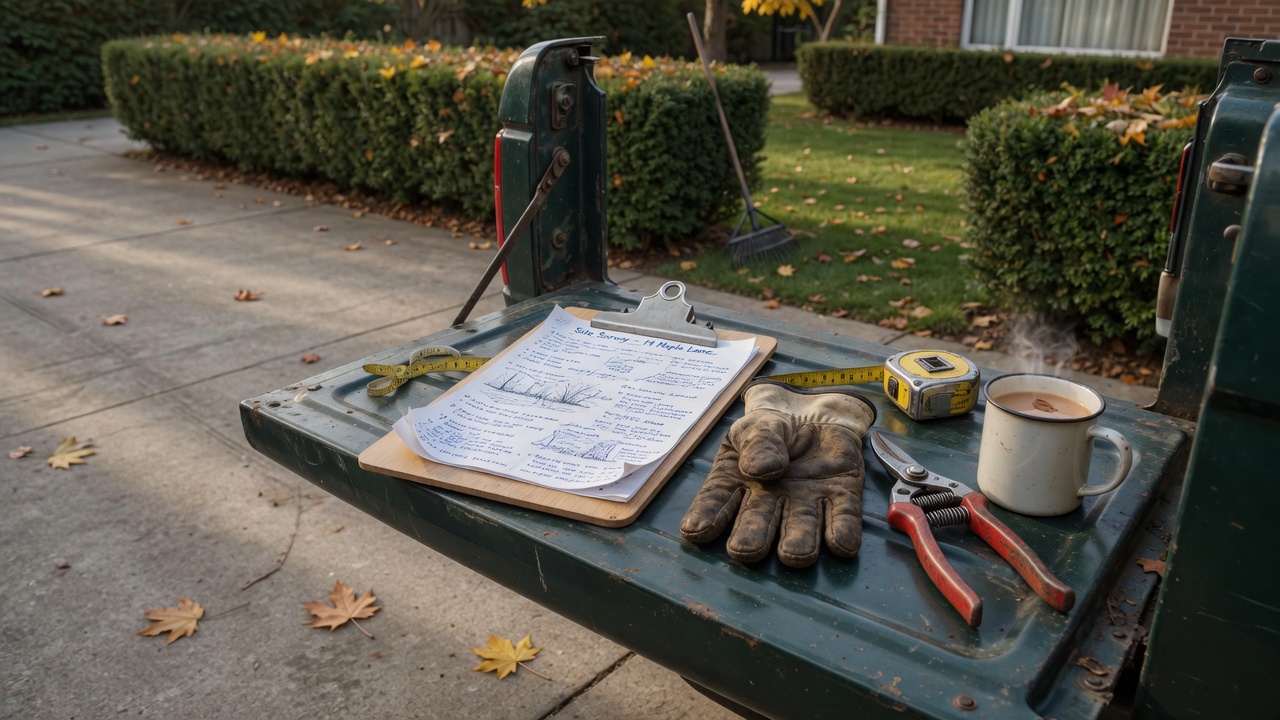
Independent landscape gardener video marketing in 2026: the 60-second at-the-clients-lawn named-gardener meet-your-gardener walkthrough that fills the seasonal-maintenance diary (and the polished cinematic drone-over-a-formal-garden reel that quietly loses first jobs)
Almost every independent landscape gardener who finally takes video seriously in 2026 ends up commissioning the same thing — a ninety-second cinematic showreel of a spotless country-house parterre at golden hour, a slow drone push over a rill running the full length of a Cotswolds walled kitchen garden, a moody montage of a colour-coordinated set of Sneeboer copper hand tools laid at forty-five degrees on a bare oak potting bench, a rack-focus close-up of a pair of unworn Barbour gauntlets and an unopened Niwaki bypass secateurs still shrink-wrapped from the RHS Chelsea trade stand, a lingering hero shot of a smiling gardener in an unrealistically pressed embroidered polo standing next to a Ferris zero-turn mower nobody has ever seen him actually put a blade under, a jump-cut sequence of an RHS Chelsea silver-gilt plaque being held up at a trade show, a slow-motion frame of a wisteria in full bloom soundtracked by an acoustic-guitar cover of Vaughan Williams, and a closing tagline card promising "creating outdoor spaces you'll love for a lifetime" over a soft-focus shot of a herringbone-brick path curving into a Yorkstone-flagged terrace. It looks like the opening frame of a national landscape-brand spring-launch spot and it books almost nobody, because the homeowner on the other side of the Google Maps pin at 8:40pm on a Sunday — a couple whose new-build cul-de-sac garden was signed off by the developer as "topsoil laid" but is in fact eight inches of stone-and-plaster spoil over compacted subsoil that has been standing water for the whole of March, a widow in her late seventies whose late husband kept the two-thirds-of-an-acre garden going for forty years and whose adult children are quietly worried she's about to hire "the man in the van with the leaflet", a downsizer in a Georgian terrace with a walled garden containing a TPO'd horse chestnut whose crown is shedding limbs over the neighbour's greenhouse and who has spent an hour trying to work out whether they need conservation-area consent or a Section 211 notice before anyone touches it, a young family moved into a 1930s semi with a mature pond in the middle of what they need to turn into a safe playing lawn for a toddler and a Labrador before summer, a listed-property owner with a Grade II farmhouse whose planning consent requires archaeological watching-brief on any spade work, a rewilding-curious homeowner who wants to convert half a quarter-acre lawn to a meadow but has no idea what to actually do in September, a couple who lost every plant in the front border to Phytophthora last winter, an Airbnb-let owner whose four-star reviews have started mentioning the "overgrown" garden with an August guest already booked, a corporate estate manager whose previous grounds contractor was terminated after a knotweed-boundary solicitor's letter, three gardener names in three tabs and a fourth tab open on a Facebook group post about "the landscaper who took the £4,000 patio deposit and disappeared", and a fifth tab open on Trustmark and the APL directory — isn't asking to be impressed. They're asking one small, quiet, slightly humiliating question: if I ring tomorrow morning and book an on-site visit for a Wednesday at ten, will the same named APL / BALI / RHS-qualified gardener whose face I've been looking at on the profile actually be the one who steps out of the pickup, will the quote he emails on Friday hold to within 10% of the final invoice or will "unforeseen ground conditions" quietly push £3,800 to £6,400, will he genuinely check whether the horse chestnut is TPO'd before anyone gets a chainsaw near it, will he refuse to touch the mature beech hedge in April because it's inside bird-nesting season under the Wildlife and Countryside Act rather than take the money and hope, will he actually be Trustmark-registered and hold current public-liability insurance for the £5,000-plus retaining wall or will "the guarantee is my handshake" mean nothing when the wall bows in year two, will he arrive on the promised Tuesday at eight or will "we've been held up on another job" become a rolling three-week slip, will he clear the arisings and pay a licensed carrier and produce a waste-transfer note or will fly-tipping traced back to my property become my Environmental Protection Act liability, will he honestly say "the soil here won't support a Buxus parterre without French drains — I'd rather sell you a wildflower matrix that will actually establish" rather than sell me the catalogue picture, will his crew be his own PAYE'd staff or a rotating cast of subcontracted day-labourers whose CSCS cards nobody has checked, and if my job is a new-build spoil-and-topsoil rescue or a downsizer takeover on an unfamiliar established garden or a TPO / conservation-area tree job or a young-family pond-removal-and-safe-play conversion or a rewilding-and-meadow conversion or a Phytophthora-and-honey-fungus-informed replant or a commercial grounds contract or a Japanese-knotweed-remediation on a boundary, will he genuinely have done it before or will I be paying for his learning curve on my one shot at the garden. The one number the Google Business Profile video actually moves (booked first on-site visits per 100 profile views, currently sitting at 0.2-1.0 on most under-tuned gardener profiles, movable to 4-7 with a well-tuned 60-second walkthrough), the three clip shapes that lift it — the at-the-clients-lawn named-gardener meet-your-gardener walkthrough for general seasonal maintenance / small patio-and-planting / block-of-visits first-enquiry generalists, the what-happens-next scenario explainer for new-build spoil rescue / downsizer takeover / TPO and conservation-area tree work / young-family pond removal / rewilding and meadow conversion / Phytophthora-informed replant / Airbnb turnaround / commercial grounds / knotweed remediation / listed-property archaeology, and the specialism welcome for TPO and conservation-area tree work / Japanese knotweed / Phytophthora-informed replant / rewilding and meadow / young-family safe-play / downsizer maintenance / new-build spoil rescue / commercial grounds / listed-property archaeology / online-only remote design — plus the cinematic drone-over-formal-garden reel trap that answers the wrong question, where each clip belongs (GBP slot, website homepage, local-authority tree-officer and conservation-officer referral surface, estate-agent and surveyor shortlist, service-and-scenario pages, Reels, TikTok, paid ads, enquiry-confirmation autoresponder, Nextdoor and local Facebook-group referral surface), the per-year plus per-season batch rhythm that fits an independent gardener without turning it into a content marketing agency, the five failure modes that keep the slot from working, where AI collapsed the £1,500-per-shoot economics that used to keep video off small gardener profiles (including the first-pass ASA CAP / CTSI / FTC / ACCC / Trustmark / APL / BALI / PCA / ISA / Arboricultural Association / RHS / Wildlife-and-Countryside-Act / EPA-waste / PA1-PA6 compliance scrub), and the one metric that steers it (booked-first-visits-per-100-views, rolling 30-day, not Instagram plays).

Independent private tutor video marketing in 2026: the 60-second at-the-kitchen-table named-tutor meet-your-tutor walkthrough that fills the weekly-lesson diary (and the polished cinematic classroom-and-textbooks reel that quietly loses first bookings)
Almost every independent private tutor who finally takes video seriously in 2026 ends up commissioning the same thing — a ninety-second cinematic reel of a spotless period-style study at golden hour, a slow drone push through an empty independent-school classroom with the sun coming through the leaded windows, a moody montage of a hardback CGP guide and a colour-coordinated set of Muji pens laid at forty-five degrees on a bare oak desk, a rack-focus close-up of an unopened past-paper still shrink-wrapped from the exam board, a lingering hero shot of a smiling tutor in an unrealistically pressed blazer standing in front of a chalkboard covered in half-finished quadratic-formula working nobody has ever seen a real student produce, a jump-cut sequence of a Year 11 student holding up a grade 9 GCSE certificate at what is very obviously not their own school hall, a soundtrack of gentle piano over the sound of a fountain pen scratching, and a closing tagline card promising "unlock your child's potential" over a soft-focus shot of an Oxford college quad. It looks like the opening frame of a national tuition-agency's autumn-term brand spot and it books almost nobody, because the parent on the other side of the Google Maps pin at 9:40pm on a Sunday — a Year 5 mum whose daughter is being submitted for the local grammar's 11+ in eleven weeks and whose current tutor has just quietly moved her to a Year 3 sibling group because "the diary got tight", a Year 10 dad whose son's mock GCSE maths came back at a grade 4 against a predicted 7 and whose maths teacher went on long-term sick leave in October, a Year 12 mum whose daughter's A-level chemistry class has had four supply teachers this term and whose UCAS prediction rests on the January mocks, a home-education parent whose eleven-year-old came out of a mainstream school after a bullying incident and whose EHCP names "specialist SEMH-informed one-to-one tuition" as a specific provision, a Year 13 dad whose son is applying to medicine and needs proper UCAT and BMAT preparation not a bookshop practice-question pack, a Year 6 parent whose child has a dyslexia diagnosis and whose SATs bridging-work for secondary needs an OG-trained tutor not a general primary tutor, an adult returner sitting her Functional Skills maths for a NHS-nursing-apprenticeship application in March, a Year 4 mum whose child has just started EOTAS provision after eighteen months of school refusal, three tutor names in three tabs and a fourth tab open on "the tutor who took the block of ten and then dropped my kid two weeks before the mocks" — isn't asking to be impressed. They're asking one small, quiet, slightly humiliating question: if I message tomorrow morning and book a first hour for a Wednesday at 4:15pm, will the same named QTS-qualified DBS-enhanced-checked tutor whose face I've been looking at on the profile actually be the one at my kitchen table when the doorbell rings, will she still be my child's tutor in eleven weeks or will she have moved us to a colleague at week four, will she actually check my son's specific exam-board specification (AQA 8300, not Edexcel 1MA1) before writing a plan rather than defaulting to a year-group syllabus, will she honestly tell me at the six-week review that we're on track for a grade 5 not a grade 7 rather than sell me another block on a promise, will she refer to an educational psychologist or a specialist SpLD tutor when the assessment finds something outside her scope, will she cancel three times in a fortnight when her day-job marking gets busy, will she charge me a rebooking fee if the after-school-club dress rehearsal moves the slot, will the invoice at the end of the month match the block price she quoted, and if my situation is 11+ grammar or GCSE resit or A-level chemistry Year 12 January-mock or SEND-and-EHCP-named-provision or home-education-and-EOTAS or Oxbridge-and-medical-school admissions or dyslexia-and-OG-trained or adult-Functional-Skills-return-to-learn, will she genuinely have tutored it before or will I be paying for her learning curve on my child's exam year. The one number the Google Business Profile video actually moves (booked first weekly lessons per 100 profile views, currently sitting at 0.3-1.1 on most under-tuned tutor profiles, movable to 4-8 with a well-tuned 60-second walkthrough), the three clip shapes that lift it — the at-the-kitchen-table named-tutor meet-your-tutor walkthrough for general Key Stage 2 / GCSE / A-level / block-of-ten first-enquiry generalists, the what-happens-next scenario explainer for 11+ grammar prep / GCSE resit / A-level Year 12 January mock / SEND-and-EHCP / home-education and EOTAS / Oxbridge and medical-school admissions / dyslexia and OG / adult Functional Skills / EAL and IELTS / IB, and the specialism welcome for 11+ / GCSE resit / A-level STEM / SEND-and-EHCP / EOTAS / Oxbridge / UCAT and BMAT / dyslexia-OG / adult Functional Skills / online-only remote — plus the cinematic classroom-and-textbooks reel trap that answers the wrong question, where each clip belongs (GBP slot, website homepage, school-SENDCo and educational-psychologist referral surface, LA EOTAS-and-alternative-provision coordinator shortlist, subject-and-key-stage pages, Reels, TikTok, paid ads, enquiry-confirmation autoresponder, local Facebook and Mumsnet referral surface), the per-year plus per-term batch rhythm that fits an independent tutor without turning it into a content marketing agency, the five failure modes that keep the slot from working, where AI collapsed the £1,500-per-shoot economics that used to keep video off small tutor profiles (including the first-pass ASA CAP / CTSI / FTC / ACCC / Tutors' Association / QTS / DBS-Update-Service / WWCC / safeguarding compliance scrub), and the one metric that steers it (booked-first-lessons-per-100-views, rolling 30-day, not TikTok plays).

Independent personal trainer video marketing in 2026: the 60-second on-the-gym-floor named-trainer meet-your-coach walkthrough that fills the recurring 1-to-1 diary (and the polished cinematic aesthetic training-montage reel that quietly loses first sessions)
Almost every independent personal trainer who finally takes video seriously in 2026 ends up commissioning the same thing — a ninety-second cinematic reel of a spotless private studio at golden hour, a slow drone push through an empty gym floor at 5am with the sun coming through the roller shutter, a moody montage of a colour-coordinated dumbbell rack polished to a mirror finish, a rack-focus close-up of an unopened bag of chalk and a folded lifting belt laid at forty-five degrees on a flight-cased Rogue bench, a lingering hero shot of a smiling trainer in unrealistically pressed branded activewear demonstrating a barbell back squat with what is obviously a warm-up plate, a jump-cut sequence of a physique client flexing at a Barcelona show ten kilos leaner than the "before" photo, a soundtrack of moody trap-hi-hat over the clink of iron on iron, and a closing tagline card promising "transform your body, transform your life". It looks like the opening frame of a national activewear brand's Q1 launch spot and it books almost nobody, because the person on the other side of the Google Maps pin at 9:40pm on a Sunday — a thirty-four-year-old woman fourteen weeks post-C-section whose midwife has mentioned diastasis recti and who cannot go back to the trainer at her old chain gym who has already told her "we'll just get you back to your pre-baby body in twelve weeks", a forty-seven-year-old six months into HRT who has read enough about perimenopause and resistance training to know she needs a coach who actually understands the hormonal picture, a fifty-eight-year-old man eleven weeks post total-knee-replacement whose consultant has signed him off for progressive strength but who cannot go back to the trainer who put him on a heavy leg press three weeks after surgery, a twenty-nine-year-old with a recent adult-ADHD diagnosis whose GP has recommended progressive resistance training as part of a broader plan, a sixty-two-year-old just off twelve months of adjuvant hormone therapy whose oncology-physio has released her to a Level 4 cancer-rehab specialist, a rugby-academy dad whose fifteen-year-old is being asked to add ten kilos of lean mass before U16 trials, a thirty-eight-year-old newly on the NHS diabetes-remission pathway whose GP has referred him for structured exercise, a woman training for her first BDFPA meet who needs a coach who can peak a lifter not a physique client, three trainer names in three tabs and a fourth tab open on a Facebook group post about "the trainer who took the twelve-session block and then quietly moved everyone onto a group class when the diary got busy" — isn't asking to be impressed. They're asking one small, quiet, slightly humiliating question: if I message tomorrow morning and book a first consultation for a Tuesday at 6:30am, will the same named CIMSPA-registered qualified trainer whose face I've been looking at on the profile actually be the one holding the clipboard when I turn up, will he still be my trainer in twelve weeks or will he have moved me to a colleague at week four, will he actually screen my postnatal / perimenopause / post-op / cancer-rehab / ADHD / diabetes / competition history before writing a programme rather than defaulting to a generic hypertrophy split, will he refer me back to my GP or pelvic-health-physio or oncology-physio when the exam finds something outside his scope, will he cancel me three times in a fortnight, will he charge me a rebooking fee if my kid's ENT appointment moves, will the direct debit at the end of the month match the block price he quoted, and if my situation is postnatal-return-to-lifting or perimenopause or post-op-knee-or-hip or cancer-rehab or adult-ADHD or type-2-diabetes-remission or first-competition-prep or youth-athletic-development, will he genuinely have coached it before or am I paying for his learning curve on my body. The one number the Google Business Profile video actually moves (booked first 1-to-1 sessions per 100 profile views, currently sitting at 0.2-0.9 on most under-tuned trainer profiles, movable to 4-8 with a well-tuned 60-second walkthrough), the three clip shapes that lift it — the on-the-gym-floor named-trainer meet-your-coach walkthrough for general-fitness / weight-loss / return-to-exercise / block-of-twelve first-enquiry generalists, the what-happens-next scenario explainer for postnatal / perimenopause / post-op knee-and-hip / cancer-rehab / adult-ADHD / type-2 diabetes remission / first-competition powerlifting / youth-athletic development / pre-and-post bariatric, and the specialism welcome for postnatal / perimenopause / post-op / cancer-rehab / neuro-inclusive / diabetes-remission / competition-prep / youth-athletic / LGBTQ+-inclusive / body-neutral-non-diet-culture / online-only remote — plus the cinematic aesthetic training-montage reel trap that answers the wrong question, where each clip belongs (GBP slot, website homepage, pelvic-health-physio and oncology-physio referral surface, GP-exercise-referral coordinator's shortlist, service-type pages, Reels, TikTok, paid ads, consultation-confirmation autoresponder, local Facebook-group referral surface), the per-year plus per-quarter batch rhythm that fits an independent trainer without turning it into a content marketing agency, the five failure modes that keep the slot from working, where AI collapsed the £1,500-per-shoot economics that used to keep video off small trainer profiles (including the first-pass ASA CAP / CTSI / FTC / ACCC / CIMSPA / REPs / NSCA / ACSM / NASM / ACE / AusActive compliance scrub), and the one metric that steers it (booked-first-sessions-per-100-views, rolling 30-day, not Instagram plays).
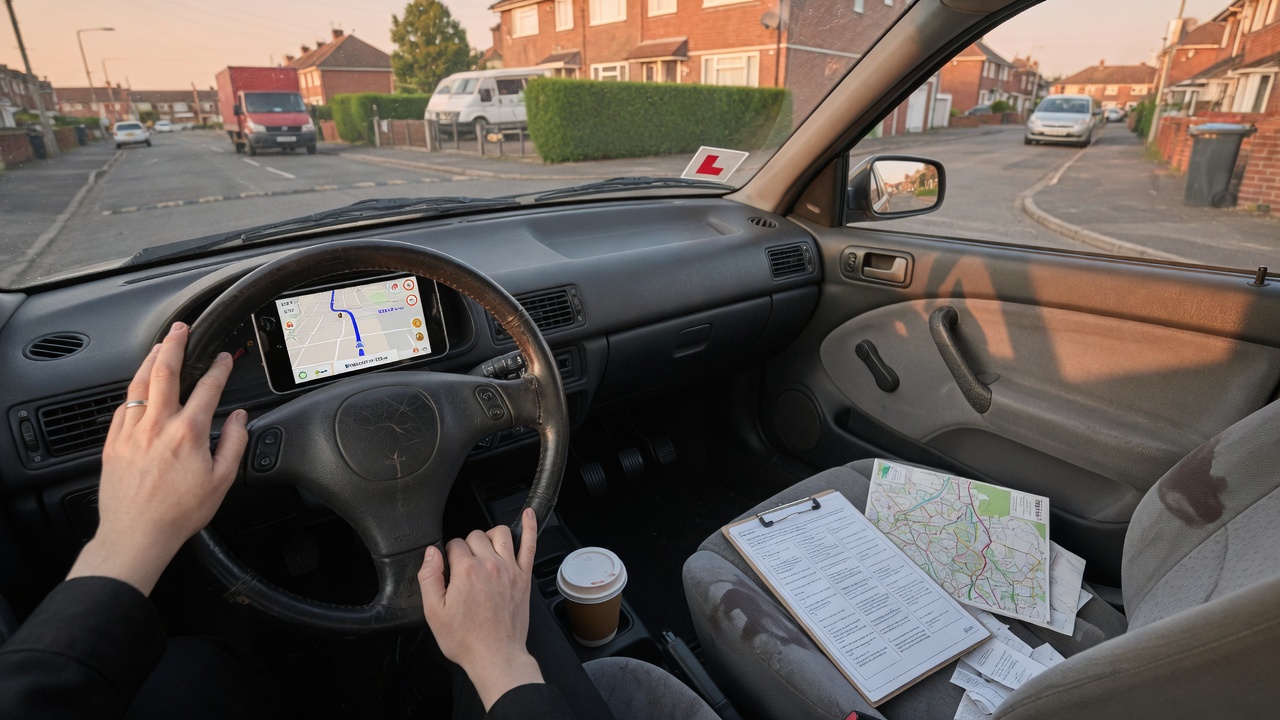
Independent driving instructor video marketing in 2026: the 60-second at-the-wheel named-instructor meet-your-instructor walkthrough that fills the recurring-lesson diary (and the polished cinematic dual-controls-and-signwritten-car reel that quietly loses first bookings)
Almost every independent driving instructor who finally takes video seriously in 2026 ends up commissioning the same thing — a ninety-second cinematic reel of a spotless signwritten Vauxhall Corsa pulling out of a leafy suburban driveway at golden hour, a slow drone push over a test-centre car park with the sun catching the windscreen, a moody montage of L-plates being magnetically clipped to a rear bumper, a rack-focus close-up of gloved hands adjusting a rear-view mirror, a lingering hero shot of a dual-controls pedal box, a soundtrack of gentle acoustic guitar over the whir of a manual gearbox slotting cleanly into third, a jump-cut of a smiling instructor in an unrealistically pressed logoed polo shirt handing a bouquet to a beaming learner holding up a pink certificate outside what is clearly not their test centre, and a tagline card promising "your pass, our promise, first time" over a soft-focus shot of a "P" plate being stuck to a car door. It looks like the opening frame of a national driving-school-franchise advert and it books almost nobody, because the person on the other side of the Google Maps pin at 8:40pm on a Thursday — a seventeen-year-old whose provisional arrived three weeks ago and whose parents have quietly told her they'll fund the first ten hours but she's on her own after that, a nervous forty-four-year-old woman on her fourth attempt whose failure sheet lists a single serious under "junctions - observations" and who cannot begin again with an instructor who will shout, a thirty-two-year-old man who's held his licence in India for eleven years and needs to convert to a UK licence, a twenty-eight-year-old woman with ADHD whose GP has told her she should not be moved between instructors, a fifty-nine-year-old man whose licence lapsed in 2017 during cancer treatment, a teenager whose autism diagnosis at fourteen means her mother is looking for an instructor who has genuinely taught autistic learners rather than one who says "of course, we treat everyone the same", a private-hire driver preparing for his council's topographical and Enhanced-DBS test, a woman preparing for the ADI Part 2 who needs an instructor-trainer not a lesson instructor, three instructor names in three tabs and a fourth tab open on a Facebook group post about "the instructor who took the money for ten lessons and then vanished" — isn't asking to be impressed. They're asking one small, quiet, slightly humiliating question: if I ring tomorrow morning and book a first two-hour lesson for a Tuesday at four, will the same named DVSA-approved green-badge ADI whose face I've been looking at on the profile actually be the one in the passenger seat when I turn the key, will he still be my instructor in nine weeks' time or will he have moved me to a colleague at week three, will he take me to the test centre I've booked (Isleworth, not Pinner, because I know the Pinner one-way at Kenton and I don't know Isleworth), will he actually teach the current DVSA syllabus rather than 2004's, will he cancel my lesson three times in a fortnight when the school run gets messy, will he charge me a booking fee if I need to move a lesson because my mum's chemo appointment moved, and if my situation is nervous-fourth-attempt or older-adult-relearner or autistic-learner or ADHD-learner or licence-lapsed-retake or Indian-licence-conversion or private-hire-topographical or ADI-Part-2-training, will he genuinely have taught it before or will I be paying for his learning curve on my provisional. The one number the Google Business Profile video actually moves (booked first lessons per 100 profile views, currently sitting at 0.3-1.2 on most under-tuned instructor profiles, movable to 4-8 with a well-tuned 60-second walkthrough), the three clip shapes that lift it — the at-the-wheel named-instructor meet-your-instructor walkthrough for first-provisional teens / general adults / block-of-ten first-enquiry generalists, the what-happens-next scenario explainer for nervous-fourth-attempt / licence-lapsed retake / licence-conversion / autism-and-ADHD / older-adult relearner / private-hire topographical / ADI Part 2 and 3 / intensive courses / Pass Plus and motorway, and the specialism welcome for nervous-and-fourth-attempt / autism-and-ADHD-friendly / older-adult-relearner / licence-conversion / private-hire / ADI-instructor-training / intensive-one-week / automatic-only / motorway-and-Pass-Plus / deaf-and-hard-of-hearing — plus the cinematic signwritten-car reel trap that answers the wrong question, where each clip belongs (GBP slot, website homepage, school-parent WhatsApp referral, service-type pages, Reels, TikTok, paid ads, enquiry-form autoresponder, local Facebook-group referral, sixth-form and FE-college partnership), the per-year plus per-quarter batch rhythm that fits an independent instructor without turning it into a content marketing agency, the five failure modes that keep the slot from working, where AI collapsed the £1,500-per-shoot economics that used to keep video off small instructor profiles (including the first-pass ASA CAP / CTSI / FTC / ACCC / DVSA advertising compliance scrub), and the one metric that steers it (booked-first-lessons-per-100-views, rolling 30-day, not TikTok plays).

Independent wedding photographer video marketing in 2026: the 60-second at-a-real-wedding named-photographer meet-your-shooter walkthrough that fills the booking diary (and the polished cinematic couples-in-a-field portfolio reel that quietly loses signed contracts)
Almost every independent wedding photographer who finally takes video seriously in 2026 ends up commissioning the same thing — a ninety-second cinematic showreel cut from the year's best fifteen weddings, an aerial drone push across a Cotswolds barn conversion at golden hour, a slow-motion confetti tunnel edit, a soft-focus first-dance snippet lit by fairy lights, a rack-focus shot of a bridal bouquet and a pair of unworn Manolos on a hotel bedspread, a rain-on-the-marquee-window handheld shot backed by a slowed-down acoustic cover of a Coldplay track, a jump-cut montage of eight different couples kissing in eight different fields set to a rising piano crescendo, and a closing tagline card promising "your day, your story, timeless". It looks like the opening frame of a national wedding-magazine advert and it books almost nobody, because the couple on the other side of the Google Maps pin at 9:40pm on a Sunday — a bride nine months out from a village-church-and-marquee-in-her-parents'-garden wedding whose Nan is on a walking frame and whose single quiet request is that the photographer will make sure Nan is properly in the group shots, a groom whose mother died three years ago and whose only ask is a specific frame of his surviving father's face changing when he sees his son at the altar, a couple planning a two-day Sikh wedding whose parents have been quietly assessing the shortlist for the "will the photographer know when to be in the langar hall and when not to, will they photograph the Anand Karaj without stepping in front of the Guru Granth Sahib" question for six weeks, a same-sex couple planning a humanist ceremony whose extended family includes one relative still not fully accepting the marriage, an elopement couple flying to a registry office in Copenhagen with two witnesses, a couple whose venue is a working farm with rain forecast and whose fear is a photographer who "cannot handle a wet Saturday", a couple whose budget is £1,800 not £4,500 who need to know honestly whether that gets them a full-day named photographer or a second-shooter working under someone else's brand, three photographer names in three tabs and a fourth tab open on a Reddit thread on "how do I know a wedding photographer will actually show up" — isn't asking to be impressed. They're asking one small, quiet, slightly humiliating question: if I sign this contract in October for a Saturday next August, will the specific human whose Instagram grid I've been staring at actually be the one behind the camera on the day, will she read the running order and know that Nan needs a chair, will she catch my dad's face at the altar without instructing him to look, will she move a drunk uncle out of a family group shot without embarrassment, will she cope with the rain rather than retreating to the barn, will she deliver the edited gallery inside the eight weeks she promised or will I still be chasing at Christmas, will the invoice match the number she quoted, and if my day is a two-day Sikh wedding or a humanist same-sex ceremony or a mid-week Copenhagen elopement, will she genuinely have shot it before or will I be paying for her learning curve on the one day of my life I cannot re-shoot. The one number the Google Business Profile video actually moves (signed weddings per 100 profile views, currently sitting at 0.2-0.5 on most under-tuned photographer profiles, movable to 1.2-1.8 with a well-tuned 60-second walkthrough), the three clip shapes that lift it — the at-a-real-wedding named-photographer meet-your-shooter walkthrough for general full-day / country-house / hotel-package / church-and-reception / first-enquiry generalists, the what-happens-next scenario explainer for Asian multi-day / church-with-no-flash / humanist same-sex / elopement-and-registry-office / farm-shed marquee in bad weather / destination-abroad / second-marriage-with-blended-family / low-light-and-late-ceremony, and the specialism welcome for documentary-reportage / film-and-hybrid / Asian multi-day / humanist and inclusive / elopement-only / black-and-white-only fine-art / editorial-portrait-led / low-light-no-flash / adventure-and-outdoors / second-marriage-and-blended-family — plus the cinematic portfolio reel trap that answers the wrong question, where each clip belongs (GBP slot, website homepage, venue-preferred-supplier listing, service-type pages, Reels, TikTok, paid ads, enquiry-form autoresponder, wedding-planning private-group referral surface, wedding-planner and celebrant referral surface), the per-year plus per-quarter batch rhythm that fits an independent photographer without turning it into a content marketing agency, the five failure modes that keep the slot from working, where AI collapsed the £2,000-per-shoot economics that used to keep video off small photographer profiles (including the first-pass ASA CAP / CTSI / FTC / ACCC / SWPP / MPA / BIPP / PPA / WPPI compliance scrub), and the one metric that steers it (signed-weddings-per-100-views, rolling 90-day, not Instagram plays).

Independent pet grooming salon video marketing in 2026: the 60-second at-the-grooming-table named-groomer meet-your-dog walkthrough that fills the recurring-groom diary (and the polished cinematic before-and-after transformation reel that quietly loses regulars)
Almost every independent pet grooming salon that finally takes video seriously in 2026 ends up commissioning the same thing — a ninety-second cinematic reel of the shopfront at golden hour, a slow drone glide down the high street, a moody montage of a spotless stainless steel grooming table with a folded fresh towel and a colour-coordinated set of Andis clippers laid out at forty-five degrees, a lingering close-up of a smiling groomer in unrealistically pressed apron finishing a scissor line on a Bichon that has clearly just been groomed off-camera by someone else, a jump-cut transformation of a matted Cockapoo turning into a show-cut Cockapoo set to an emotive acoustic guitar track, and a tagline card promising "loving care for every four-legged family member since 2011". It looks like the opening frame of a national pet-food-brand advert and it books almost nobody, because the owner on the other side of the Google Maps pin at 9:40pm on a Sunday — a first-time doodle owner whose eighteen-month-old F1B Cavapoo has finally hit the coat change and matted behind the ears, a Cocker Spaniel owner whose vet visit last week ended with a note that ear plucking cannot be put off any longer, a nervous rescue Lurcher owner whose dog cannot be muzzled for grooming after a botched clip at a chain salon eighteen months ago, a cat owner whose fourteen-year-old semi-longhair Persian has just been diagnosed with early kidney disease, a Shih Tzu owner who moved to the area three months ago from a village where their previous groomer knew the topknot pattern by heart, an elderly Springer's owner whose dog has just come home from a lymph-node biopsy, three grooming-salon names open in three browser tabs and a fourth tab open on "how do I know if a groomer is being kind to my dog when I'm not there" — isn't asking to be impressed. They're asking one small, quiet, slightly humiliating question: if I drop my dog off at 8:30am on a Wednesday for a five-hour groom, will the same named qualified groomer I met at the meet-and-greet actually be the person on the clippers rather than a rotating apprentice, will she recognise the matting as a welfare judgement rather than force a comb through it, will she ring me before she reaches for a #10 blade rather than adding a "dematting surcharge" to the invoice, will the drying room have separate kennels and low-decibel dryers, will there be a stop and a phone call if my dog shows any sign of distress, will the price at pickup match the phone quote, and if my dog turns out to be one who shouldn't be groomed today will the salon have the professional courage to tell me. The one number the Google Business Profile video actually moves (booked first grooms per 100 profile views, currently sitting at 1-2 on most under-tuned salon profiles, movable to 5-8 with a well-tuned 60-second walkthrough), the three clip shapes that lift it — the at-the-grooming-table named-groomer meet-your-dog walkthrough for routine recurring grooms / first-ever grooms / general breed cuts / new-to-the-area regulars, the what-happens-next scenario explainer for doodle coat-change and first mat / puppy first groom / anxious-and-rescue clippers-adverse / senior-and-medical-considerations / cat groom / hand-stripping terriers / double-coat "please don't shave my husky" / vet-medical-referral cases, and the specialism welcome for breed-standard show cuts with Level 3 groomer / hand-stripping terrier breeds / cat grooming with IPG feline certification / senior-and-medical with vet-communication protocol / anxious-and-rescue with PPG force-free-handling / hydrotherapy-plus-groom / low-stress puppy first-groom / double-coat deshed specialist — plus the cinematic transformation reel trap that answers the wrong question, where each clip belongs (GBP slot, website homepage, service-type pages, Reels, TikTok, paid ads, meet-and-greet-confirmation autoresponder, Nextdoor and local dog-walker WhatsApp referral surface, vet-practice and behaviourist referral surface), the per-year plus per-quarter batch rhythm that fits an independent salon without turning it into a content marketing agency, the five failure modes that keep the slot from working, where AI collapsed the £1,500-per-shoot economics that used to keep video off small salon profiles (including the first-pass ASA CAP / CTSI / FTC / ACCC / animal-welfare compliance scrub), and the one metric that steers it (first-grooms-per-100-views, rolling 30-day, not video plays).

Independent domestic cleaning business video marketing in 2026: the 60-second at-the-front-door named-owner meet-the-team walkthrough that fills the recurring-clean diary (and the polished cinematic van-and-uniform reel that quietly loses regular bookings)
Almost every independent domestic cleaning company that finally takes video seriously in 2026 ends up commissioning the same thing — a ninety-second cinematic reel of two signwritten vans pulling out of the depot at golden hour, a slow drone glide across the industrial estate, a moody montage of colour-coordinated cleaning caddies laid out on a workbench with unopened bottles of eco-branded spray and a folded stack of unrealistically white microfibre cloths that have plainly never been used on a real skirting board, a soft-focus shot of a smiling team in unrealistically pressed matching polo shirts lined up in front of a company-branded van gripping brand-new caddy trays as though for a group photograph at a trade show, a lingering close-up of a Henry vacuum and a bottle of Ecover cranberry-and-cedar surface spray staged on the doormat of a house whose owner was clearly asked to leave the room for the shot, and a tagline card overlaid on stock footage promising "the trusted name in home cleaning since 2004". It looks like the opening frame of a national commercial-cleaning-brand advert on a Sunday-night broadcast break and it books almost nobody, because the homeowner on the other side of the Google Maps pin at 9:40pm on a Sunday — a woman on maternity leave with a six-week-old baby who has not touched a hoover in eleven days, a two-income household with two under-fives and a dog losing every Saturday to a job neither of them wants, a landlord with a mid-tenancy inspection on Friday whose outgoing tenant left an oven that looks like a crime scene, a holiday-let host whose Saturday-morning turnaround has a check-in at 3pm and a check-out at 10 and a laundry pile that has to move through a washing machine in under four hours, a woman whose elderly mother has just come home from hospital after a fall and cannot manage the bathroom, an office manager whose in-house evening cleaner has quit and whose landlord requires a nightly-clean audit trail from a DBS-cleared contractor, three cleaning-company names open in three browser tabs and a fourth tab open on "how do I know if a cleaner is going to steal from me" — isn't asking to be impressed. They're asking one small, quiet, slightly humiliating question: if I ring this company on Monday morning and let their team through my front door with a set of my house keys on a Wednesday morning while I'm at work, will the same two named vetted DBS-cleared cleaners actually turn up every fortnight, will they be insured and bonded if something breaks, will the direct debit at the end of the first month match the price the owner quoted me on the phone before the first visit, and can I cancel without a hidden three-month notice clause, or am I about to hand a set of keys and my alarm code to a rotating cast of subcontractors from an agency whose owner I've never actually spoken to. The one number the Google Business Profile video actually moves (booked recurring cleans per 100 profile views, currently sitting at 1-2 on most under-tuned firm profiles, movable to 5-8 with a well-tuned 60-second walkthrough), the three clip shapes that lift it — the at-the-front-door named-owner meet-the-team walkthrough for recurring weekly-and-fortnightly / first-visit enquiries / keyholder cleans / general domestic, the what-happens-next scenario explainer for end-of-tenancy / post-build / holiday-let same-day turnaround / spring-and-deep / hypoallergenic / elderly-and-care-package / mid-tenancy landlord inspection / moving-in first clean, and the specialism welcome for end-of-tenancy with ARLA checklist / holiday-let same-day turnaround with in-house laundry / post-build with HEPA equipment / hypoallergenic and eczema-safe / elderly-and-care-package / small-office nightly contract with DBS-cleared team / oven-deep and appliance-restoration / carpet-and-upholstery — plus the cinematic van-and-uniform reel trap that answers the wrong question, where each clip belongs (GBP slot, website homepage, service-type pages, Reels, TikTok, paid ads, walkthrough-confirmation autoresponder, Nextdoor and local WhatsApp referral surface, letting-agent and holiday-let-management referral surface), the per-year plus per-quarter batch rhythm that fits an independent firm without turning it into a content marketing agency, the five failure modes that keep the slot from working, where AI collapsed the £1,500-per-shoot economics that used to keep video off small firm profiles (including the first-pass ASA CAP / CTSI / FTC / ACCC compliance scrub), and the one metric that steers it (recurring-cleans-per-100-views, rolling 30-day, not video plays).

Independent chiropractic clinic video marketing in 2026: the 60-second adjusting-room named-chiropractor exam walkthrough that fills the new-patient diary (and the polished cinematic clinic reel that quietly loses first-consultations)
Almost every independent chiropractic clinic that finally takes video seriously in 2026 ends up commissioning the same thing — a ninety-second cinematic reel of the clinic frontage at golden hour, a slow drone glide across the wellness-park car park, a moody montage of a spotless adjusting bench with a folded fresh face-cradle paper roll that has clearly been arranged for the shot, a lingering close-up of an unrealistically smiling chiropractor in unrealistically pressed navy scrubs poised over a spine model in a consulting room that has plainly never seen a real patient, a serene shot of an activator instrument laid on a clean tray next to a colour-coordinated set of Thera-bands, a soft-focus glimpse of a spinal x-ray on a lightbox that no clinician is actually reading, and a tagline card overlaid on stock footage promising "restoring alignment, restoring lives, since 2003". It looks like the opening frame of a private-healthcare-brand advert and it books almost nobody, because the person on the other side of the Google Maps pin at 9:40pm on a Sunday — six weeks into a nagging lower-back grumble that started after a house move and now radiates down the back of one leg, a shoulder that clicks every time they reach into the back seat of the car and now wakes them up when they roll onto their side, a neck that has been locked at a twenty-degree tilt since a bad night on a Travelodge pillow ten days ago and has now progressed to a headache behind the right eye that ibuprofen no longer touches, a pregnant patient whose midwife has mentioned "pelvic girdle pain" and quietly recommended a chiropractor who does prenatal work, a personal-injury solicitor's client whose whiplash claim needs a written treatment plan by Friday, a keen recreational runner whose IT band has been shrieking every third mile for a month, three chiropractor names open in three browser tabs and a fourth tab open on "does chiropractic actually work for sciatica" — isn't asking to be impressed. They're asking one small, quiet, slightly humiliating question: if I ring this clinic on Monday morning, will an actual qualified chiropractor take a proper history, actually put hands on the joint that's the problem, actually tell me the honest truth about whether this is a four-visit fix or something a scan needs to look at first, actually price it fairly without steering me at a pre-paid twenty-four-session "care plan", and refer me on to a GP or musculoskeletal imaging pathway if that's what the exam actually points at, or am I about to be signed up to a lifetime "wellness maintenance" subscription by someone who's already reaching for the drop-table before they've asked me a single question. The one number the Google Business Profile video actually moves (booked first consultations per 100 profile views, currently sitting at 1-2 on most under-tuned clinic profiles, movable to 5-8 with a well-tuned 60-second walkthrough), the three clip shapes that lift it — the adjusting-room named-chiropractor exam walkthrough for routine MSK / lower back / neck-and-shoulder / general practice / first-visit enquiries, the what-happens-next scenario explainer for lumbar disc-related sciatica / whiplash-associated disorder / prenatal pelvic-girdle pain / first paediatric consultation / cervicogenic headache and migraine / sports-injury and extremity work / post-op rehabilitation, and the specialism welcome for prenatal and paediatric with Webster certification / sports and extremity work / whiplash and personal-injury / disc-related sciatica and flexion-distraction / headache and migraine and upper-cervical / workplace and desk-worker MSK / geriatric mobility / TMJ and craniocervical — plus the cinematic clinic reel trap that answers the wrong question, where each clip belongs (GBP slot, website homepage, treatment-condition pages, Reels, TikTok, paid ads, booking-confirmation autoresponder, GP-and-midwifery-and-PI-solicitor referral surface, private-medical-insurance directory profile), the per-year plus per-quarter batch rhythm that fits an independent clinic without turning it into a content marketing agency, the five failure modes that keep the slot from working, where AI collapsed the £2,000-per-shoot economics that used to keep video off small clinic profiles (including the first-pass GCC / RCC / ACA / AHPRA compliance scrub), and the one metric that steers it (first-consultations-per-100-views, rolling 30-day, not video plays).

Independent optometry practice video marketing in 2026: the 60-second consulting-room named-optometrist eye-exam walkthrough that fills the appointment diary (and the polished cinematic dispensary reel that quietly loses new patient calls)
Almost every independent optometry practice that finally takes video seriously in 2026 ends up commissioning the same thing — a ninety-second cinematic reel of the shopfront at golden hour, a slow drone glide across the high street, a moody montage of a colour-coordinated wall of designer frames that has clearly been dusted for the shot, a lingering close-up of a smiling optometrist in an unrealistically pressed white coat with a slit lamp neither of them is really using, a serene older patient trying on horn-rimmed acetates in soft window light, and a tagline card overlaid on stock footage promising "caring for your family's eyes since 1988". It looks like the opening frame of a national eyewear-chain advert and it books almost nobody, because the person on the other side of the Google Maps pin at 9:40pm on a Sunday — a nine-year-old whose short-sight prescription has jumped a full dioptre in twelve months and whose school just sent home a letter mentioning "myopia management", a fifty-two-year-old who has finally stopped denying that they hold restaurant menus at arm's length and needs to stop wincing at a work laptop by Friday, a contact-lens wearer whose left eye has been red and gritty for a week and who has now Googled "dry eye clinic near me" for the third night running, a diabetic patient whose GP surgery has just sent a reminder that annual retinal screening is overdue, a driver whose recent car-insurance renewal flagged that their last eye test was in 2019 and who has been quietly avoiding motorway night driving for the last eight months, three practice names open in three browser tabs and a fourth tab open on "how much is an eye test for a child in [town]" — isn't asking to be impressed. They're asking one small, quiet, slightly humiliating question: if I book an eye test at this practice, will an actual optometrist take twenty-five real minutes with me, actually explain what the OCT scan showed, actually tell me the honest truth about whether my child needs myopia-management contact lenses or just an updated single-vision prescription, actually price the glasses I need without steering me at the frames on the highest-margin wall, and hand me a written prescription I can walk out of the door with, or am I about to be signed up to an unnecessary supplementary imaging pathway and a £400 pair of frames I didn't ask for. The one number the Google Business Profile video actually moves (booked eye tests per 100 profile views, currently sitting at 1-2 on most under-tuned practice profiles, movable to 5-8 with a well-tuned 60-second walkthrough), the three clip shapes that lift it — the consulting-room named-optometrist eye-exam walkthrough for routine sight tests / driving check-ups / presbyopia / adult first-time enquiries / general practice, the what-happens-next scenario explainer for paediatric first exams / school-vision-screening follow-ups / first pair of reading glasses / red or gritty eye / floaters or flashes / diabetic retinal screening / driving-licence concerns / first cataract mentioned / dry-eye clinic / contact lens fitting / myopia control fitting, and the specialism welcome for paediatric optometry and myopia management / dry-eye clinic / complex contact lenses and ortho-K / low-vision rehabilitation / sports vision / visual stress and dyslexia-adjacent care / glaucoma shared-care / diabetic screening / domiciliary and care-home visits — plus the cinematic dispensary reel trap that answers the wrong question, where each clip belongs (GBP slot, website homepage, service pages, Reels, TikTok, paid ads, booking-confirmation autoresponder, reception waiting-area screen loop, GP-surgery and community-optometry referral surface), the per-year plus per-quarter batch rhythm that fits an independent practice without turning it into a content marketing agency, the five failure modes that keep the slot from working, where AI collapsed the £2,000-per-shoot economics that used to keep video off small practice profiles (including the first-pass GOC / College of Optometrists / AOP / AOA / AHPRA compliance scrub), and the one metric that steers it (eye-tests-per-100-views, rolling 30-day, not video plays).

Independent physiotherapy clinic video marketing in 2026: the 60-second treatment-room named-clinician assessment walkthrough that fills the appointment diary (and the polished cinematic clinic reel that quietly loses new patient calls)
Almost every independent physiotherapy clinic that finally takes video seriously in 2026 ends up commissioning the same thing — a ninety-second cinematic reel of the clinic frontage at golden hour, a slow drone glide across the health-park car park, a moody montage of a spotless plinth and a colour-coordinated set of resistance bands laid out on a workbench that has plainly never seen a real assessment, a shot of an unrealistically smiling physio in unrealistically pressed navy scrubs applying tape to a knee that was clearly already fine, a serene patient in gym-wear staring wistfully out of a window, and a tagline card overlaid on stock footage promising "restoring movement, restoring lives, since 2005". It looks like the opening frame of a national private-healthcare-brand advert and it books almost nobody, because the person on the other side of the Google Maps pin at 9:40pm on a Sunday — six weeks into a nagging lower-back grumble that started after a house move and hasn't shifted, a shoulder that clicks every time they reach into the back seat of the car and now wakes them up when they roll over, a knee that won't straighten fully six weeks after a football tackle their GP said would "settle down", a whiplash claim their insurer needs a written recovery plan for by Friday, a post-natal pelvic-floor issue they haven't told anyone about, three physio names open in three browser tabs and a fourth tab open on "how many physio sessions does it take to fix sciatica" — isn't asking to be impressed. They're asking one small, quiet, slightly humiliating question: if I ring this clinic on Monday morning, will an actual chartered physio listen to what's actually going on, actually put hands on the joint, actually tell me whether this is a four-session fix or something a scan needs to see, and hand me a plan I can follow at home between visits, or am I about to be signed up to a twelve-session package by someone who's already reaching for the tape. The one number the Google Business Profile video actually moves (booked first appointments per 100 profile views, currently sitting at 1-2 on most under-tuned clinic profiles, movable to 5-8 with a well-tuned 60-second walkthrough), the three clip shapes that lift it — the treatment-room named-clinician assessment walkthrough for general MSK / lower-back / neck-and-shoulder / sports injury / post-op / whiplash / general practice, the what-happens-next scenario explainer for post-op ACL / total knee or hip replacement / shoulder impingement / chronic lower-back pain and sciatica / whiplash-associated disorder / plantar fasciitis / tennis elbow / post-natal pelvic floor / BPPV and vestibular, and the specialism welcome for pelvic and women's health / vestibular / paediatric / neurological rehab / hand therapy / oncology-related rehab / TMJ / sports rehab / geriatric mobility — plus the cinematic clinic reel trap that answers the wrong question, where each clip belongs (GBP slot, website homepage, treatment pages, Reels, TikTok, paid ads, booking-confirmation autoresponder, GP-and-consultant referral surface, private-medical-insurance directory profile), the per-year plus per-quarter batch rhythm that fits an independent clinic without turning it into a content marketing agency, the five failure modes that keep the slot from working, where AI collapsed the £2,000-per-shoot economics that used to keep video off small clinic profiles (including the first-pass HCPC / CSP / APTA / APA compliance scrub), and the one metric that steers it (first-appointments-per-100-views, rolling 30-day, not video plays).

Independent electrician video marketing in 2026: the 60-second at-the-consumer-unit named-owner walkthrough that fills the callout diary (and the polished cinematic van reel that quietly loses rewire and EV-charger jobs)
Almost every independent electrical contractor that finally takes video seriously in 2026 ends up commissioning the same thing — a ninety-second cinematic reel of two signwritten vans pulling out of the yard at golden hour, a slow drone glide across the trading estate, a moody montage of a torque screwdriver and a clean set of Wago connectors on a workbench that has plainly never seen a real second-fix, a shot of an unrealistically smiling sparky in unrealistically pressed overalls holding a multimeter to a socket that was clearly already working, and a tagline card overlaid on stock footage promising "NICEIC-registered quality since 1994". It looks like a national utility-brand advert and it books almost nobody, because the homeowner on the other side of the Google Maps pin at 10:20pm on a Sunday — kitchen sockets stone dead, an RCD in the consumer unit that keeps tripping the moment they reset it, a faint bakelite smell coming from behind the fridge, a mortgage-refinance surveyor's report flagging the wiring as "pre-1990s and requiring further investigation", three electrician names open in three browser tabs and a fourth tab open on "how much is a full rewire" — isn't asking to be impressed. They're asking one small, quiet, slightly humiliating question: if I ring this firm on Monday morning, will an actual qualified electrician turn up, actually take the cover off the consumer unit, actually tell me whether this is a £90 fix or a £6,000 rewire, and hand me a written price before they leave, or am I about to be talked into a whole-house job I don't need. The one number the Google Business Profile video actually moves (booked callouts per 100 profile views, currently sitting at 1-2 on most under-tuned firm profiles, movable to 5-8 with a well-tuned 60-second walkthrough), the three clip shapes that lift it — the at-the-consumer-unit named-owner walkthrough for fault-finding / RCD trips / consumer-unit upgrades / EICR remedials / general domestic, the what-happens-next scenario explainer for EICR C2 remedials / EV-charger installations with DNO notification / solar-and-battery retrofits / garden-office submains / three-phase upgrades / immersion-heater failures / old Wylex or Crabtree boards / kitchen-refurb rewire scope, and the specialism welcome for EV-charger / solar-and-battery / heritage rewire / three-phase commercial / fire-alarm and emergency lighting / marine and boatyard / industrial-control / data-cabling firms — plus the cinematic van reel trap that answers the wrong question, where each clip belongs (GBP slot, website homepage, service pages, Reels, TikTok, paid ads, callout-visit autoresponder, out-of-hours on-hold phone message), the once-per-year plus per-season batch rhythm that fits an owner-operator without turning it into a content marketing agency, the five failure modes that keep the slot from working, where AI collapsed the £1,500-per-shoot economics that used to keep video off small firm profiles (including the first-pass Part P / BS 7671 / NEC / AS/NZS 3000 compliance scrub), and the one metric that steers it (booked-callouts-per-100-views, rolling 30-day, not video plays).

Independent roofing contractor videos in 2026: the 60-second on-the-roof named-owner walkthrough that fills the estimate diary (and the cinematic drone reel that quietly loses five-figure jobs)
Almost every independent roofing firm that finally takes video seriously in 2026 ends up commissioning the same thing — a ninety-second cinematic reel of the yard at golden hour, a slow drone glide across the neighbourhood rooftops, a moody montage of unopened boxes of shingles and a clean tape measure resting on a workbench that has clearly never seen a real tear-off, a shot of a smiling crew in unrealistically clean high-vis standing on a driveway next to a ladder that never touched a gutter, and a tagline card overlaid on stock footage promising "quality craftsmanship since 1987". It looks like a big-box home-improvement advert and it books almost nobody, because the homeowner on the other side of the Google Maps pin at 8:40pm on a Wednesday — a bucket in the loft catching last night's rain, three greasy handprints of moss on the ceiling in the back bedroom, a neighbour's WhatsApp screenshot warning about the "storm-chaser" in the white van who left a business card on their door two hours ago, three roofer names open in three browser tabs and a fourth tab with an insurance-adjuster's phone number — isn't asking to be impressed. They're asking one small, quiet, slightly humiliating question: if I ring this firm on Thursday morning, will an actual human turn up on the driveway, actually put a ladder on the roof, actually take a photo of what they see, and hand me a written price on a piece of paper before they leave, or am I about to be talked into a re-roof I can't afford by someone who's already halfway to the next postcode. The one number the Google Business Profile video actually moves (booked estimates per 100 profile views, currently sitting at 1-2 on most under-tuned firm profiles, movable to 5-8 with a well-tuned 60-second walkthrough), the three clip shapes that lift it — the on-the-roof named-owner walkthrough for leak repair / storm damage / missing tiles or shingles / flashing failures / general residential, the what-happens-next scenario explainer for storm-damage insurance claims / flat-roof end-of-life / chimney flashing failures / ice-dam damage / ventilation-related decking rot / solar panel installation / unpermitted previous re-roofs, and the specialism welcome for heritage slate / lead-work / GRP and EPDM flat / standing-seam metal / single-ply commercial / solar-integrated / listed-building conservation — plus the cinematic drone reel trap that answers the wrong question, where each clip belongs (GBP slot, website homepage, service pages, Reels, TikTok, paid ads, estimate-visit autoresponder, post-storm on-hold phone message), the once-per-year plus per-storm batch rhythm that fits an owner-operator without turning it into a content marketing agency, the five failure modes that keep the slot from working, where AI collapsed the £1,500-per-shoot economics that used to keep video off small firm profiles (including the first-pass NFRC / GAF / CertainTeed / Work-at-Height compliance scrub), and the one metric that steers it (booked-estimates-per-100-views, rolling 30-day, not video plays).

Independent accountancy practice videos in 2026: the 60-second named-accountant plain-English walkthrough that fills the discovery-call diary (and the polished cinematic office reel that quietly loses new clients)
Almost every independent accountancy practice that finally takes video seriously in 2026 ends up commissioning the same thing — a ninety-second cinematic reel of the office at golden hour, a slow drone glide across the business park, a moody montage of a pristine spreadsheet on a widescreen monitor no client has ever actually seen, a stack of untouched hardback tax manuals on a mahogany bookshelf, a shot of an unrealistically polished partner in an unrealistically pressed shirt leaning over a laptop that isn't switched on, and a tagline card about "trusted advisors since 1978" overlaid on a photograph of a suited handshake in front of a floor-to-ceiling window. It looks like the opening slide of a mid-tier consulting firm's pitch deck and it wins almost no new engagements, because the SMB owner on the other side of the Google Maps pin at 10pm on a Sunday — HMRC nudge letter on the kitchen table, VAT threshold breach spreadsheet open on the laptop, first-year Companies House filing deadline three weeks away, a Making Tax Digital for Income Tax Self Assessment reminder from the current accountant that they didn't understand, three practice names open in three browser tabs — isn't asking to be impressed. They're asking one small, quiet, slightly humiliating question: if I ring this practice on Monday morning and try to explain what my business actually does, will the person on the other end of the phone speak to me in words I understand, or will they open with "so what's your accounting reference date" and make me feel like I've already failed the interview. The one number the Google Business Profile video actually moves (booked discovery calls per 100 profile views, currently sitting at 1-2 on most under-tuned practice profiles, movable to 5-8 with a well-tuned 60-second walkthrough), the three clip shapes that lift it — the named-accountant plain-English walkthrough for sole traders / freelancers / small limited companies / contractors / first-year startups, the what-happens-next scenario explainer for VAT-threshold crossings / incorporations / R&D claims / MTD ITSA / first-year Companies House filings / IR35 determinations / compliance checks, and the specialism welcome for contractor / e-commerce / property SPV / creative-industries / farm and agricultural / dental and medical / cross-border US-UK practices — plus the cinematic office reel trap that answers the wrong question, where each clip belongs (GBP slot, website homepage, service pages, LinkedIn, YouTube, discovery-call autoresponder, Xero and QuickBooks advisor directories), the per-year plus per-quarter batch rhythm that fits an independent practice without turning it into a content marketing agency, the five failure modes that keep the slot from working, where AI collapsed the £2,000-per-shoot economics that used to keep video off small practice profiles (including the first-pass ICAEW / ACCA / AICPA compliance scrub), and the one metric that steers it (discovery-calls-per-100-views, rolling 30-day, not video plays).

Independent law firm video marketing in 2026: the 90-second named-solicitor plain-English walkthrough that fills the consultation diary (and the cinematic values reel that quietly loses clients)
Almost every independent solicitor's office that finally takes video seriously in 2026 ends up commissioning the same thing — a ninety-second cinematic reel of the Georgian frontage at golden hour, a slow drone glide across the market square, a moody montage of leather-bound law reports and a fountain pen on a mahogany blotter that has clearly never been used, a shot of an unrealistically clean partner in an unrealistically pressed shirt leaning thoughtfully on a boardroom table, and a tagline card about "trusted legal advice since 1867" overlaid on a photograph of a suited handshake in front of the Royal Courts of Justice. It looks like the opening credits of a Sunday-night legal drama and it wins almost no new instructions, because the person on the other side of the Google Maps pin at 11pm on a Sunday — divorce petition on the kitchen table, redundancy consultation letter scanned into their phone, a will they've been putting off since a parent's diagnosis, a leasehold conveyancing quote from the estate agent's "recommended" firm that they instinctively don't trust, three solicitor names open in three browser tabs — isn't asking to be impressed. They're asking one small, quiet, slightly humiliating question: if I ring this firm on Monday morning and try to explain what's happened to me, will the person on the other end of the phone treat me like a human being who is scared and doesn't know the words, or will they treat me like a billable hour with a postcode. The one number the Google Business Profile video actually moves (booked initial consultations per 100 profile views, currently sitting at 1-2 on most under-tuned firm profiles, movable to 5-8 with a well-tuned 90-second walkthrough), the three clip shapes that lift it — the named-solicitor plain-English walkthrough for family law / conveyancing / wills and probate / employment / small-claim civil, the what-happens-next scenario explainer for divorce petitions served / first-time buyer conveyancing / unfair dismissal / probate on a first estate / will-writing after a diagnosis, and the specialism welcome for single-partner firms / specialist boutiques / small legal-aid practices / cross-border family / criminal appeals — plus the cinematic values reel trap that answers the wrong question, where each clip belongs (GBP slot, website homepage, practice-area pages, LinkedIn, YouTube, paid ads, enquiry-form autoresponder), the per-year plus per-quarter batch rhythm that fits an independent firm without turning it into a content marketing agency, the five failure modes that keep the slot from working, where AI collapsed the £2,000-per-shoot economics that used to keep video off small firm profiles (including the first-pass SRA transparency scrub), and the one metric that steers it (consultations-per-100-views, rolling 30-day, not video plays).

Med spa video marketing in 2026: the frame-matched three-week before-and-after that fills the injectables book (and the cinematic wellness reel that books nobody)
Almost every independent med spa that finally takes video seriously in 2026 ends up commissioning the same thing — a ninety-second cinematic reel of the clinic at golden hour, a slow drone glide across the parking lot, a moody montage of a jade roller on a spotless marble bench that has clearly never seen a real consultation, a smiling nurse in unrealistically clean scrubs holding a sealed vial up to soft window light, and a tagline card overlaid on a photograph of a serene woman in a white towel who has plainly never had a needle anywhere near her face. It looks like a national skincare brand advert on a Sunday-night streaming break and it books almost nobody, because the woman on the other side of the Google Maps pin at 9:40pm on a Tuesday — sitting on the edge of her bed with the bathroom mirror app open on her phone, three tabs of "botox near me" and "lip filler [town]" and "reviews for [clinic]" pulled up, a wedding in six weeks or a fortieth birthday in four or a divorce three months settled and the first faint permission to spend money on herself — isn't asking to be impressed. She's asking one small, quiet, slightly private question: if I walk into this clinic and hand my face to a stranger with a needle, am I going to walk out looking like a version of myself I recognise, or am I going to walk out looking like the botched TikTok warnings my daughter keeps sending me. The one number the Google Business Profile video actually moves (booked consultations per 100 profile views, currently sitting at 1-2 on most under-tuned clinic profiles, movable to 5-8 with a well-tuned 45-second before-and-after), the three clip shapes that lift it — the frame-matched three-week before-and-after for injectables / botox / dermal filler / lip enhancement / chin sculpting / tear troughs, the treatment explainer for laser resurfacing / RF microneedling / IPL / HydraFacial / PDO threads / skinboosters / medical peels / body contouring, and the named-injector welcome for solo nurse-prescribers / small partnerships / aesthetic doctors / specialist injectors — plus the cinematic wellness reel trap that answers the wrong question, where each clip belongs (GBP slot, website homepage, treatment pages, Reels, TikTok, paid ads, consultation-confirmation email), the per-quarter plus per-treatment batch rhythm that fits an independent clinic without turning it into a content marketing agency, the five failure modes that keep the slot from working, where AI collapsed the £2,000-per-shoot economics that used to keep video off small clinic profiles (including the first-pass POM compliance scrub), and the one metric that steers it (consultations-per-100-views, rolling 30-day, not video plays).
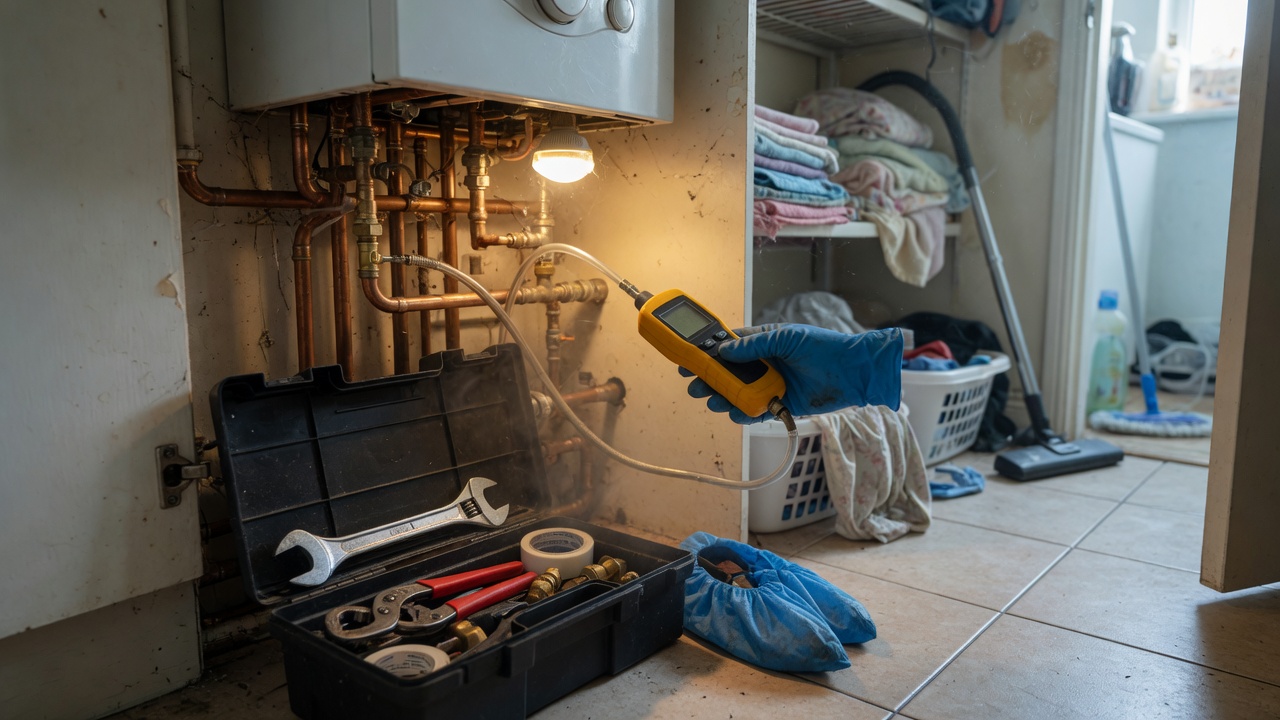
Plumber and heating engineer videos in 2026: the 60-second under-the-boiler walkthrough that fills the callout diary (and the polished cinematic van reel that quietly kills emergency jobs)
Almost every independent plumbing and heating firm that finally takes video seriously in 2026 ends up commissioning the same thing — a ninety-second cinematic reel of a signwritten van pulling out of the yard at golden hour, a slow drone glide across the industrial estate, a moody montage of clean torque wrenches and unopened copper couplings on a workbench that has clearly never seen a real airing-cupboard job, and a tagline card overlaid on a photo of an unrealistically smiling engineer in clean overalls next to a boiler that was already working when they arrived. It looks like a national-chain British Gas advert and it books almost nobody, because the homeowner on the other side of the Google Maps pin at 6:30am on a January Tuesday — no hot water, two children who need showers before school, a boiler that made a strange bang at 2am and now shows an F22 fault code, three engineer names open in three browser tabs — isn't asking to be impressed. They're asking one small, quiet, slightly embarrassing question: if I call this number, will a real Gas Safe engineer answer, will they actually turn up today, and will the invoice at the end be something I can look at without having to sit down. The one number the Google Business Profile video actually moves (booked callouts per 100 profile views, currently sitting at 1-2 on most under-tuned firm profiles, movable to 5-8 with a well-tuned 60-second walkthrough), the three clip shapes that lift it — the under-the-boiler walkthrough for general plumbing / boiler repair / emergency callouts / landlord safety certificates, the diagnosis explainer for the ten most common faults your vans actually see (F22 low pressure, F75 pump fault, diverter valves, airlocks, blocked condensate pipes, expansion vessels), and the named-engineer welcome for family firms / sole traders / heat-pump / unvented cylinder / commercial-gas specialists — plus the cinematic van reel trap that answers the wrong question, where each clip belongs (GBP slot, website homepage, service pages, Reels, TikTok, paid ads, on-hold phone message and quote autoresponder), the once-per-year plus per-fault batch rhythm that fits an independent firm without turning it into a content marketing agency, the five failure modes that keep the slot from working, where AI collapsed the £1,500-per-shoot economics that used to keep video off small trade profiles, and the one metric that steers it (booked-callouts-per-100-views, rolling 30-day, not video plays).

Veterinary clinic videos in 2026: the 60-second exam-room walkthrough that fills the appointment book (and the polished cinematic clinic reel that quietly kills new-client calls)
Almost every independent veterinary clinic that finally takes video seriously in 2026 ends up commissioning the same thing — a ninety-second cinematic reel of the practice at golden hour, a slow drone glide across the car park, a moody montage of a stethoscope on a spotless steel bench that has clearly never seen a wriggling terrier, and a tagline card overlaid on a photograph of a serene labrador puppy being held by a smiling nurse in unrealistically clean scrubs in an examination room that has plainly never been used for an examination. It looks like a national pet-insurance advert and it books almost nobody, because the person on the other side of the Google Maps pin at 11pm on a Tuesday — small dog on the sofa doing something they weren't doing yesterday, a cat that hasn't eaten since Sunday, a rabbit whose breathing has changed, three clinic names open in three browser tabs — isn't asking to be impressed. They're asking one small, quiet, slightly heartbreaking question: if I take my animal to this clinic, will the person on the other side of the consult-room door treat them the way I would. The one number the Google Business Profile video actually moves (new-clients-per-100-profile-views, currently sitting at 1-2 on most under-tuned practice profiles, movable to 5-8 with a well-tuned 60-second walkthrough), the three clip shapes that lift it — the exam-room walkthrough for general practice / vaccinations / check-ups / family pets, the species-specific explainer for rabbits / exotics / avian / reptiles / senior cats / senior dogs / dental / orthopaedic, and the named-vet welcome for independent practices / small partnerships / specialist referral / farm-and-equine mixed — plus the cinematic clinic reel trap that answers the wrong question, where each clip belongs (GBP slot, website homepage, service pages, Reels, TikTok, paid ads, waiting-room screen loop), the once-per-year plus per-concern batch rhythm that fits an independent practice without turning it into a content marketing agency, the five failure modes that keep the slot from working, where AI collapsed the £2,000-per-shoot economics that used to keep video off small practice profiles, and the one metric that steers it (new-clients-per-100-views, rolling 30-day, not video plays).

Auto repair shop videos in 2026: the 60-second under-the-hood walkthrough that fills the service bay (and the polished cinematic garage reel that quietly loses jobs)
Almost every independent auto repair shop that finally takes video seriously in 2026 ends up shooting the same thing — a ninety-second cinematic reel of the workshop at golden hour, a slow drone glide across the roller-shutter door, a moody montage of clean torque wrenches on a workbench that has clearly never seen a real job, and a tagline card overlaid on a photo of a smiling mechanic in unrealistically clean overalls next to a car that never came in for work. It looks like a chain-dealership advert and it books almost nobody, because the driver on the other side of the Google Maps pin at 8am on a Wednesday morning — dashboard light on, engine making a noise it wasn't making yesterday, three shop names open in three browser tabs — isn't asking to be impressed. They're asking one small, quiet, slightly embarrassing question: am I going to walk out of this place having paid double what the job was worth for something I didn't need doing. The one number the Google Business Profile video actually moves (booked jobs per 100 profile views, currently sitting at 1-2 on most under-tuned workshop profiles, movable to 5-8 with a well-tuned 60-second walkthrough), the three clip shapes that lift it — the under-the-hood walkthrough for MOTs / servicing / brakes / tyres / general repair, the diagnosis explainer for check-engine lights / dashboard warnings / mystery noises / DPF / EV faults, and the named-owner welcome for family-owned indies / specialists / EV / hybrid / classic / prestige — plus the cinematic garage reel trap that answers the wrong question, where each clip belongs (GBP slot, website homepage, service pages, Reels, TikTok, paid ads, waiting-area screen loop), the once-per-year plus per-fault batch rhythm that fits an independent workshop without turning it into a content marketing agency, the five failure modes that keep the slot from working, where AI collapsed the £1,500-per-shoot economics that used to keep video off small workshop profiles, and the one metric that steers it (jobs-per-100-views, rolling 30-day, not video plays).

Barbershop and hair salon videos in 2026: the 45-second chair-side transformation that fills the book (and the polished cinematic reel that quietly kills walk-ins)
Almost every independent salon and barbershop that finally takes video seriously in 2026 books the same shoot — a videographer for half a day, a wide-angle lens, a slow drone-glide up the shopfront at golden hour, a moody montage of three empty chairs, a smiling stylist folding a towel with impossibly slow hands, a tagline card over a photo of the sink. It runs ninety seconds, wins compliments from the videographer's peers, and books almost nobody, because the person on the other side of the Google pin at 9pm on a Sunday isn't asking whether the salon is photogenic — they're asking one small question: will I walk out of here looking like a version of myself I actually want to look like on Monday morning. The one number the GBP video actually moves (new-client bookings per 100 profile views, currently sitting at 1-2 on most under-tuned shop profiles, movable to 5-8 with a well-tuned 45-second chair-side transformation), the three clip shapes that lift it — the 45-second chair-side transformation for barbers, general cuts, blowouts and styling, the technique-specific portfolio for colour / balayage / extensions / textured hair / curly specialists, and the named-stylist welcome for booth renters and specialists whose bookings are personal — plus the cinematic shopfront reel trap that answers the wrong question, where each clip belongs (GBP slot, website homepage, service pages, Reels, TikTok, Booksy / Fresha / Vagaro video slots, paid ads, waiting-area screen loop), the once-a-week transformation plus per-hire batch rhythm that fits an independent shop without turning it into a content agency, the five failure modes that keep the slot from working, where AI collapsed the £1,500-per-shoot economics that used to keep video off small shop profiles, and the one metric that steers it (bookings-per-100-views, rolling 30-day, not video plays).

Dental practice videos in 2026: the 60-second inside-the-surgery walkthrough that fills the appointment book (and the polished cinematic about-us reel that quietly kills call-through)
Almost every independent dental practice that takes video seriously in 2026 ends up commissioning the same thing — a ninety-second cinematic reel of the building exterior at golden hour, a slow drone pass across the roof, a stethoscope-free montage of smiling staff in scrubs, and a tagline card overlaid on a photograph of an empty waiting room. It looks like a hospital advert on a Sunday-night property show and it books almost nobody, because the searcher on the other side of the screen at 10pm on a Tuesday isn't asking to be impressed — they're asking one small question: is this the surgery where I won't feel worse walking out than I did walking in. The one number the Google Business Profile video actually moves (new-patient calls-per-100-profile-views, currently sitting at 1-2 on most under-tuned practice profiles, movable to 5-8 with a well-tuned 60-second walkthrough), the three clip shapes that lift it — the inside-the-surgery walkthrough for general dentistry / hygiene / family practices, the frame-matched before-and-after for cosmetic / whitening / orthodontics / veneers / implants, and the named-clinician welcome for specialists — plus the polished cinematic reel trap that answers the wrong question, where each clip belongs (GBP slot, website homepage, treatment service pages, Reels, TikTok, paid ads, waiting-room screen loop), the once-per-year plus per-case batch rhythm that fits an independent practice without turning it into a content marketing agency, the five failure modes that keep the slot from working, where AI collapsed the £2,000-per-shoot economics that used to keep video off small practice profiles, and the one metric that steers it (calls-per-100-views, rolling 30-day, not video plays).

Amazon A+ Content video in 2026: the 45-second product-in-hand demo that lifts conversion (and the manufacturer trade-show reel that quietly wastes the slot)
Amazon quietly promoted the A+ Content video module from an experimental beta into a standard Brand Registered surface across 2024 and 2025, and most private-label sellers responded the way most private-label sellers respond to anything Amazon changes — they dropped in whatever the manufacturer sent them, moved on, and forgot the module existed. The shopper on the other side of the buy box in 2026 has already priced-compared, already read the star rating, and already dismissed the top-of-search sponsored slot; they landed on the listing to answer one silent question before their thumb decides whether to tap Add to Cart, and the A+ video is the fastest surface on the page that can answer it. The one number the A+ video actually moves (unit session percentage on the ASIN, currently sitting at 8–12% on most mid-tuned listings, movable to 15–22% with a well-tuned 45-second demo), the three clip shapes that lift it — the product-in-hand demo for gadgets, tools, kitchenware and small appliances, the size-and-fit scale demo for apparel, accessories, bags and personal care, and the what-actually-arrives trust demo for health & beauty, supplements, food and pet — plus the manufacturer trade-show reel trap that answers the wrong question, where the same clip also lives (main image carousel, Brand Store hero, Sponsored Brands Video ads, off-Amazon Meta and TikTok cutdowns), the per-SKU 30-minute launch shoot rhythm that fits a private-label operator without hiring an agency, the five failure modes that keep the slot from working, where AI collapsed the £800-per-SKU shoot economics that used to keep A+ video the preserve of funded brands, and the one metric that steers it (unit session percentage on the ASIN, rolling 30-day, alongside return rate).

Google Business Profile videos in 2026: the 30-second staff walkthrough that lifts call rates (and the polished about-us reel that quietly kills them)
Google quietly turned the video slot on the Business Profile from a nice-to-have into a real ranking and conversion surface over the last two years, and most local businesses responded the way most local businesses respond to anything Google changes — they uploaded the About page video from the website, moved on, and forgot the tab existed. The searcher on the other side of the map pin isn't looking for a brand story; they're standing on a pavement in the rain with a decision to make in the next ninety seconds, and the video slot is the one place on the profile that can put their last silent doubt to bed. The one number the GBP video actually moves (calls-per-100-profile-views, currently sitting at 1-2 on most under-tuned profiles, movable to 5-8 with a well-tuned 30-second walkthrough), the three clip shapes that lift it — the front-door-to-counter staff walkthrough for hospitality / retail / salons / clinics, the frame-matched before-and-after for trades and home services, and the named-owner welcome for professional services — plus the polished about-us reel trap that answers the wrong question, where each clip belongs (GBP slot, Apple Business Connect, website hero, booking-confirmation loop), the once-per-quarter batch rhythm that fits a solo local operator without turning them into a content creator, where AI collapsed the £600-per-shoot economics that used to keep video off small local profiles entirely, and the one metric that steers it (calls-per-100-views, rolling 30-day, not video plays).

eBay listing videos in 2026: the 45-second condition proof that lifts sell-through (and the manufacturer stock reel that quietly kills bids)
eBay quietly promoted video from an experimental beta into the standard listing slot last year, and most sellers responded the way most sellers respond to anything eBay changes — they dropped in a stock manufacturer clip or a two-minute "welcome to my store" reel and moved on. Both are quietly costing bids, because the buyer on the other side of the screen isn't shopping for atmosphere — they routed around Amazon for a specific reason, and the one question the whole tab is trying to answer is whether this specific unit is the specific thing they need in the specific condition the description claims. The three clips that actually convert a scroller into a buyer in 2026 — the condition close-up that shows every mark including the ones not in the description (used and refurb), the forty-five-second demo that beats the manufacturer's polished ad on trust because it's obviously the seller's hand on the seller's unit (new items, gadgets, tools), and the size-and-fit scale clip that prevents the single biggest source of eBay returns (clothing, parts, accessories) — plus the manufacturer stock reel trap that answers the wrong question, where the video actually lives (eBay slot, listing description embed, Vinted / Depop / Facebook Marketplace cross-list, unlisted YouTube), the batch rhythm that folds video into the photo session already happening, the five failure modes that keep the slot from working (music laid over silence, shaky no-light, reused clips, welcome-to-my-store reels, stock manufacturer footage), where AI collapsed the £120-per-SKU shoot economics that used to keep video off reseller catalogues entirely, and the one metric that steers it (sell-through rate on active listings, rolling 30-day, not video plays).

Shopify product page video in 2026: the 20-second demo that lifts add-to-cart (and the polished brand reel that quietly drops conversion)
Every DTC brand that upgrades its Shopify theme in 2026 finds the same shiny hero slot at the top of the product page — big, autoplay, right where the second product photo used to sit — and nine times out of ten drops a two-minute brand anthem into it. Soft synth, a slow-motion pour, a smiling founder, three product beauty shots, a tagline card, a logo lockup. It looks like a Series A pitch reel and it quietly costs the brand add-to-carts, because it answers a question the shopper standing on that page never asked. The one number the PDP video actually moves (add-to-cart rate on that specific page, currently sitting at 4-7% on most DTC catalogues, movable to 7-12% with a well-tuned 20-second demo), the three demo shapes that lift it — the product-in-hand-with-scale demo for anything a photo can't communicate for size, the before-and-after quick-fix demo for anything sold on a visible outcome, and the first-30-seconds-of-use demo for anything with a "will I actually use it" doubt — plus the polished brand reel that quietly drops conversion (three specific failures: no product in the first three seconds, visual grammar the shopper reads as an ad, runtime three times the shopper's attention budget), where the video actually belongs on the PDP (second slot in the image carousel, autoplay muted with loop on, first frame legible as a still, tested on a real mid-range Android), the two-tier per-SKU + per-collection rhythm that fits a solo DTC operator's bandwidth, where AI collapsed the £600-per-SKU shoot economics that used to keep PDP video the preserve of funded brands, and the one metric that steers it (add-to-cart on the specific page, rolling 30-day, held against traffic mix).

Short-term rental listing videos in 2026: the three clips that lift a host's booking rate (and the drone tour that farms saves but not stays)
Almost every host who takes their short-term rental seriously eventually pays for a video, and almost all of them commission the same thing — a ninety-second cinematic reel of the property empty and immaculate, opened by a drone sweep of the roofline, closed by a couple on the deck at golden hour. It collects saves on Instagram, wins compliments from the videographer's peers, and quietly books almost nothing, because the searcher on the other side of the screen at 9pm on a Sunday isn't asking to be impressed — they're asking one small question: will we feel right in this house. The three clips that actually convert a scrolling searcher into a paid stay in 2026 — the arrival walkthrough that walks the exact path a guest takes at the door (light switches, coffee, best bedroom, wifi, the one thing that isn't obvious from the photos), the quiet-Sunday-morning clip that sells the ordinary moment guests are actually going to have (real ambient sound, no cinematic music, no people to imagine themselves replacing), and the one-honest-caveat clip that names who this isn't for and self-qualifies every booking that lands after it — plus the drone-reel trap that answers the wrong question, where each clip belongs (Airbnb slot, Google Business Profile, Reels), the once-per-season batch that stays fresh without turning the host into a content creator, where AI collapsed the £900-per-shoot economics that used to keep listing videos stale for years, and the one metric that steers it (unique listing views to booked nights, rolling 30-day, not IG saves).

Landing page hero video in 2026: the 30-second product demo that converts a cold visitor (and the polished brand anthem that quietly kills the signup rate)
Every founder who ships a new landing page in 2026 hits the same fork in the road — the design template ships with a hero video slot, big and cinematic and above the fold, and the only decision left is what to put in it. Ninety per cent of the time the video that eventually lands there is a polished brand anthem: soft synth music, a slow-motion drone shot, a smiling team, three abstract product screens fading into each other, a tagline card, a logo. It looks like a Series A pitch reel and it converts almost nobody, because it does not answer the one question the cold visitor came here to answer. The one number the hero video actually moves (page-level signup rate, currently sitting at 1.5-3% on most small-team pages, movable to 4-8% with a well-tuned 30-second demo), the four-element structure that lands cold — the visitor's specific problem named on-screen in the first three seconds, a concrete before-and-after demonstrated in real product footage rather than described, legibility with the sound off because ninety per cent of hero plays are muted, and a CTA line that lives inside the video pointing at the real signup button — plus the polished brand-anthem trap that answers questions the visitor never asked, the thirty-second script end to end, where the hero sits in the wider funnel, where AI collapsed the fortnight-per-hero cost that made most small teams leave the video slot empty for years, and the one metric that steers it (signup rate on the same page across a rolling two-week window, holding traffic constant).

YouTube channel trailer in 2026: the 90-second welcome video that converts strangers to subscribers (and the polished about-us reel that gets skipped)
Almost every channel that hits its first algorithmic bump discovers something quietly humbling — the surge of new visitors that finally landed on the channel page mostly did not subscribe. Ninety per cent of the time the reason is the channel trailer: the sixty-to-ninety-second auto-play welcome video that sits at the top of the channel page, plays without a click for any signed-out visitor, and decides in five seconds whether the stranger who just arrived belongs here. Most channels either have no trailer, a two-year-old one they've forgotten about, or a polished about-us reel that looks impressive and converts nobody. The one number the trailer moves (channel-page subscribe rate, currently sitting at 1-3% on most channels, movable to 5-12% with a well-tuned trailer), the four-element structure that lands cold — a specific stranger named in the first five seconds, one concrete promise not a menu, a real proof clip from a real video, and a named cadence with a forward subscribe reason — plus the polished about-us reel trap that ignores the visitor's only real question, the ninety-second script end to end, where the trailer sits in the wider channel system, and where AI collapsed the day-per-trailer cost that made most channels leave the trailer slot empty for years.
YouTube thumbnails in 2026: the four elements that still earn the click on a small channel (and the polished agency thumbnail that quietly buries it)
Somewhere around 2023 the YouTube-thumbnail conversation quietly turned into an arms race — biggest channels hiring illustrators, running twelve A/B variants, posting breathless case studies on two-point CTR lifts. Small channels watched, panicked, and started paying $60 a thumbnail on Fiverr hoping to buy their way into the same reference class. Then the high-polish thumbnails those small channels bought started to under-perform, reliably enough that a whole cohort of tiny channels watched a smartphone-shot thumbnail out-click the professionally-produced one on the exact same video. The four elements every browse-feed thumbnail that reliably earns the click on a small channel shares — one clear subject taking up 40-60% of the frame, three or fewer words that carry emotional charge rather than clarifying the title, a face or a body with implied motion (the honest-reaction thumbnail out-clicks the over-emoted MrBeast-descendant), and legibility at the 168px phone size that most agency-designed thumbnails silently fail — plus the polished agency thumbnail trap (a designer optimising for a big-channel portfolio brief produces the wrong output for a small-channel browse feed), the two-variant discipline that fits inside a weekly upload schedule (change one lever, not all four), where AI actually helps (compressing the per-variant cost, not the design decision), and the one metric that steers it (CTR against your own rolling median, always alongside watch-through, never against someone else's screenshot).

Pinterest video pins in 2026: the three formats that still drive traffic to a small site (and the aesthetic still image that gets buried)
For fifteen years Pinterest was the platform where a single beautifully composed still image could quietly send a small blog or Etsy shop a river of visitors it never had to pay for — then, quarter by quarter, the feed changed shape, and the still images that used to rise now sink. Every creator who ignored the shift is watching their impressions on last year's pretty rectangles fall off a cliff and concluding "Pinterest doesn't work anymore," when the truth is Pinterest works fine — it just moved. What Pinterest is actually judged on now (outbound clicks per thousand impressions, not saves and not impressions), the three video-pin formats that reliably fill the slots the still image used to own — the fifteen-second transformation reveal, the tight one-idea explainer, and the animated numbered list — plus what quietly stopped working (the perfect flat lay, the huge dense infographic, and the repurposed Instagram carousel dropped in unedited), where the video pin actually fits in a funnel that lives on your blog or shop, the one-afternoon-a-week batch system that produces ten to thirty pins a month without collapsing quality, and where AI collapsed the per-pin cost that used to keep video off small accounts entirely.

Freelance marketplace video in 2026: the profile clip that wins Upwork and Fiverr projects (and the polished agency showreel that clients scroll past)
The average buyer on Upwork or Fiverr shortlists a freelancer in about ten seconds — glance at the star rating, glance at the description top, scroll the portfolio, decide whether to keep reading or move on. A static profile is competing against dozens of near-identical sellers, so the shortlist decision comes down to the one thing a buyer can't fake by reading the description: sixty seconds of the freelancer themselves, in their own voice, doing the specific thing they're being hired for. The four-part sixty-second structure that wins projects — a one-line specialty in the first ten seconds, thirty seconds of the work being done on camera, twelve seconds naming an honest constraint (what you're NOT for), and one clean line of process — plus why the polished agency showreel converts lower than no video at all (removes the fit signal a marketplace buyer is trying to read, invokes an agency reference class the solo shopper isn't playing), how the sixty-second version cascades into three downstream cuts a serious pipeline needs, and the one metric that steers it (inbound messages per hundred profile views, not proposal-to-hire rate).

B2B cold outreach video in 2026: the 45-second personalised loom that quadruples reply rates (and the templated intro reel that gets marked as spam)
Every B2B sales playbook still tells you to attach a "quick intro video" to your cold outreach — a smiling head-and-shoulders shot, thirty seconds of company overview, the tagline, three logos, an ask for fifteen minutes. It looks competent. Recipients now archive it in the first second because they've learned the shape, and every future email from you gets sorted faster the next time. Meanwhile a small handful of sellers are quietly booking calls from a different kind of video: forty-five seconds, obviously made for one person, saying something the recipient has never heard before about their own situation. The four-beat structure that opens replies in 2026 — the recipient's name plus one specific detail in the first seven seconds, one observation with teeth from real research, a single sentence of relevance framed against that observation, and a soft ask that costs a busy person nothing to say yes to — plus why "personalised" is misused to mean mail-merge with a chyron, where the video actually belongs in the sequence (touch two, after a plain-text first), the cadence that keeps personalisation intact (15-20 a week, not 100), and the one metric that steers it (reply rate per hundred sent, not open rate, not the vanity "watched to end" number the tool flatters you with).

Recipe videos in 2026: the structure that holds a food viewer to the final plate (and the cinematic b-roll that quietly kills reach)
Food is the most-watched category on every platform, which makes it look like an easy win — until a beautifully shot recipe dies at three hundred views. The reflex is to blame the lighting or the algorithm, but the real problem is almost always the same: the video is built like a film when it needs to be built like a promise. A scrolling stranger doesn't watch a recipe to admire it; they watch to answer one question — can I make that, and is it worth it? — and they answer "do I want that?" in two seconds and "could I make that?" in three more, so if the video hasn't shown the finished plate yet there is nothing to say yes to. What a food viewer actually decides in the first five seconds, the payoff-first structure that holds them to the plate (the reward up front, the one reason it's worth it, a fast legible build, then the payoff again to close the loop), the three shapes it hangs on — the craving recipe that lives on the opening frame, the one-technique video that earns saves and authority, and the constraint recipe that manufactures shares — plus the cinematic b-roll trap that kills reach (a moody pan with no payoff and no promise, so the cold viewer leaves before the cooking starts), the batch system that turns one cooking session into a week of videos, the metrics that steer it (watch-through and saves, not views), and where AI collapsed the editing cost that made a food channel a choice between cooking and the timeline.

BookTok in 2026: the three video formats that actually sell books (and the cover-reveal spam BookTok scrolls past)
BookTok is the closest thing publishing has to a working discovery engine — a corner of TikTok where one clip can put an unknown title on bestseller tables and keep a backlist novel selling years after release. Which is why every author eventually shows up, posts a cover reveal and a "my book is out now" announcement, gets four hundred views from people who already follow them, and concludes BookTok "doesn't work." It works fine — it just doesn't run on news, it runs on the feeling a book gives a reader, and the purchase is downstream of the emotion. What a BookTok video is actually judged on (a hook that stops the thumb, then the save and send that turn into copies, not the view count), the three formats that move books — the trope promise that matches a reader to the exact experience they crave, the reaction that proves the book delivers without spoiling it, and the premise hook that reaches the coldest stranger with one irresistible line — plus the cover-reveal spam the feed scrolls past (an announcement lands only with people who already care, so it reaches your followers, earns no saves, and moves no strangers), the batch system that mines one book for dozens of clips off two sessions a week, the one metric that steers it (saves and sends, not views), and where AI collapsed the editing cost that made promotion a choice between marketing the last book and writing the next one.

Faceless finance YouTube in 2026: the three video formats that earn the niche's high RPM (and the advice trap that gets a channel demonetized)
Finance is the niche every faceless creator eventually hears about, because the number is real: advertisers pay more to reach people thinking about money than almost any other audience, so a finance channel can earn several times the RPM of a gaming or entertainment channel on the same views. That's the draw. The catch nobody mentions is the other half — finance is "Your Money or Your Life" content, the category YouTube and Google scrutinise hardest, which means the same channel that could earn the highest ad rates is the one most likely to be quietly suppressed or demonetized if it drifts into giving advice it isn't allowed to give. The whole game is a single line: education pays, advice punishes. The three formats that sit safely on the education side — the evergreen explainer that compounds a library (how compound interest works, what an index fund is), the context breakdown that rides real financial-news spikes by explaining what it means rather than what to do, and the money story that makes a dry principle stick to a human arc — plus the advice trap that ends channels (specific buy/sell calls and get-rich framing that strip the ads, cap the reach, and edge toward regulated advice), the batch system that keeps a channel fed off two focused sessions a week, the one metric that steers it (RPM alongside watch-through, not raw views), and where AI collapsed the per-video cost that kept the highest-RPM niche the preserve of funded teams.

Podcast video clips in 2026: the three clip formats that actually grow a show (and the full-episode dump that kills the feed)
Nobody discovers a podcast by browsing a directory of episode titles — directories are search tools for shows people already know the name of. Discovery, the part where a total stranger becomes a subscriber, happens on the vertical feeds of TikTok, Reels, and Shorts, where a short clip introduces you, proves you're worth an hour, and points at the full episode. That inverts the old order: the clip is now the front door and the episode is the room behind it. Which is why the reflex answer — run each episode through an auto-clipper and post whatever falls out — quietly holds shows back: the tool gives you twelve sixty-second rectangles, but it can't decide which sixty seconds is worth a stranger's attention or frame it to land cold. What a clip is actually judged on in the first two seconds (hook, stand alone, resolve), the three formats that deliver all three — the one-idea clip that finishes a complete thought, the tension clip that carries real friction, and the story clip cut to keep its arc intact — plus the full-episode dump that kills the feed (fragments that start mid-sentence, resolve nowhere, and teach the algorithm to stop showing you to new people), the batch system that turns one recording into a week of clips off a single session, the one metric that steers it (watch-through and follows-per-clip, not raw views), and where AI collapsed the per-clip editing cost that pushed shows toward mindless auto-chopping in the first place.

Faceless Facebook Reels in 2026: the three page formats that still earn from content monetization (and the reposted-TikTok trap that kills reach)
Everyone chasing short-form money moved to TikTok and Instagram and quietly wrote Facebook off as the platform their parents use — which is exactly why it is worth a second look. Two facts sit under the reputation: Facebook's short-form feed is genuinely enormous, and the platform still pays creators directly through its consolidated content monetization program. Put them together and you get a rare situation — a huge, paying audience most serious short-form creators are actively ignoring because it isn't cool. The catch is that Facebook is specific about what it pays for: original content made natively for its feed, not clips exported from somewhere else. The three faceless formats that still earn — the niche saver built to be saved and shared, the story page that travels on Facebook's uniquely emotional re-sharing, and the how-it-works page that explains one thing per Reel — plus the reposted-TikTok trap that kills reach before you start (the rival-app watermark every algorithm is trained to catch, suppressed on sight and ineligible for payouts), the batch system that keeps a page fed off two focused sessions a week, the one metric that steers it (shares and saves, not raw views), and where AI collapsed the per-clip cost that pushed everyone toward recycled content in the first place.

Dropshipping video ads in 2026: the three creative angles that still convert cold traffic (and the supplier montage that gets your account flagged)
The era of pointing a product at a ring light, cutting it to a trending sound, and watching cheap sales roll in is over — killed by two things at once: saturation (the same winning product cloned across dozens of stores running near-identical supplier footage) and ad platforms that got much better at recognising low-effort, duplicated creative and quietly throttling it. The uncomfortable truth underneath both is the same: the product is not your moat — anyone can source the identical item by tomorrow — so the creative is the only thing you actually own. What a cold viewer is really deciding in the first two seconds (keep watching or flick the thumb, not your product versus a competitor's), the three angles that still convert — the problem-first demo that opens on the frustration not the object, the native review that works by not looking like an ad, and the wow demonstration where the hook is the demo itself — plus the recycled supplier montage that gets your account flagged (duplicate-content detection, rising CPMs, manual review that pauses spend at the worst moment), the test cadence that finds a winner (test angles before details, judge on hook rate, kill fast, refresh before fatigue), and where the economics finally changed so original creative is cheaper than the flagged alternative.

Shorts vs long-form in 2026: which format actually builds an audience you can sell to (and the cross-posting trap that grows the numbers but not the revenue)
"Should I do Shorts or long-form?" is the wrong question, and it's the reason so many creators spend a year building the wrong thing. It treats two formats as rivals fighting over the same slot in your week, when they do completely different jobs: short-form is the cheapest reach ever invented — shown to strangers, judged on the first two seconds, gone by dinner — while long-form is the only place trust accrues and offers actually convert, because nobody watches eight minutes of you by accident. Reach and revenue are not the same currency, and the exchange rate between them is where almost every creator quietly loses. The honest job each format does (short-form earns one specific next action, not a view count; long-form banks the watch-time that makes a viewer believe you), the three bridges that connect them — the teaser, the identity, the named destination — and the crossover rate nobody measures that tells you whether the doorway is open or leaking. Plus the cross-posting trap that feels like leverage and isn't: one clip blasted everywhere, views up, followers up, revenue dead flat, because distribution multiplies whatever you point it at and pure reach points at nothing. The four honest rules of thumb for which end to lead with depending on where you are, and the one-anchor-a-week system that fits both formats into a real solo schedule.

Selling digital planners in 2026: the demo-video loop that converts browsers into buyers (and the three template niches AI already flooded)
A digital planner is the closest thing to a perfect side-hustle product — you make it once and sell it forever, with no stock, no shipping, and no per-sale cost. Which is exactly why the marketplaces are drowning in them, and why a beautiful template with a still screenshot now sells almost nothing: a buyer scrolling a wall of near-identical thumbnails has no way to tell whether your weekly spread will fix their week or sit unopened like the last three they bought. The thing you're really selling isn't a PDF — it's the feeling of a calmer week, and a still image can't deliver that feeling. The demo-video loop that actually converts (the mess named in three seconds, a hand moving through the planner, a real week filling in, one honest setup truth), the three niches AI already flooded past saving — the generic dated daily, the everything-bundle mega-template, and the trend-chased aesthetic clone — plus where each cut goes (the listing demo, the discovery cut, the Pinterest workhorse), the pricing that holds when you sell the fixed problem instead of the page count, the one metric that steers it (listing conversion, not views), and where AI collapsed the day-per-video cost that kept the demos from ever getting made.

SaaS onboarding videos in 2026: the three activation moments a walkthrough should own (and the feature-tour that quietly raises churn)
Founders obsess over the renewal screen and the cancellation flow, because that's where lost revenue shows up in the dashboard — but by the time a user reaches "are you sure you want to cancel?", the decision was made weeks earlier, in the first session, when they signed in for the first time and the product failed to make itself obvious. They didn't rage-quit; they got a little confused, told themselves they'd come back later, closed the tab, and later never arrived. That silent first-session drop-off is the single largest leak in almost every early-stage SaaS, and the onboarding video is built to plug it — except almost everyone makes the wrong one. The feature tour that quietly raises churn (the walk through every menu and setting that overwhelms a user who has no shelf to put any of it on yet), versus the three activation walkthroughs that retain — first value in sixty seconds down the shortest path to a visible win, their real data crossing from your demo example to their own account, and the habit loop that gives them a reason to come back next week — plus the tight sub-ninety-second clip structure that names the outcome and walks one path with no detours, where each video actually belongs (the empty state, the setup step, the day-three email), the one metric that tells you it's working (activation rate and time-to-first-value, not views), and where AI collapses the day-per-video cost that keeps founders from ever building the system.

The Amazon Influencer Program in 2026: the on-page review video that earns at the point of decision (and the three product categories that never convert)
Almost every guide to earning from Amazon front-loads the impossible part — build an audience, drop a link, and pray a slice of it clicks through and buys inside the tracking window. The Amazon Influencer Program's onsite video feature inverts that entirely: once you're approved, your review clips can appear directly on the product detail page, in front of a shopper who is already reaching for their card. You're no longer persuading a stranger to care about a category; you're answering the single doubt of someone who has decided they probably want this and is looking for one reason to click buy — the warmest traffic in commerce, handed to you for free. The point-of-decision structure that converts (the doubt named in five seconds, the demonstration photos can't fake, the one honest caveat that builds more trust than thirty seconds of praise, the who-it's-for verdict), the three product categories where it never works no matter how good the video is — rock-bottom commodities, zero-differentiation items, and high-consideration electronics whose buyers decided off-platform and whose commissions are capped low — plus why coverage beats polish, the two metrics that actually matter (pages you have a live video on, and lifetime earnings per clip), and where AI collapses the editing bottleneck so an afternoon yields fifteen finished clips instead of three.

Scaling a stalled channel in 2026: the batch-week system that triples output without more hours (and the "just post more" advice that burns creators out)
Almost every channel that plateaus gets the diagnosis wrong. The creator decides they've run out of ideas, or that the algorithm turned on them — when what actually broke is quieter: the channel was running on raw motivation, motivation is finite, and nothing was ever built to take over when it dipped. In the exciting early weeks enthusiasm did the whole job, so no system was needed; that works right up until the first flat week, and then it doesn't. And the standard advice — post more, post daily, out-work everyone — makes it worse, because it multiplies the exact thing that empties the tank: the daily cold start, the blank page, the full film-and-edit scramble done fresh every time. The batch-week production system that replaces willpower with a machine — one repeatable format template so no video starts from nothing, one plan block so you decide a month at once instead of daily, one make block so you pay the setup cost once and produce the whole batch in a sitting, and one repurpose queue that harvests three or four shorts and a teaser from every anchor recording — plus the one metric (opening retention and new-follower rate, not total views) that steers the machine toward what actually holds attention, where AI collapsed the make-and-repurpose labour that used to make batching too heavy for one person, and the thirty-day install order that gets you publishing consistently without a single day of dread.

Brand deals for small channels in 2026: the three-part pitch that lands sponsors under 10k followers (and the media kit that gets ignored)
Almost every small creator believes sponsorship is a reward you unlock at some follower threshold, so they wait — grinding for reach while a channel a fraction of their size quietly closes four-figure deals. The waiting crowd missed the point: a brand isn't buying reach (it can buy that cheaper on any ad platform), it's buying trust inside a specific community it can't otherwise access, and a small, tight audience is often worth more per follower than a big diffuse one. The three-part pitch that actually lands deals under 10k followers — the audience match that names the brand's buyer instead of your size, the concrete campaign idea that does the brand's thinking for them, and the low-risk proof that makes yes the safe choice — plus why the polished media-kit PDF gets ignored (it describes you; the brand wants to know if you'll move a number without creating a headache), where to find the small brands whose founder still reads the inbox, what to actually charge when you're selling qualified access rather than raw views, and the usage-rights money creators give away without noticing.

Becoming a UGC creator in 2026: the three deliverables brands actually pay for (and the demo-reel mistake that gets you ghosted)
UGC is one of the few creator side-hustles where your own follower count barely matters — you're paid to make short, authentic-looking videos that brands run as ads, skipping the two-year audience-building runway entirely. That's exactly why the field filled up fast, and why most new creators pitch the wrong thing: they sell a pretty, cinematic clip when the brand is buying the absence of obvious craft wrapped around a message that still converts. The three deliverables brands actually pay for in 2026 — the hook pack (a testing menu of first-three-second openers), the problem–solution spot (the believable testimonial that reads as true, not as an ad), and the variation set (one winning concept re-cut a dozen ways before it fatigues) — plus the demo-reel mistake that gets you ghosted (the slick montage that answers a question the brand never asked), where AI changed the economics and where it didn't, and the four-rung rate ladder that climbs from a fifty-dollar one-off to a monthly creative retainer.

Paid communities in 2026: the onboarding week that decides who stays (and the ghost-town spiral that empties them by month two)
A paid membership is the best recurring asset a solo creator can own — it bills every month someone stays, it lives on infrastructure you rent rather than an algorithm you're at the mercy of, and it's the closest a solo creator gets to owning an asset instead of renting attention. It's also the easiest to kill by accident: almost every one that fails dies the same way, a burst of launch-day sign-ups, a quiet second month, and a ghost town by the third — a spiral where emptiness compounds exactly the way activity does, and the member count keeps flattering you because cancellations lag weeks behind the moment people stopped caring. The onboarding week that actually decides retention (first post, first reply, first win before day seven), the three loops that keep a room alive — a reliable weekly rhythm, member-to-member connection that doesn't depend on you, and visible progress that ties members' identity to the room — plus why the cheapest communities churn hardest, the free video-and-newsletter discovery layer that fills the room without cold-selling strangers, and the one metric (weekly active members) that catches the spiral before the churn does.

Faceless TikTok in 2026: the four content engines the algorithm still pushes (and the two formats it now throttles)
TikTok is still the one platform where a brand-new account with zero followers can land on a hundred thousand feeds by Friday — no face, no reveal, no personality required — because the For You page tests each video on a small audience and widens the circle based on how they respond, not on who posted it. What changed is the floor: the shortcuts that used to fake faceless growth (grabbing a viral clip, stapling a trending sound over stock images) have been quietly throttled, and most struggling accounts are still running them and blaming the algorithm. The four content engines the For You page still rewards — the micro-explainer, the list or ranking, the narrated story, and the ambient loop — plus the two formats now actively suppressed (reposted clips with no transformation, and slideshow spam over trending audio) that drag down the reach of everything else on the account, the three-second retention rule underneath all of it, and the niche discipline that beats posting three times a day.

Growing a newsletter with video in 2026: the three discovery loops that add subscribers who open (and the lead-magnet that fills your list with dead emails)
Almost every newsletter growth guide ends in the same place — make a free PDF, gate it behind an email, run traffic at it — and it works in the narrow sense that the subscriber number climbs, right up until six months later the list is twelve thousand strong and the open rate is nine percent, because most of those addresses came from people who wanted the download and never wanted you. A list is only worth what its readers open, and the surest way to break it is to grow faster than the attention behind it. The three video loops that add people who actually open — the teaser-to-issue loop that turns every issue into a real sample of the product, the answer-in-public loop that captures searching practitioners instead of freebie collectors, and the back-catalogue loop that makes your archive keep recruiting for free — plus the dead-email lead-magnet that drags your whole sender reputation down while the counter keeps flattering you, and the one metric (engaged subscribers per week) that stops the vanity number from fooling you.

Speaker demo reels in 2026: the two-minute structure that books paid keynotes (and the highlight compilation of applause that gets ignored)
Every emerging speaker knows they need "a reel", and nearly all of them ship the same thing: a two-and-a-half-minute montage of stage lighting, laughing audiences, standing ovations, and quick-cut soundbites of theatrical moments set to a driving music track — it looks like a movie trailer for a speaker and it books almost no paid work. The reason isn't quality; it's fit. A booker isn't sitting down to be entertained but to decide whether to risk a fee on someone they've never seen, and that decision needs a completely different reel. The two-minute structure that actually gets you shortlisted in 2026 — thirty seconds of positioning promise, sixty seconds of one continuous demonstration you can hold uninterrupted, thirty seconds of tight credibility close — plus why the applause compilation reads as "this speaker doesn't yet have a signature argument", where the reel actually needs to live (website above the fold, LinkedIn pinned post, YouTube with a longer edit), and the inbound-enquiry metric that decides whether it's pulling its weight.
Personal-brand video for the salaried professional in 2026: the four patterns that turn a reputation into a second income (and the polished thought-leadership post that reads as trying too hard)
A senior engineer, an accountant with fifteen years in the room, a mid-career product manager sitting on a body of expertise that would earn them a second income if the right people knew they had it — the standard advice is to post on LinkedIn, share your insights, build your personal brand, and nearly every one of them tries it, gets tepid engagement, and quietly stops. The advice isn't wrong; it's aimed at a format that used to work and doesn't anymore. The four short-form video patterns that actually convert expertise into inbound consulting work in 2026 — the "here's what I did today" first-person work POV, the meeting-room misconception correction, the overlooked-tool walkthrough, and the ten-years-in retrospective — plus the polished thought-leadership carousel that reads as trying too hard, why the day job's IP boundaries are smaller than most people assume, and the funnel metric that decides whether the whole thing is actually pulling in money.

Coaching videos in 2026: the three formats that turn viewers into paid clients (and the credibility reel that gets scrolled past)
Nearly every coach and consultant now has a "content strategy" and almost none of it books calls. Walk any feed and you'll see the same shape — a smiling professional, five confident mindset tips, a call to "DM me to work together" — and it converts to almost nothing because it now signals a category before it signals a specific person. Meanwhile a small handful of coaches are quietly filling their calendars from three specific video formats that answer a prospect's actual worry, let them watch the coach work, or show them the room they'd be walking into. The three formats that turn a stranger into a paid client in 2026 — the objection handler, the case deconstruction, and the free-session preview — plus the credibility reel that most of the industry ships and almost nobody rewards, and the metric that decides which of them is actually pulling its weight.

Video sales letters in 2026: the four-beat script that still converts cold traffic (and the 30-minute monologue that empties the page)
For a decade the video sales letter had one recognisable shape: a long, breathless monologue on plain slides, an origin story that took ten minutes to land, crossed-out prices, and a countdown timer that reset on every reload. It converted while cold traffic hadn't seen the trick yet — and in 2026 they've seen it a thousand times, so the moment a viewer recognises the pattern the shutter comes down and nothing after it gets through. The VSL didn't die; the costume did. The four beats that still turn a stranger into a buyer: the callout that proves you're talking to them, the mechanism given away instead of guarded, the proof you actually have instead of the proof you don't, and one clear ask with no theatre — plus the retention curve that shows you the exact second trust broke, which no conversion percentage ever can.

Cause-driven video in 2026: the three stories that turn strangers into supporters (and the tragedy reel that earns tears but no donations)
Almost every small charity and cause-driven founder eventually makes the same video: a montage of the worst of the problem, a wall of grim statistics, a slow piano, and a plea at the end. It feels like what a serious cause is supposed to make — and it is the one most likely to win a share, a wince, and no new supporters at all. Big numbers numb; a person overwhelmed by the scale of a crisis feels helpless, not called to act. A donation isn't an emotion, it's a decision, and it runs on three quiet questions the giver never says out loud: would my bit matter, would the money get there, are these my kind of people? The three videos that actually build a base in 2026: the one-person story that makes a single life fundable, the where-it-goes proof that shows the pound at work, and the volunteer film that opens the door to a community — plus the metric, donors and sign-ups not shares, that tells you which one is working.

Teaching a skill online in 2026: the three tutorial formats that still build a loyal audience (and the step-by-step walkthrough AI made worthless)
For fifteen years the way to grow a following as a teacher was simple: make the clearest step-by-step tutorial on the internet. That whole strategy just collapsed. A language model now produces a flawless, personalised walkthrough of almost anything in seconds, for free, with no ads — so if "how to do the steps" is all you offer, you're competing with a machine that does it better. But teaching was never only procedure. The commodity layer got swallowed; the part that actually made people follow a teacher didn't. The three formats that still build a loyal audience in 2026: the judgement video that transfers taste instead of steps, the real-work video that shows you getting unstuck on camera, and the skill-ladder series that gives a learner the map a search box never will — plus the right way to let AI carry the production without letting it become the teacher.

Music release videos in 2026: the four short clips that build a song's audience before launch (and the cinematic music video that drops to silence)
Here's the version most independent musicians live through at least once: you finish the song, spend the whole budget on one beautiful music video, drop it at noon on release day — and watch the numbers flatten by the weekend. Nothing was wrong with the music. What was wrong was the shape of the rollout. A release isn't a launch event, it's a curve that has to start climbing before the song is even out, because the streaming algorithms and the short-form feeds both reward pre-existing demand. The four short videos that actually build a release in the weeks before: the hook loop that gets the earworm stuck before the song exists, the why-this-song story that turns a track into something people care about, the make-of that lets fans feel early, and the copyable sound template that hands the song to other people to spread — plus where the music video actually fits, which is the encore, not the opener.

TikTok Shop in 2026: the video formats that actually sell, the viral ones that don't, and the cadence that compounds
There's a sinking feeling that hits a small brand the morning after a TikTok takes off: half a million views, a flood of comments, and a Shop dashboard that barely twitched — eleven units. You went viral and almost nothing happened. The clip did exactly what it was built to do — grab attention — it just grabbed the wrong kind. Reach and intent are different currencies, and TikTok Shop only spends one. The formats that actually move product in 2026: the problem-first demo that earns the tap, the honest "is it worth it" review that works with a buyer's scepticism instead of against it, and the in-context use clip that lets a stranger picture the product in their own life — plus the cadence, read on sell-through not views, that turns a feed into a storefront that compounds.

Fitness creator content in 2026: the three formats that convert followers into clients (and the transformation reels that only farm saves)
There is a specific kind of fitness creator who has done everything the advice told them to do — daily posts, transformation reels hitting hundreds of thousands of views, enormous save counts — and earns almost nothing from it. The instinct is to chase more reach. It's the wrong fix: they have a conversion problem disguised as a growth success. The content that grew the account is built to be admired and scrolled past, not to make a stranger decide to pay you to change their body. The three formats that actually book clients in 2026: the method-in-the-open video that earns trust in your judgement, the objection-killer that dismantles the silent reasons people don't book, and the honest real-client-process video that shows exactly what they'd be buying — plus the ratio that finally turns saves into bookings.

AI video dubbing in 2026: the three layers that make a dub land in a new market (and the word-for-word auto-translation that gets you unsubscribed)
Dubbing used to mean a studio, a voice cast, and a five-figure invoice, so only the biggest channels ever crossed a language border. AI collapsed that to cents — and now creators are flooding YouTube with one-click translated audio that the new audience bounces off in fifteen seconds. The reason: a literal dub translates the language but not the communication. A dub that actually wins a market is three layers deep — meaning (idiom and examples rewritten as a native would say them), voice (real tone, pace, and emphasis, not a flat synthetic read), and the visible layer (the title, hook, thumbnail text, and on-screen captions that get the audio heard at all). Skip any one and the viewer feels the seam.

Kickstarter campaign videos in 2026: the 90-second structure that funds the project (and the cinematic founder story that drains the pledge page)
You spent three weeks on a beautiful origin film — your story, soft music, slow shots of your hands — and the pledge bar barely moved. The thing nobody tells a founder first: a crowdfunding video isn't your story, it's a 90-second sequence that dismantles a stranger's doubts in the order they arrive. Is it real (the product working in frame zero), is it for me (the problem named sharply), can they ship it (proof, and only now the person behind it), why now (the ask, and a real reason to pledge today). Lead with the emotional origin story and withhold the product, and you've made something lovely that drains the very attention it was meant to convert.

Etsy listing videos in 2026: the clip that lifts add-to-cart, the photo it must never replace, and the field that still decides the click
You added a video to your best listing because everyone said you should, and the dashboard barely moved. The thing nobody tells a maker first: an Etsy listing video does not get you found — it can't lift you in search and it won't win the click in the grid. It has one job: convert the shopper already standing in your listing, thumb hovering. The clip that does it shows the three things a photo can't — scale against a human reference, texture in moving light, the thing in use — while your tags, title, and thumbnail do the discovery work upstream. And the cinematic film that replaces your lead photo quietly costs you the click it was meant to win.

Customer testimonial videos in 2026: the three formats that earn trust (and the scripted brag reel that reads as fake)
A happy customer agreed to say something nice, so you scripted them superlatives, lit it like a commercial — and it converts nobody. A buyer in 2026 smells a manufactured endorsement in two seconds. The three testimonial formats that still earn trust: the specific-result story with one real number, the objection-killer clip that voices the doubt and resolves it, and the day-in-the-life proof that shows real use in a real life — and the conversion lift that picks which to make.

Repurposing video in 2026: the four cuts that travel from a single shoot (and the auto-chopped highlights that just flood the feed)
You recorded one good thing and the advice is to "repurpose" it into twenty posts — so you feed it to a clip-chopper, it spits out fifteen viral moments, and they all sink. The problem was never volume. A clip pulled out of context is an orphan, a sentence with no setup. The four cuts that actually travel from one recording in 2026: the hook clip that re-opens one idea to win the click, the teaching cut that delivers a whole lesson, the proof moment that shows a real result, and the native short re-tailored for each feed — and the watch-through that picks them.

Restaurant video marketing in 2026: the three clips that fill tables (and the cinematic food film that just feeds the algorithm)
A restaurant loses covers not because nobody saw it, but because the person scrolling at 6pm never felt hungry or sure enough to book. The glossy brand film collects saves and books nothing — it asks to be admired in a moment that needs appetite. The three clips that actually fill tables in 2026: the dish-in-motion clip that triggers the craving, the room-and-occasion video that sells the night out, and the behind-the-pass story that turns a first visit into a regular — and the number that tells you which is working.

Video marketing for local service businesses in 2026: the three videos that book jobs (and the TV-style commercial that wastes the budget)
A local service business doesn't have an awareness problem — when the boiler dies, the customer is already searching. It has a trust problem: three names in the same map pack, thirty seconds to choose. The slick commercial answers a question nobody asked. The three videos that actually win the job in 2026: the proof-of-work clip that shows the result, the what-to-expect answer that removes price-and-process friction, and the meet-the-owner video that wins the dead heat — and the metric that picks which to make.

Founder-led video on LinkedIn in 2026: the three formats that book sales calls (and the polished brand film that gets scrolled past)
The polished brand film collects compliments from your peers and books exactly zero sales calls — the feed is trained to scroll past anything that looks like an ad. The three founder-led formats that actually start qualified conversations in 2026: the lesson clip that earns authority with real scars, the contrarian take that finds and sorts your buyers, and the customer-problem story that turns intent into a reply. The one that wastes your budget, and the reply rate that picks your format.

Webinars in 2026: which three formats still convert, which one empties the room, and the show-up rate that decides it
The live 60-minute pitch webinar empties the room before the offer — people register for free and never show. The three formats that still convert in 2026: the on-demand micro-webinar that sells while you sleep, the live workshop that converts a higher ticket, and the multi-day challenge that sells a transformation. The one that wastes a month of promotion, and the show-up rate that picks your format.

Real estate listing videos in 2026: the three that book viewings (and the cinematic drone reel that doesn't)
The glossy drone reel wins the most likes and books the fewest viewings — it impresses an audience instead of informing a buyer. The three listing video formats that actually fill a solo agent's diary in 2026: the honest walkthrough that lets buyers self-qualify, the neighbourhood story that sells the life, and the vertical teaser that finds buyers off the portals. Where each belongs, and the one-shoot production loop that makes all three.

AI avatar videos in 2026: the three use cases that still convert (and the uncanny-valley spokesperson that kills the sale)
The synthetic brand spokesperson reads as fake before it speaks — and a viewer who notices doesn't tune out, they feel deceived. The three AI avatar use cases that still convert in 2026: the explainer presenter, the multilingual scale play, and the social variant engine. The one that torches trust, the avatar-or-real-footage decision, and the production loop a solo creator can run.

Product demo videos in 2026: the three formats that convert signups (and the feature tour nobody finishes)
The guided feature tour is the demo founders default to — and the one prospects abandon at 20 seconds. The three formats that actually convert in 2026: the hook clip that wins the click, the use-case demo that lets a prospect see their own work, and the proof loop that gets a new user to a first result. Where each belongs, and the production loop a solo founder can run.

Online courses in 2026: the three formats that still sell (and the one AI commoditized)
The day a free chatbot could answer every "how do I" question, the eight-hour information course stopped being worth $199 — but three formats got more valuable, not less. The cohort, the implementation course, and the hard-won-expertise course that still sell, the one AI killed, the pricing that holds, and the launch loop that fills the first cohort.

AI UGC ads in 2026: the three hooks brands still pay for (and the polished studio spot that stopped converting)
The glossy studio spot now reads as an ad before a word is spoken — and buyers swipe past it. The three UGC hook structures ecommerce brands still pay for in 2026, the AI-native stack that ships a dozen tested variants a day, the weekly sprint, the side-hustle economics, and the authenticity line you don't cross.

Kindle self-publishing in 2026: the three book categories that still sell (and the two AI flooded)
AI buried the generic guide and the blank journal — and sharpened the categories built on real expertise, story craft, and a disciplined launch. The three that still sell on Kindle, the two AI flooded into worthlessness, the royalty math, and the launch that earns genuine reviews.

How to grow a faceless Instagram account in 2026: the solo creator's path to 100k followers and real revenue
Faceless Instagram still carries a scammy reputation — which is exactly why the opening is wide. The Reels-first reason it works in 2026, the niches that grow and monetise, a six-hour weekly content engine, the realistic 0-to-100k path, and the four revenue layers that turn followers into income.

AI affiliate marketing in 2026: the solo creator's path to $5k/month
Everyone declared affiliate marketing dead the moment AI started writing review articles — they were half right. The lazy version died; the disciplined version is the best-margin side hustle a solo creator can run. The four engines that still convert, the AI-native stack, a 90-day build, and the commission math from $0 to $5k/month.

How to start a podcast in 2026: the solo creator's path to 10,000 monthly downloads
AI cut indie-podcast production from a full weekend per episode to about ninety minutes. The 2026 stack, a weekly workflow that holds, the realistic 0-to-10k download path, and the four monetisation routes that actually pay a solo show.

AI short-form video in 2026: how solo creators ship 60 clips a month (and which ones actually grow)
TikTok, Reels and Shorts now reward a different production loop than long-form. The 2026 AI stack, a weekly 60-clip workflow, hook structures that still work, the seven-day niche test, and the two monetisation paths that actually pay.

Programmatic SEO with AI in 2026: how solo founders rank for thousands of keywords
Programmatic SEO got fixable for solo founders — a clean dataset plus an AI pipeline now ships a 5,000-page site in a fortnight. The four archetypes that still rank in 2026, the realistic build stack, indexing rules, the revenue math at every milestone, and the four traps that quietly waste a quarter.

How to sell digital products in 2026: the solo creator's path to $5k/month
Digital products are the side-hustle that quietly went mainstream — templates, prompt packs, courses, and downloadable tools clearing $3,000–$15,000 a month for one-person shops. Which four categories actually pay, the AI-native stack, a 14-day launch loop, pricing that holds, and the revenue math from $500 to $10k/month.

How to build a micro-SaaS as a solo founder in 2026: the realistic path to $10k MRR
Micro-SaaS is the quietest gold rush of 2026 — one-person products doing $5k–$25k MRR with 85% margins. The four idea signals, the AI-native stack, week-long validation, pricing that holds, distribution that works, and the revenue math at every milestone.

How to build a newsletter business in 2026: the realistic 0-to-10,000 subscriber path
Paid newsletters are quietly the highest-margin solo business of 2026 — but only the ones that get the first thousand subscribers right. The twelve-month path, niche signals, AI as research engine (not writer), free-vs-paid timing, and the revenue math at every milestone.

How to monetise a faceless YouTube channel in 2026: seven revenue layers beyond AdSense
AdSense alone caps most faceless channels at $2–8 RPM. The seven revenue layers stacked on top, the sequence to add them, the realistic monthly mix, and the four mistakes that quietly flatten earnings.

Faceless YouTube niches that still work in 2026 (and the ones that quietly died)
AI flooded faceless YouTube — but a handful of niches kept printing revenue. Which six survived, which six collapsed, the four signals that separate them, and a five-point stress test to run before you commit to a niche.

How to start a one-person AI agency in 2026 (the realistic 90-day path)
A one-person AI agency now bills what a six-person shop billed in 2023. The five services that actually sell, the pricing that holds against undercutters, the 90-day client-acquisition path, and the four failure modes that quietly kill it.

AI business models in 2026: 6 solo paths compared (with revenue math)
Faceless YouTube vs. niche newsletter vs. digital products vs. one-person AI agency vs. micro-SaaS vs. done-for-you content. Realistic 12-month revenue ceilings, time-to-first-dollar, weekly hours, and the hardest-part trap for each.

How to replace a marketing agency with AI in 2026 (and what to keep human)
AI now does what mid-tier marketing agencies charge $3,000–10,000 a month for. Where it matches, where it still falls short, the realistic monthly budget, and the hybrid week that lets one operator run their own marketing function without losing quality.

AI video production in 2026: how solo creators ship 30 videos a month
AI cut faceless video production from eight days to two-and-a-half hours per video. The real cost breakdown, the weekly sprint workflow that takes advantage of it, where AI still falls short, and what the new unit economics actually mean for solo creators.

How to validate a faceless YouTube niche in an afternoon
A practical four-hour workflow that filters thousands of plausible-looking niches down to one that's actually worth a year of your time — using only free tools and four hard signals.

The quiet boom: why faceless content channels are becoming real businesses
Faceless YouTube channels, niche newsletters and AI-narrated long-form video are quietly turning into seven-figure businesses. Where the money actually comes from, how AI changed the math, and where this is going.
Create your first Business Blueprint in three minutes.
Sign-up is 30 seconds. Your account opens with 30 free credits — enough to run a niche search and preview a Blueprint before you top up.
Credits never expire. No subscription. 30 free on registration.